HUMAN Security (formerly PerimeterX) is an application security company focused on stopping automated abuse: sophisticated bots, account takeover, fake account creation, scraping, ad fraud, client-side supply-chain attacks, and transaction fraud. HUMAN operates the Human Defense Platform, which combines a JavaScript sensor and mobile SDKs running on the client with risk decisioning services on the server side. Products in the platform include Bot Defender (formerly PerimeterX Bot Defender), Account Defender, Credential Intelligence, Transaction Abuse Defense, Ad Fraud Sensor / MediaGuard, Code Defender (client-side script and supply-chain protection), and Scraper Protection. HUMAN is primarily an enterprise vendor — onboarding, sensor configuration, and policy tuning go through the HUMAN portal and a customer success team — but the platform exposes REST APIs and SDKs that engineering teams integrate into web apps, mobile apps, edge workers, and back-end services.
HUMAN Security is listed with 5 APIs on the APIs.io network. Tagged areas include Bot Mitigation, Account Takeover, Ad Fraud, Client-Side Security, and Application Security.
HUMAN Security’s developer surface includes documentation, engineering blog, product news, and 13 more developer resources.
Regulatory Posture applies to this provider. Its tags matched the
Horizontal (data, software, accessibility, platform) regime, so
Regulatory Posture carries 15 points of the composite.
If this regime is wrong for your business, say so on your
provider repo — the
applicability map is public and we will correct it.
Create-or-Update Ergonomics could not be measured. We hold no machine-readable contract for
this provider to read, so there is nothing to measure a write surface against. Excluded rather than scored zero:
never-measured and measured-empty are different facts. Publishing an OpenAPI is what makes this facet — and
several others — scorable at all.
The six quality facets above are damped to 85 points between them,
because the conditional facet above carries the other
15. That is why each facet's contribution is shown against a damped
maximum: raising a quality facet moves the composite by 85% of its nominal
weight, not 100%. The full arithmetic is at apis.io/rating/.
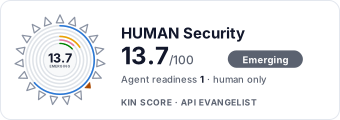
Show this score on your site.
It updates itself when the score changes. Paste this where you link to your API docs:
<a href="https://apis.io/providers/human-security/"><img src="https://apis.io/badge/human-security/card.svg" alt="HUMAN Security on APIs.io — Kin Score by API Evangelist"></a>
Other styles, a README pill and a shields.io endpoint are on the badge page.
Raise your score.
Agent readiness — checks not met, largest first (exact, from this profile):
Machine-Readable Auth+10 pts — a served openid-configuration/oauth-authorization-server carrying `issuer` (served), else the securitySchemes class in the provider OpenAPIs — bound (mutualTLS, DPoP, Signature) > negotiable (oauth2 authorizationCode/clientCredentials, openIdConnect) > bearer (http bearer, apiKey) Ask about this →
Idempotency+9 pts — OpenAPI mutating operations declare an idempotency key — a header, a request-body property, or a named de-duplication token whose own description says so (verified); else common[].type matches /idempoten/i (documented) Ask about this →
Stable Error Semantics+8 pts — OpenAPI $refs a shared error schema across 4xx/5xx responses (verified), else common[].type includes ErrorCatalog / ErrorCodes / DeclineCodes Ask about this →
12 more unmet checks in the Agent Readiness table above.
Kin Score — facets with the most composite points still available (weight × headroom):
Each check links to what satisfies it. Publish the artifact, or tell us where it already lives, and the score moves on the next scoring run.
Not sure how this applies to your stack? Ask about any one item. Kin Lane reads every question, looks at your profile and your situation, and replies with what a fix would take — scoped to that one area, priced up front, yours whether you ship it or not. Ask a question →
The Kin Score Market layer reads a provider inside its market:
its position, and how deep its integrations go. Depth is only comparable within a position. Provisional and unweighted:
not part of the Kin Score or agent readiness.
Registered MCP server and declares compatibility are report only — not weighted.
Undeclared means we found nothing we can read, so there is no number: we never infer integrations.
Bot Defender (formerly PerimeterX Bot Defender) is HUMAN's flagship product for stopping automated traffic against web and mobile properties. A JavaScript sensor and mobile SDKs...
Account Defender protects against account takeover, fake account creation, and post-login abuse by scoring login, signup, and session events with behavioral, device, and credent...
Transaction Abuse Defense extends HUMAN's signals into checkout, payment, and high-value transaction flows to detect carding, payment abuse, gift-card cracking, and similar auto...
Scraper Protection targets large-scale content scraping by automated agents, including LLM training scrapers and competitive intelligence bots, layering signals from the JS sens...
HUMAN Security API pricing
Not yet checked against HUMAN Security's own pricing page. Compiled by API Evangelist on 2026-05-22; confirm before you rely on a figure. A free plan or tier is listed.
Calls without X-API-Key need no key. Calls with it need a paid plan — get a key.
Get an API key
Free tier, no form to fill in. Signing in shares your email address with us — we
store it to create your key and to recognise you if you sign in with another
provider. See our Privacy Policy and
Terms.
 Kin Score
How this is scored →
 It updates itself when the score changes. Paste this where you link to your API docs: