Hoplite
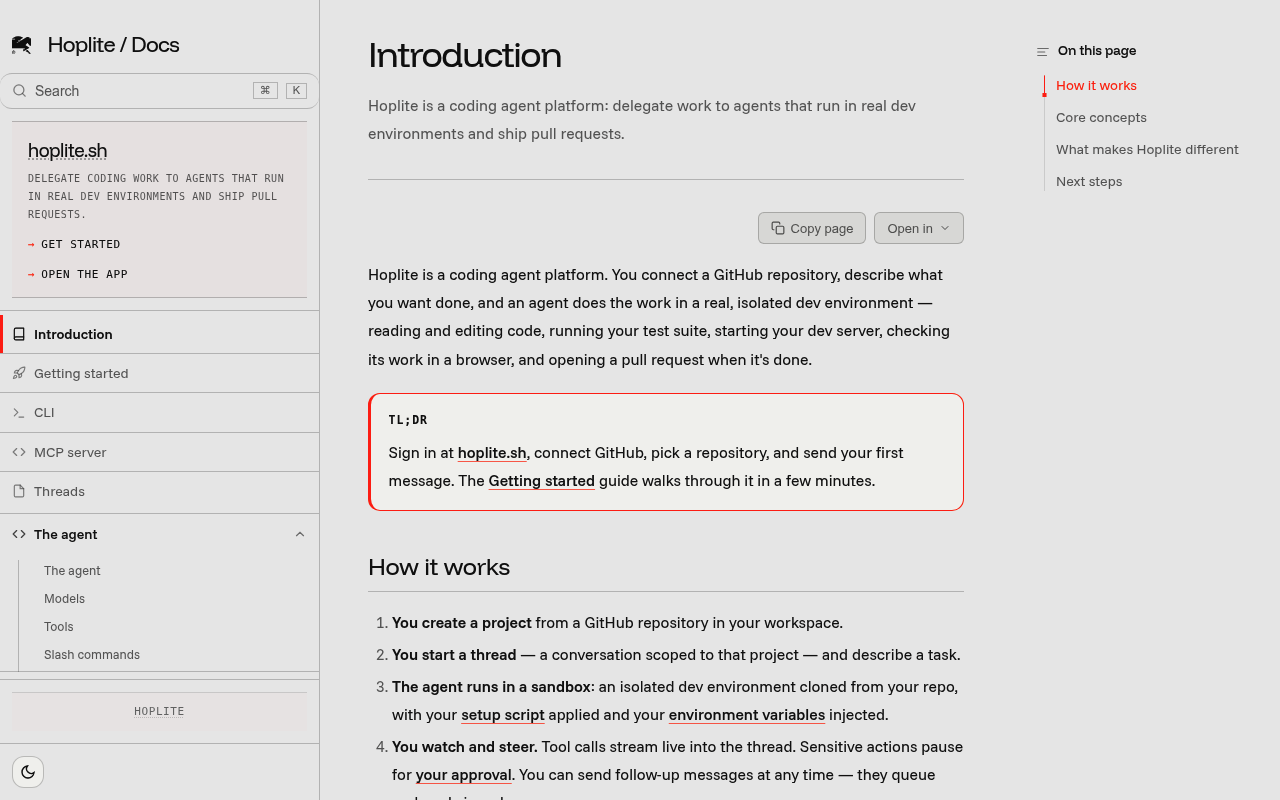
Hoplite is a cloud coding-agent platform (Y Combinator S26). You connect a GitHub repository, describe a task in a thread, and an autonomous agent does the work inside an isolated, cloned dev environment (a "sandbox") — reading and editing code, running your test suite, starting your dev server, verifying changes in a built-in browser, and opening a pull request when it's done. Runs stream live into the thread with inline approvals for sensitive actions, a diff view, and a PR rail that tracks checks, reviews, and unresolved comments. Hoplite runs a lineup of OpenAI (GPT-5.6 family, GPT-5.3 Codex) and Anthropic (Fable 5, Opus 4.8, Sonnet 4.6, Haiku 4.5) models, bills on prepaid credits via Stripe, and integrates with GitHub, Slack, Linear, and customer-hosted MCP servers. It also exposes its own hosted MCP server and a CLI so you can drive Hoplite from Claude Code, Cursor, or any MCP client. Founded 2026 in San Francisco by Ryan Morrissey and Bence Redmond.
Hoplite is listed with 1 API on the APIs.io network. Tagged areas include Company, Coding Agents, Developer Tools, AI Agents, and Cloud Development Environments.
The Hoplite catalog on APIs.io includes 1 event-driven AsyncAPI specification.
Hoplite’s developer surface includes engineering blog, documentation, getting-started guide, pricing, signup flow, CLI, authentication, and 15 more developer resources.
Kin Score
 Kin Score
How this is scored →
Kin Score
How this is scored →scored 2026-10-17 · rubric v0.24.0
APIs 1
Individual APIs this provider publishes, each with its own machine-readable definition.
Hoplite API
The Hoplite platform API at api.hoplite.sh. Documented through the developer docs (no public OpenAPI published as of this profiling). Surfaces include model-provider discovery (...
MCP Servers 1
Model Context Protocol servers that expose these APIs to AI agents.
Hoplite MCP Server
Hoplite operates its own official hosted Model Context Protocol server so an MCP client (Claude Code, Cursor, or any MCP client) can list projects, start Hoplite agent threads, ...
MCP SERVEREvent Specifications 1
AsyncAPI definitions for this provider's event-driven and streaming APIs.
Hoplite Webhooks
ASYNCAPISecurity Posture 2
Authentication, domain security, vulnerability disclosure, and trust-center signals.
Resources
Get Started 4
Portal, sign-up, and the first successful call
Documentation 1
Reference material describing how the API behaves
Agent Surfaces 2
MCP servers, agent skills, and machine-readable catalogs
Design & Contract 6
Pagination, idempotency, versioning, errors, and events
Build 2
SDKs, sample code, and the tooling you integrate with
Access & Security 2
Authentication, authorization, and security posture
Operate 1
Status, limits, changes, and where to get help
Commercial 1
Pricing, plans, and the legal terms of use
Company 3
The organization behind the API
Source (apis.yml)
Work with this as data
Every provider here is available over the APIs.io API and to AI agents over MCP.