Google Pay
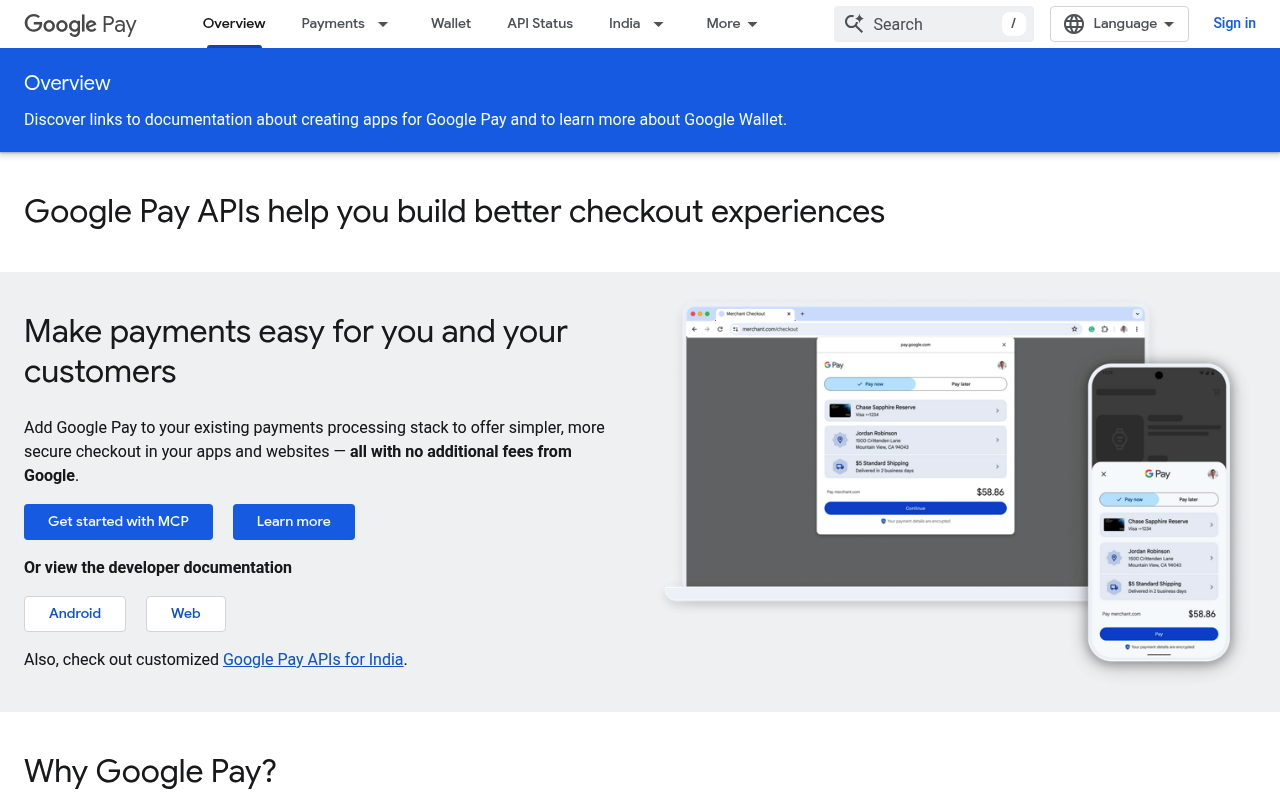
Google Pay is Google's digital wallet and payment surface, exposed to developers as a family of distinct APIs rather than one endpoint. The Google Pay API for Web and Android is a client-side payment sheet that returns a signed, ECIES-encrypted payment token for a merchant's gateway to decrypt; the Google Wallet API is a REST service on walletobjects.googleapis.com for issuing loyalty cards, event tickets, boarding passes, transit tickets, gift cards and offers; Google Standard Payments carries the integrator APIs for issuers and PSPs; and the Google Pay & Wallet Developer MCP server gives AI coding agents live access to merchant profiles, integration status and the official documentation.
Google Pay is listed with 9 APIs on the APIs.io network. Tagged areas include Agentic Commerce, Checkout, Contactless Payments, Digital Wallet, and Merchants.
Google Pay’s developer surface includes pricing, developer portal, getting-started guide, developer console, support, engineering blog, changelog, and 35 more developer resources.
Kin Score
 Kin Score
How this is scored →
Kin Score
How this is scored →scored 2026-10-23 · rubric v0.25.0
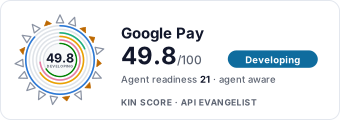 It updates itself when the score changes. Paste this where you link to your API docs:
<a href="https://apis.io/providers/google-pay/"><img src="https://apis.io/badge/google-pay/card.svg" alt="Google Pay on APIs.io — Kin Score by API Evangelist"></a>Other styles, a README pill and a shields.io endpoint are on the badge page.
Markets this provider is in provisional
The Kin Score Market layer reads a provider inside its market: its position, and how deep its integrations go. Depth is only comparable within a position. Provisional and unweighted: not part of the Kin Score or agent readiness.
| Market | Position | Depth | Registered MCP server | Declares compatibility |
|---|---|---|---|---|
| EMV Card Terminals (card acceptance hardware and kernels) | undeclared | - | - | - |
| Mobile SDK Publishers (Play SDK Index, CocoaPods, ADA certification) | undeclared | - | - | - |
Registered MCP server and declares compatibility are report only — not weighted. Undeclared means we found nothing we can read, so there is no number: we never infer integrations.
APIs 9
Individual APIs this provider publishes, each with its own machine-readable definition.
Google Pay API
Enables integration of the Google Pay payment method into web applications, allowing merchants to accept payments from cards saved to Google Accounts. The API provides JavaScrip...
Google Pay API for Android
Enables integration of Google Pay into Android applications, allowing users to pay with cards saved to their Google Account. The API provides methods to check payment readiness ...
Google Wallet API
APIs for creating and managing digital passes for Google Wallet, including loyalty cards, event tickets, boarding passes, transit tickets, gift cards, offers, and generic passes...
Google Pay Facilitated Transaction Event API
Provides services hosted by Google for processing facilitated payment events as part of Google Standard Payments. Payment integrators use this API to report and manage transacti...
Google Pay Virtual Cards API
Enables payment integrators to enroll cards, retrieve virtual card numbers, manage transactions, and handle authentication challenges for virtual card payments. Used by issuers ...
Google Pay Push Provisioning API
Allows card issuers to provision payment cards directly into Google Pay and Google Wallet from their own applications. Issuers can set default payment tokens, manage token lifec...
Google Pay Payment Card Recognition API
Enables Android applications to scan credit and debit cards using the device camera to extract card number and expiration date through on-device optical character recognition. P...
Google Pay India Merchant SDK
A toolkit for developers in India to integrate their Android, iOS, and web applications with Google Pay for accepting UPI and card-based payments. Supports merchant onboarding, ...
Google Universal Commerce Protocol
A standard for securely and efficiently exchanging commerce data between merchant and platform systems to enable checkout experiences directly on Google surfaces including Searc...
Scroll for all 9
MCP Servers 1
Model Context Protocol servers that expose these APIs to AI agents.
Google Pay & Wallet Developer MCP server
Google's first-party remote MCP server for Google Pay and Google Wallet developers. It exposes documentation search over the official Google Pay and Google Wallet docs plus live...
MCP SERVERPricing Plans 1
Published pricing tiers and plan structures.
Rate Limits 1
Documented rate limits and quota policies.
Google Pay Rate Limits
RATE LIMITSFinOps 1
Cost, billing, and metering signals for API financial operations.
Google Pay Finops
FINOPSJSON Schema 1
Standalone JSON Schema definitions for this provider's data models.
Google Pay Payment Handler Configuration
JSON SCHEMASecurity Posture 3
Authentication, domain security, vulnerability disclosure, and trust-center signals.
Scopes 1
OAuth scopes governing access to this provider's APIs.
Resources
Get Started 5
Portal, sign-up, and the first successful call
Documentation 4
Reference material describing how the API behaves
Agent Surfaces 4
MCP servers, agent skills, and machine-readable catalogs
Design & Contract 5
Pagination, idempotency, versioning, errors, and events
Build 4
SDKs, sample code, and the tooling you integrate with
Access & Security 6
Authentication, authorization, and security posture
Operate 6
Status, limits, changes, and where to get help
Commercial 5
Pricing, plans, and the legal terms of use
Company 3
The organization behind the API
Source (apis.yml)
Work with this as data
Every provider here is available over the APIs.io API and to AI agents over MCP.