Google Cloud Trace
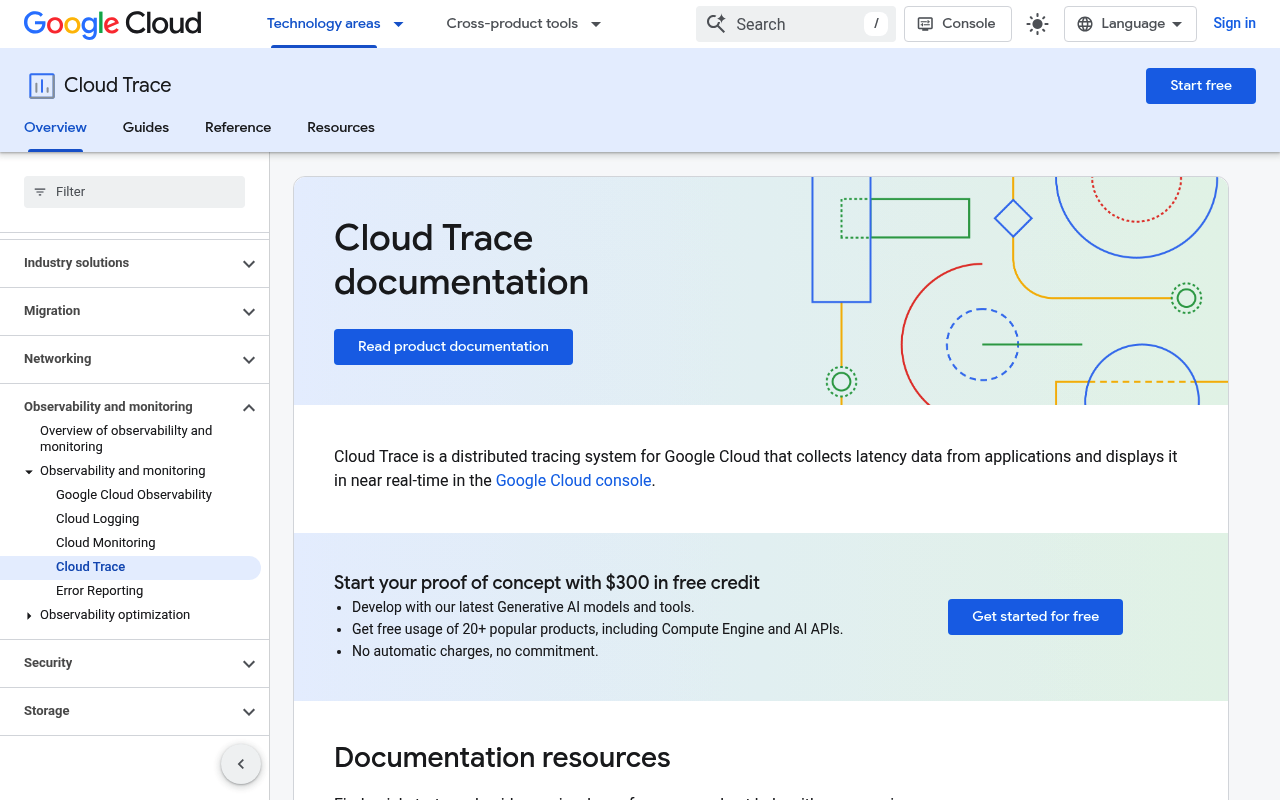
Google Cloud Trace is a distributed tracing system that collects latency data from applications and displays it in near real-time. It helps developers understand how requests propagate through their application, identify performance bottlenecks, and analyze latency across microservices and distributed architectures running on Google Cloud.
Google Cloud Trace publishes 1 API contract indexed on the APIs.io network: Projects API. Tagged areas include Distributed Tracing, Google Cloud, Latency, Observability, and Performance.
The Google Cloud Trace catalog on APIs.io includes 1 Spectral governance ruleset.
Google Cloud Trace’s developer surface includes developer portal, getting-started guide, documentation, authentication, pricing, support, engineering blog, and 14 more developer resources.
What this lets a business do 1
Business capabilities this provider's published APIs can perform, derived from its own contracts. Browse all capabilities →
Kin Score
 Kin Score
How this is scored →
Kin Score
How this is scored →scored 2026-10-17 · rubric v0.24.0
APIs 1
Individual APIs this provider publishes, each with its own machine-readable definition.
Google Cloud Trace Projects API
The Projects API from Google Cloud Trace — 4 operation(s) for projects.
Postman Collections 1
Ready-to-run Postman collections for exercising this provider's APIs.
Open Collections 3
Open, tool-agnostic API collections (OpenAPI-derived and Bruno).
API Collection
OPEN COLLECTIONGoogle Cloud Trace Projects API
OPEN COLLECTIONGoogle Cloud Trace API
OPEN COLLECTIONPricing Plans 1
Published pricing tiers and plan structures.
Rate Limits 1
Documented rate limits and quota policies.
Google Cloud Trace Rate Limits
RATE LIMITSFinOps 1
Cost, billing, and metering signals for API financial operations.
Spectral Rules 1
Spectral governance rulesets for linting and validating these APIs.
Security Posture 2
Authentication, domain security, vulnerability disclosure, and trust-center signals.
Agentic Access 1
Recommended x-agentic-access execution contracts for AI agents.
Resources
Get Started 2
Portal, sign-up, and the first successful call
Documentation 1
Reference material describing how the API behaves
Agent Surfaces 1
MCP servers, agent skills, and machine-readable catalogs
Design & Contract 1
Pagination, idempotency, versioning, errors, and events
Build 2
SDKs, sample code, and the tooling you integrate with
Access & Security 3
Authentication, authorization, and security posture
Operate 3
Status, limits, changes, and where to get help
Commercial 5
Pricing, plans, and the legal terms of use
Company 2
The organization behind the API
Other 1
Properties that don't map to a standard resource type
Source (apis.yml)
Work with this as data
Every provider here is available over the APIs.io API and to AI agents over MCP.