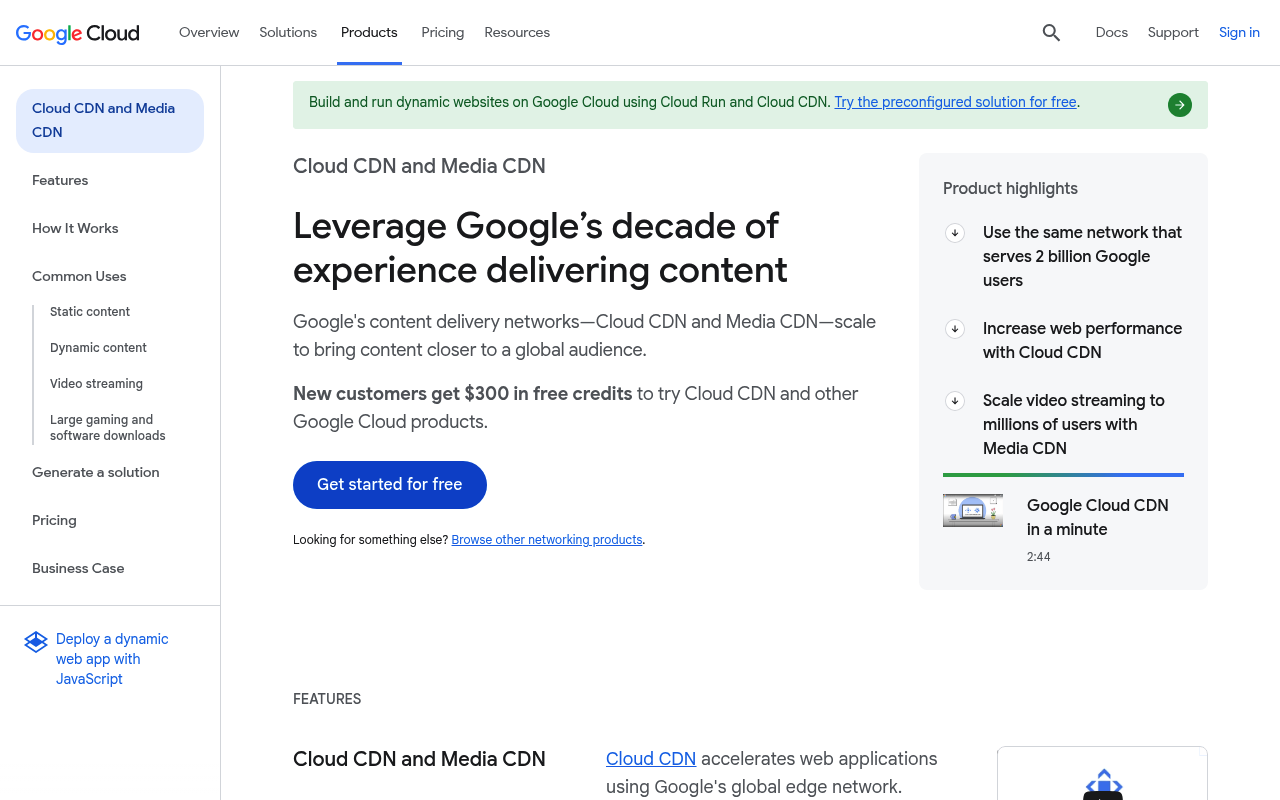
Google Cloud CDN
Google Cloud CDN (Content Delivery Network) uses Google's globally distributed edge points of presence to cache HTTP(S) load-balanced content close to users. It accelerates content delivery, reduces serving costs, and improves availability by leveraging Google's global network infrastructure for fast, reliable content distribution.
Google Cloud CDN publishes 3 API contracts indexed on the APIs.io network: BackendServices API, Cache Invalidation API, and URL maps API. Tagged areas include Caching, CDN, Content Delivery, Google Cloud, and Networking.
The Google Cloud CDN catalog on APIs.io includes 1 JSON-LD context and 1 Spectral governance ruleset.
Google Cloud CDN’s developer surface includes authentication, developer portal, getting-started guide, documentation, pricing, support, and 17 more developer resources.
What this lets a business do 1
Business capabilities this provider's published APIs can perform, derived from its own contracts. Browse all capabilities →
Kin Score
 Kin Score
How this is scored →
Kin Score
How this is scored →scored 2026-10-17 · rubric v0.24.0
What adopting Google Cloud CDN moves on the Kin Score 0
Google Cloud CDN is an area vendor: providers adopt it to run part of their developer surface. This is the Kin Score checks its features can move for a provider that adopts it, what each one really earns, and what it earns nothing for.
Google Cloud CDN moves no Kin Score check. It caches and accelerates content. Cloud Armor policies and reCAPTCHA bot management allow, deny, rate-limit or redirect automated clients, and Service Extensions run custom code in the request path. The fetched docs mention no AI-crawler consent signal, Web Bot Auth, agent monetization, security.txt or llms.txt, so a provider on it scores exactly what its own published artifacts earn.
Nothing the Kin Score reads. Google Cloud CDN's features serve the provider's operations, not the published surface the score measures.
What Google Cloud CDN ships that earns nothing (2)
- Cloud Armor bot management — Filtering bots publishes no AIPREF/ContentSignal/WebBotAuth artifact for the provider.
- Cloud CDN with Service Extensions — Caching and TLS change nothing any check reads.
A model, not a score. Adopting this vendor changes a provider's Kin Score only when the provider publishes the resulting artifacts on its own surface; nothing here writes a score, and no sponsorship or partnership can. The rating is not for sale → · Full vendor facets artifact
APIs 3
Individual APIs this provider publishes, each with its own machine-readable definition.
Google Cloud CDN BackendServices API
Manage CDN-enabled backend services
Google Cloud CDN Cache Invalidation API
Invalidate cached content
Google Cloud CDN URL maps API
Manage URL maps for routing
Postman Collections 3
Ready-to-run Postman collections for exercising this provider's APIs.
Open Collections 5
Open, tool-agnostic API collections (OpenAPI-derived and Bruno).
API Collection
OPEN COLLECTIONGoogle Cloud CDN API
OPEN COLLECTIONGoogle Cloud CDN BackendServices API
OPEN COLLECTIONGoogle Cloud CDN BackendServices CacheInvalidation API
OPEN COLLECTIONGoogle Cloud CDN BackendServices UrlMaps API
OPEN COLLECTIONPricing Plans 2
Published pricing tiers and plan structures.
Rate Limits 1
Documented rate limits and quota policies.
Google Cloud Cdn Rate Limits
RATE LIMITSFinOps 1
Cost, billing, and metering signals for API financial operations.
Google Cloud Cdn Finops
FINOPSSemantic Vocabularies 1
JSON-LD contexts and semantic vocabularies used across these APIs.
Cdn Context
JSON-LDSpectral Rules 1
Spectral governance rulesets for linting and validating these APIs.
Google Cloud CDN — jsonschema rules
SPECTRALJSON Schema 1
Standalone JSON Schema definitions for this provider's data models.
Google Cloud CDN Backend Service
JSON SCHEMASecurity Posture 3
Authentication, domain security, vulnerability disclosure, and trust-center signals.
Scopes 1
OAuth scopes governing access to this provider's APIs.
Agentic Access 1
Recommended x-agentic-access execution contracts for AI agents.
Resources
Get Started 2
Portal, sign-up, and the first successful call
Documentation 1
Reference material describing how the API behaves
Agent Surfaces 1
MCP servers, agent skills, and machine-readable catalogs
Design & Contract 1
Pagination, idempotency, versioning, errors, and events
Build 2
SDKs, sample code, and the tooling you integrate with
Access & Security 5
Authentication, authorization, and security posture
Operate 3
Status, limits, changes, and where to get help
Commercial 5
Pricing, plans, and the legal terms of use
Company 1
The organization behind the API
Other 2
Properties that don't map to a standard resource type
Source (apis.yml)
Work with this as data
Every provider here is available over the APIs.io API and to AI agents over MCP.