Gitar
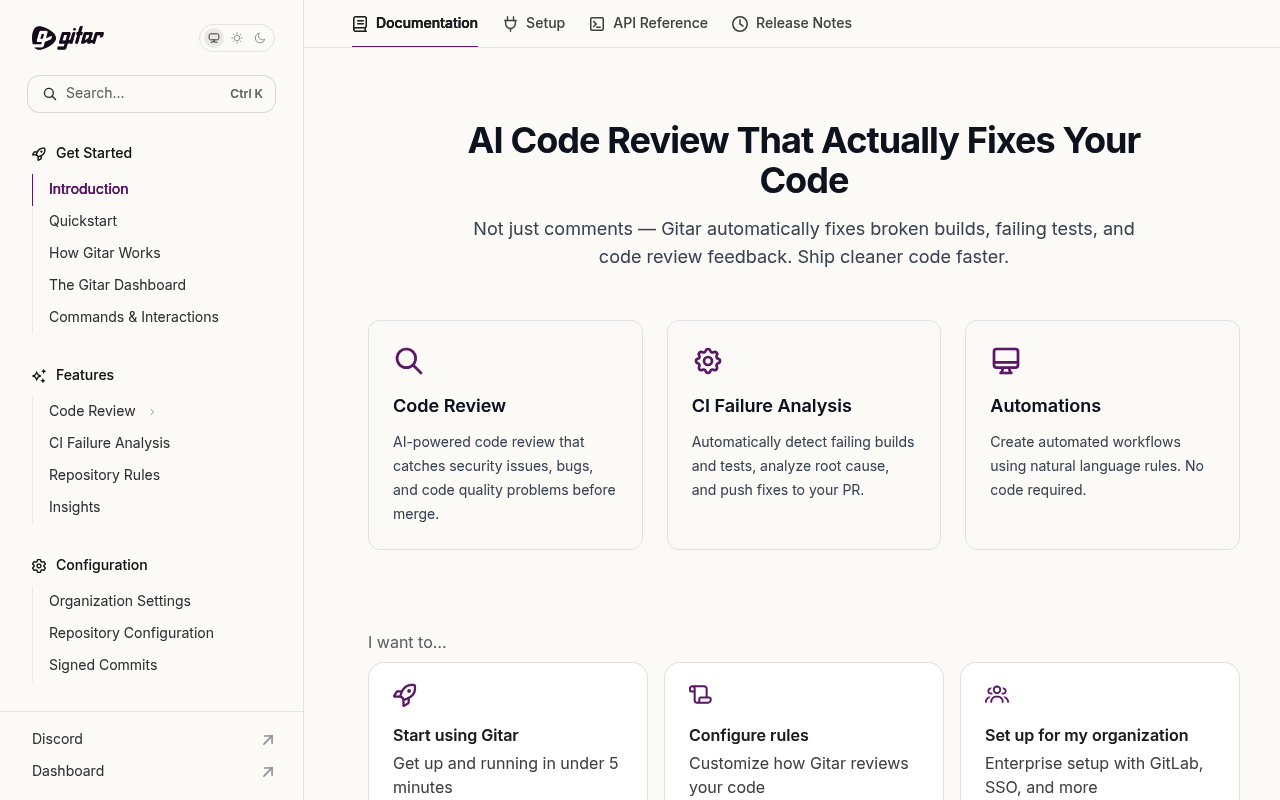
Gitar is an AI code review platform that goes beyond commenting on pull and merge requests — it automatically fixes broken builds, failing tests, linting errors, and code-review findings, and validates every change against your CI pipeline before it is pushed. It works directly in the GitHub and GitLab PR interface, analyzes CI failures, deduplicates flaky tests, and runs natural-language repository rules from a .gitar/rules directory. Built by engineers from Uber's development stack and acquired by Sonar (SonarQube), Gitar is used by teams including SoFi, DeepL, and Altruist. It exposes a Bearer-token External API (api.gitar.ai/v1) on the Enterprise plan for installation health checks and GitLab project onboarding, and integrates with Buildkite, CircleCI, Bitrise, Jira, Linear, and Slack.
Gitar publishes 3 API contracts indexed on the APIs.io network: GitLab MR Status API, GitLab Projects API, and Installation Health API. Tagged areas include Company, Developer Tools, Code Review, CI/CD, and Code Quality.
Gitar’s developer surface includes documentation, API reference, getting-started guide, engineering blog, pricing, signup flow, support, and 24 more developer resources.
What this lets a business do 1
Business capabilities this provider's published APIs can perform, derived from its own contracts. Browse all capabilities →
Kin Score
 Kin Score
How this is scored →
Kin Score
How this is scored →scored 2026-10-17 · rubric v0.24.0
APIs 3
Individual APIs this provider publishes, each with its own machine-readable definition.
Gitar GitLab MR Status API
The GitLab MR Status API from Gitar — 1 operation(s) for gitlab mr status.
Gitar GitLab Projects API
The GitLab Projects API from Gitar — 1 operation(s) for gitlab projects.
Gitar Installation Health API
The Installation Health API from Gitar — 1 operation(s) for installation health.
Open Collections 4
Open, tool-agnostic API collections (OpenAPI-derived and Bruno).
API Collection
OPEN COLLECTIONGitar External GitLab MR Status API
OPEN COLLECTIONGitar External GitLab MR Status GitLab Projects API
OPEN COLLECTIONGitar External GitLab MR Status Installation Health API
OPEN COLLECTIONPricing Plans 1
Published pricing tiers and plan structures.
Gitar Plans Pricing
PLANSOpenAPI Overlays 1
Overlays applied on top of this provider's contracts. Each card says who wrote it: a document the provider publishes, or one API Evangelist derived or generated.
Gitar Openapi Overlay
UNRECORDEDSecurity Posture 3
Authentication, domain security, vulnerability disclosure, and trust-center signals.
Agentic Access 1
Recommended x-agentic-access execution contracts for AI agents.
Resources
Get Started 4
Portal, sign-up, and the first successful call
Documentation 3
Reference material describing how the API behaves
Agent Surfaces 4
MCP servers, agent skills, and machine-readable catalogs
Design & Contract 5
Pagination, idempotency, versioning, errors, and events
Build 1
SDKs, sample code, and the tooling you integrate with
Access & Security 4
Authentication, authorization, and security posture
Operate 2
Status, limits, changes, and where to get help
Commercial 4
Pricing, plans, and the legal terms of use
Company 2
The organization behind the API
Other 2
Properties that don't map to a standard resource type
Source (apis.yml)
Work with this as data
Every provider here is available over the APIs.io API and to AI agents over MCP.