FlightAware is a global flight tracking and data platform that provides real-time flight tracking, mapping, and predictive technology to both individual users and commercial aviation companies. The platform collects data from a variety of sources including air traffic control systems, radar, ADS-B, and satellite data, and exposes that data to developers and commercial customers through its AeroAPI query-based REST API and its Firehose streaming feed.
FlightAware publishes 10 API contracts indexed on the APIs.io network, including Airports API, Alerts API, Flights API, and 7 more. Tagged areas include Aviation, Flights, Flight Tracking, Mapping, and Radar.
The FlightAware catalog on APIs.io includes 1 event-driven AsyncAPI specification and 1 Spectral governance ruleset.
FlightAware’s developer surface includes authentication, documentation, pricing, engineering blog, support, GitHub presence, API reference, and 28 more developer resources.
Regulatory Posture applies to this provider. Its tags matched the
Horizontal (data, software, accessibility, platform) regime, so
Regulatory Posture carries 15 points of the composite.
If this regime is wrong for your business, say so on your
provider repo — the
applicability map is public and we will correct it.
Create-or-Update Ergonomics applies to this provider. This API accepts writes, so it
carries 10 points of the composite. It is scored from the published contracts
themselves: whether a caller can create-or-update in one call, whether the write accepts a key the caller already
holds, and whether the response says which branch ran. Without that, every write needs a search-and-branch in
front of it, and the first time that check is skipped a duplicate record is created.
Scored against the observed mean rather than raw — a provider at the catalog average is unchanged by this facet,
not penalised by it.
The six quality facets above are damped to 75 points between them,
because the conditional facet above carries the other
25. That is why each facet's contribution is shown against a damped
maximum: raising a quality facet moves the composite by 75% of its nominal
weight, not 100%. The full arithmetic is at apis.io/rating/.
Show this score on your site.
It updates itself when the score changes. Paste this where you link to your API docs:
<a href="https://apis.io/providers/flightaware/"><img src="https://apis.io/badge/flightaware/card.svg" alt="FlightAware on APIs.io — Kin Score by API Evangelist"></a>
Other styles, a README pill and a shields.io endpoint are on the badge page.
Raise your score.
Agent readiness — checks not met, largest first (exact, from this profile):
MCP Server+12 pts — deployment.mode + probe verdict on the mcp/ manifest, not the pointer; an unprobed slug falls back to authorship
Idempotency+9 pts — OpenAPI mutating operations declare an idempotency key — a header, a request-body property, or a named de-duplication token whose own description says so (verified); else common[].type matches /idempoten/i (documented)
A2A Agent Card+8 pts — a2a/-a2a.yml manifest, graded on conformance.grade against A2A 1.0.0
Delegated User Identity+6 pts — a served discovery document listing authorization_code in grant_types_supported (served), else an oauth2 authorizationCode flow or openIdConnect declared in an OpenAPI (documented)
Protected Resource Metadata+5 pts — a served /.well-known/oauth-protected-resource carrying `resource` (documented), and naming its authorization_servers (verified)
4 more unmet checks in the Agent Readiness table above.
Kin Score — facets with the most composite points still available (weight × headroom):
The Kin Score Market layer reads a provider inside its market:
its position, and how deep its integrations go. Depth is only comparable within a position. Provisional and unweighted:
not part of the Kin Score or agent readiness.
Registered MCP server and declares compatibility are report only — not weighted.
Undeclared means we found nothing we can read, so there is no number: we never infer integrations.
Standards this provider implements or carries. De facto ones are profiled and measured by the API Commons; formal ones come from the standards directory and are linked by the provider's own tags. The evidence column says how each claim was established — not that it was made.
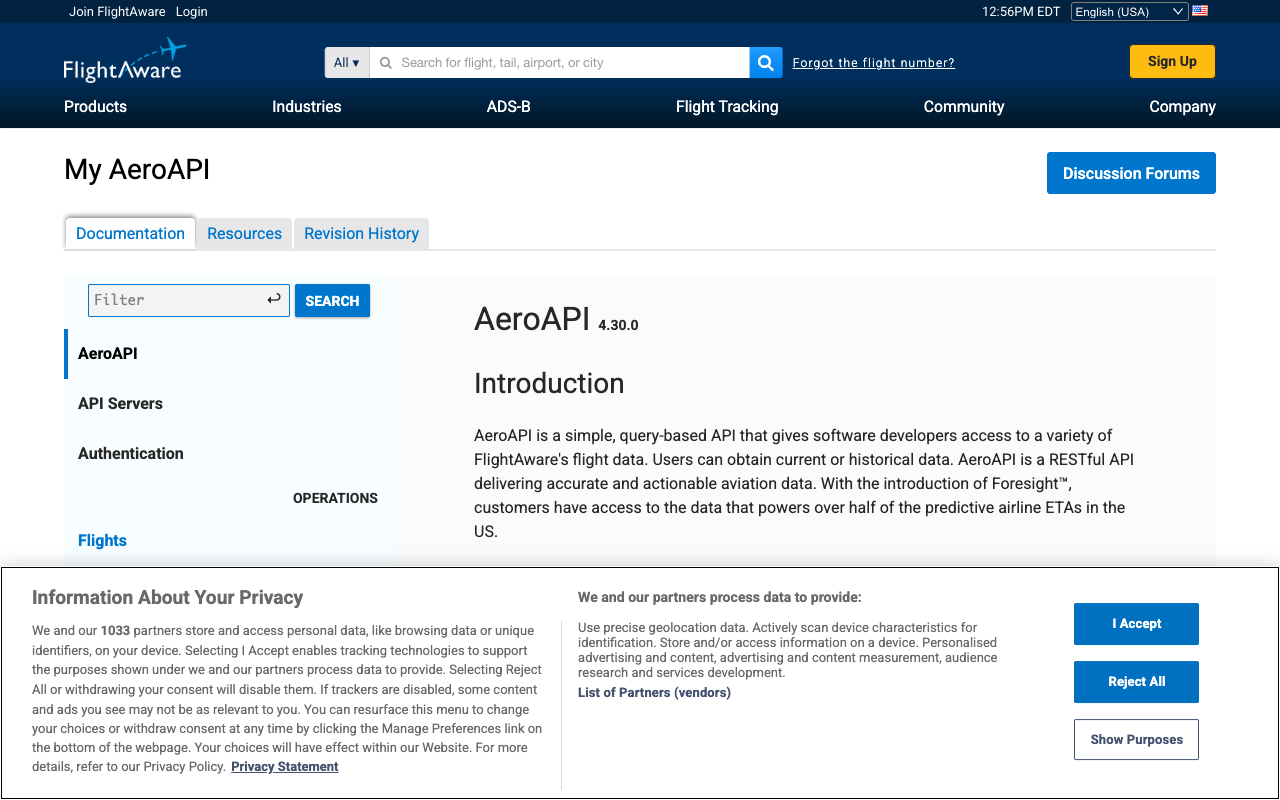
AeroAPI is FlightAware's query-based REST API for accessing aviation data on demand. It exposes 60+ endpoints across flights, airports, operators, alerts, history, and Foresight...
Firehose is FlightAware's real-time streaming feed of global flight data, delivering ADS-B, radar, and ATC-derived position, status, and event messages over a persistent TLS con...
AeroAPI alerting can be used to configure and receive real-time alerts on key flight events. With customizable alerting offered by our alert endpoints, AeroAPI empowers users to...
The account surface of AeroAPI — GET /account/usage, added in AeroAPI 4.30.0. It reports the calling account's AeroAPI consumption over a requested period, and it is the only in...
Overlays applied on top of this provider's contracts. Each card says who wrote it: a document the provider publishes, or one API Evangelist derived or generated.
aid: flightaware
name: FlightAware
description: FlightAware is a global flight tracking and data platform that provides real-time flight tracking, mapping, and
  predictive technology to both individual users and commercial aviation companies. The platform collects data from a variety
  of sources including air traffic control systems, radar, ADS-B, and satellite data, and exposes that data to developers
  and commercial customers through its AeroAPI query-based REST API and its Firehose streaming feed.
type: Index
deliveryModel:
  model: saas
  open_source: false
  commercial: true
  callable_host: true
  label: Hosted service · you call their endpoint
  confidence: high
  source:
  - openapi
  - pricing
  generated: '2026-08-28'
  method: derived
accessModel:
  pricing: paid
  onboarding: unknown
  trial: false
  try_now: false
  public: false
  label: Paid
  confidence: high
  source:
  - plans
  - authentication
  - rate-limits
  - security
  generated: '2026-11-06'
  method: derived
image: https://kinlane-images.s3.amazonaws.com/shared/apis-json/icons/flightaware.png
access: 3rd-Party
position: Consuming
created: '2025-02-24'
modified: '2026-09-10'
tags:
- Aviation
- Flights
- Flight Tracking
- Mapping
- Radar
- Satellite
- Traffic Control
tags_raw:
- Aviation
- Flights
- Flight Tracking
- Mapping
- Radar
- Satellites
- Traffic Control
url: https://raw.githubusercontent.com/api-evangelist/flightaware/refs/heads/main/apis.yml
specificationVersion: '0.23'
apis:
- aid: flightaware:aeroapi
  name: FlightAware AeroAPI
  description: AeroAPI is FlightAware's query-based REST API for accessing aviation data on demand. It exposes 60+ endpoints
    across flights, airports, operators, alerts, history, and Foresight predictive analytics, and supports both real-time
    and historical flight tracking, status, positions, routes, and notifications.
  humanURL: https://www.flightaware.com/aeroapi/portal/
  baseURL: https://aeroapi.flightaware.com/aeroapi
  tags:
  - Airports
  - Alerts
  - Aviation
  - Flights
  - Flight Tracking
  - Foresight
  - History
  - Operator
  - Predictive Analytics
  tags_raw:
  - Airports
  - Alerts
  - Aviation
  - Flights
  - Flight Tracking
  - Foresight
  - History
  - Operators
  - Predictive Analytics
  properties:
  - type: Documentation
    url: https://www.flightaware.com/aeroapi/portal/documentation
  - type: Portal
    url: https://www.flightaware.com/aeroapi/portal/
  - type: Pricing
    url: https://www.flightaware.com/commercial/aeroapi/
- aid: flightaware:firehose
  name: FlightAware Firehose
  description: Firehose is FlightAware's real-time streaming feed of global flight data, delivering ADS-B, radar, and ATC-derived
    position, status, and event messages over a persistent TLS connection for enterprise-grade flight tracking, situational
    awareness, and operations analytics.
  humanURL: https://www.flightaware.com/commercial/firehose/
  tags:
  - ADS-B
  - Aviation
  - Flight Tracking
  - Real-Time
  - Streaming
  properties:
  - type: Documentation
    url: https://www.flightaware.com/commercial/firehose/documentation
  - type: ProductPage
    url: https://www.flightaware.com/commercial/firehose/
- aid: flightaware:flightaware-airports-api
  name: FlightAware Airports API
  description: The airports API from FlightAware — 17 operation(s) for airports.
  humanURL: https://www.flightaware.com/aeroapi/portal/
  baseURL: https://aeroapi.flightaware.com/aeroapi
  tags:
  - Airports
  tags_raw:
  - airports
  properties:
  - type: OpenAPI
    url: openapi/flightaware-airports-api-openapi.yml
  - type: Overlay
    url: overlays/flightaware-airports-api-overlay.yaml
- aid: flightaware:flightaware-alerts-api
  name: FlightAware Alerts API
  description: 'AeroAPI alerting can be used to configure and receive real-time alerts on key flight

    events. With customizable alerting offered by our alert endpoints, AeroAPI empowers

    users to selectively pick various types of events/filters to alert on. By doing so,

    you can receive specially tailored alerts delivered to you for events such as flight plan

    filed, flight departure (out and off), flight arrival (on and in), and more!


    To get started with alerting, the **PUT /alerts/endpoint** endpoint must first be used

    to set up the account-wide default URL that alerts will be delivered to. This step must

    be done before any alerts can be configured and will serve as the fallback URL that all

    alerts will be sent to for the account if a specific delivery URL is not designated on a

    particular alert. If this is not performed before configuring alerts, then you will

    receive a 400 error with an error message reminding you of this step when trying to interact

    with the **POST /alerts** endpoint. Once a URL is set via the **PUT /alerts/endpoint** endpoint,

    then alerts can be configured using the **POST /alerts** endpoint. The **GET /alerts** endpoint

    can also be used to retrieve all currently configured alerts associated with your AeroAPI key.

    The **GET /alerts** endpoint will allow you to easily retrieve the id of any specific alerts of

    interest configured for the account which can let you use the **GET** **PUT** and **DELETE**

    **/alerts/{id}** endpoints to retrieve, update, and delete specific alerts.


    When configuring an individual alert, the *target_url* field can be set to a URL that’s

    different than the account-wide target endpoint set via the **PUT /alerts/endpoint**. If

    the *target_url* field is set on an alert, then that specific alert will be delivered to

    the specified *target_url* rather than the default account-wide one. If this field is not

    configured for the alert, then the alert will be delivered to the default account-wide endpoint.

    By setting this field, one can easily target different alerts to be received by different endpoints

    which can be useful for configuring per-application alerts or sending alerts to an alternate

    development environment without having to adjust a production alert configuration.


    For each alert configured, one-to-many ‘events’ can be set for alert delivery. While most

    events will result in one alert delivery, both the *arrival* and the *departure* events can

    result in multiple alerts delivered (referred to as bundled). The *departure* event bundles the

    departure (actual OFF the ground) alert, along with the flight plan filed alert and up to 5

    per-departure changes which can include alerts for significant departure delays of over

    30 minutes, gate changes, and airport delays. FlightAware Global customers will

    also receive *Power on* and *Ready to taxi* alerts as part of the departure bundle. The *arrival* event

    bundles the arrival (actual ON the ground) alert, along with up to 5 en-route changes (including delays

    of over 30 minutes and excluding diversions) identified. FlightAware Global customers will also receive

    *taxi stop* times as part of the *arrival* bundle. Setting a bundled type and unbundled type for an

    On/Off will only result in a single alert in the case where events may overlap.


    If there is a need to change the alert configurations, updating an alert using the **PUT /alerts/{id}**

    endpoint and a unique alert identifier (id) is preferred rather than creating an additional alert.

    By doing so, you can avoid duplicate alerts being delivered which could create unnecessary noise

    if they are not of interest anymore.


    If at any point there is a need to delete an alert, the **DELETE alerts/{id}** endpoint can be

    leveraged to delete an alert so that it won’t be delivered anymore. As a reminder, specific alert

    IDs can be retrieved from the **GET /alerts** endpoint.'
  humanURL: https://www.flightaware.com/aeroapi/portal/
  baseURL: https://aeroapi.flightaware.com/aeroapi
  tags:
  - Alerts
  tags_raw:
  - alerts
  properties:
  - type: OpenAPI
    url: openapi/flightaware-alerts-api-openapi.yml
  - type: Overlay
    url: overlays/flightaware-alerts-api-overlay.yaml
- aid: flightaware:flightaware-flights-api
  name: FlightAware Flights API
  description: The flights API from FlightAware — 11 operation(s) for flights.
  humanURL: https://www.flightaware.com/aeroapi/portal/
  baseURL: https://aeroapi.flightaware.com/aeroapi
  tags:
  - Flights
  tags_raw:
  - flights
  properties:
  - type: OpenAPI
    url: openapi/flightaware-flights-api-openapi.yml
  - type: Overlay
    url: overlays/flightaware-flights-api-overlay.yaml
- aid: flightaware:flightaware-foresight-api
  name: FlightAware Foresight API
  description: 'Foresight endpoints provide access to FlightAware''s Foresight predictive models and

    predictions for key events. Our advanced machine learning (ML) models identify key

    influencing factors for a flight to forecast future events in real-time, providing

    unprecedented insight to improve operational efficiencies and facilitate better

    decision-making in the air and on the ground. To learn more about the power of Foresight,

    visit https://www.flightaware.com/commercial/foresight/


    These endpoints each mirror a non-Foresight equivalent endpoint of similar functionality,

    with the addition of all the ML ''predicted'' values included in the Foresight response. The

    respective non-Foresight endpoint response includes a flag, ''foresight_predictions_available'',

    which can optionally be used as a trigger to obtain and leverage Foresight predictions on an

    as-needed basis and manage cost. Foresight is only available to Premium tier customers.

    Contact integrationsales@flightaware.com for more information, pricing details, and to have

    your account enabled for Foresight.'
  humanURL: https://www.flightaware.com/aeroapi/portal/
  baseURL: https://aeroapi.flightaware.com/aeroapi
  tags:
  - Foresight
  tags_raw:
  - foresight
  properties:
  - type: OpenAPI
    url: openapi/flightaware-foresight-api-openapi.yml
  - type: Overlay
    url: overlays/flightaware-foresight-api-overlay.yaml
- aid: flightaware:flightaware-history-api
  name: FlightAware History API
  description: The history API from FlightAware — 5 operation(s) for history.
  humanURL: https://www.flightaware.com/aeroapi/portal/
  baseURL: https://aeroapi.flightaware.com/aeroapi
  tags:
  - History
  tags_raw:
  - history
  properties:
  - type: OpenAPI
    url: openapi/flightaware-history-api-openapi.yml
  - type: Overlay
    url: overlays/flightaware-history-api-overlay.yaml
- aid: flightaware:flightaware-miscellaneous-api
  name: FlightAware Miscellaneous API
  description: The miscellaneous API from FlightAware — 6 operation(s) for miscellaneous.
  humanURL: https://www.flightaware.com/aeroapi/portal/
  baseURL: https://aeroapi.flightaware.com/aeroapi
  tags: []
  tags_raw:
  - miscellaneous
  properties:
  - type: OpenAPI
    url: openapi/flightaware-miscellaneous-api-openapi.yml
  - type: Overlay
    url: overlays/flightaware-miscellaneous-api-overlay.yaml
- aid: flightaware:flightaware-operators-api
  name: FlightAware Operators API
  description: The operators API from FlightAware — 8 operation(s) for operators.
  humanURL: https://www.flightaware.com/aeroapi/portal/
  baseURL: https://aeroapi.flightaware.com/aeroapi
  tags:
  - Operator
  tags_raw:
  - operators
  properties:
  - type: OpenAPI
    url: openapi/flightaware-operators-api-openapi.yml
  - type: Overlay
    url: overlays/flightaware-operators-api-overlay.yaml
- aid: flightaware:flightaware-account-api
  name: FlightAware Account API
  description: 'The account surface of AeroAPI — GET /account/usage, added in AeroAPI 4.30.0. It reports the calling account''s
    AeroAPI consumption over a requested period, and it is the only in-band signal a consumer has for its own spend: AeroAPI
    returns no rate-limit response headers and declares no 429, so headroom and cost must be polled from here rather than
    read off a response.'
  humanURL: https://www.flightaware.com/aeroapi/portal/
  baseURL: https://aeroapi.flightaware.com/aeroapi
  tags:
  - Account
  tags_raw:
  - account
  properties:
  - type: OpenAPI
    url: openapi/flightaware-account-api-openapi.yml
  - type: Overlay
    url: overlays/flightaware-account-api-overlay.yaml
common:
- type: CapabilityMap
  url: capabilities/flightaware-capability-edges.yml
  name: FlightAware Business Capability Map
- type: AgenticAccess
  url: agentic-access/flightaware-agentic-access.yml
- type: DomainSecurity
  url: security/flightaware-domain-security.yml
- type: Authentication
  url: authentication/flightaware-authentication.yml
- type: LinkedIn
  url: https://www.linkedin.com/company/flightaware
- type: Website
  url: https://www.flightaware.com/
- type: CommercialData
  url: https://www.flightaware.com/commercial/data/
- type: Documentation
  url: https://www.flightaware.com/aeroapi/portal/documentation
- type: Pricing
  url: https://www.flightaware.com/commercial/aeroapi/
- type: Blog
  url: https://blog.flightaware.com/
- type: Support
  url: https://www.flightaware.com/about/contact/
- type: PrivacyPolicy
  url: https://www.flightaware.com/about/privacy
- type: TermsOfService
  url: https://www.flightaware.com/about/termsofuse
- type: GitHub
  url: https://github.com/flightaware
- type: Integrations
  url: https://www.flightaware.com/apps
- type: DeveloperPortal
  url: https://www.flightaware.com/aeroapi/portal/
- type: APIReference
  url: https://www.flightaware.com/aeroapi/portal/documentation
- type: SignUp
  url: https://www.flightaware.com/account/join/
- type: StatusPage
  url: https://status.flightaware.com/
- type: Deprecation
  url: https://www.flightaware.com/commercial/firehose/documentation/revisionhistory
- type: Lifecycle
  url: lifecycle/flightaware-lifecycle.yml
- type: ChangeLog
  url: changelog/flightaware-changelog.yml
- type: Conventions
  url: conventions/flightaware-conventions.yml
- type: ErrorCatalog
  url: errors/flightaware-problem-types.yml
- type: Conformance
  url: conformance/flightaware-conformance.yml
- type: DataModel
  url: data-model/flightaware-data-model.yml
- type: Webhooks
  url: asyncapi/flightaware-events.yml
- type: Packages
  url: packages/flightaware-packages.yml
- type: AgentSkill
  url: skills/_index.yml
- type: LLMsTxt
  url: llms/flightaware-llms.txt
- type: X-MCPServerCandidate
  url: mcp/flightaware-mcp.yml
- type: WSDL
  name: FlightXML 2 (legacy SOAP)
  url: wsdl/flightaware-flightxml2.wsdl
- type: WSDL
  name: FlightXML 3 (legacy SOAP)
  url: wsdl/flightaware-flightxml3.wsdl
- type: RateLimits
  url: rate-limits/flightaware-rate-limits.yml
- type: Plans
  url: plans/flightaware-plans-pricing.yml
- type: FinOps
  url: finops/flightaware-finops.yml
integrations:
- name: FlightAware
- name: Small FlightAware airplane
- name: FlightAware FlightFeeders side-by-side.
x-enrichment:
  date: '2026-09-10'
  status: enriched
  artifacts_added: 27
  pass: local-v3
maintainers:
- FN: Kin Lane
  email: kin@apievangelist.com
FlightAware API — frequently asked questions
Does FlightAware have an API?
Yes. APIs.io lists 10 APIs from FlightAware, including FlightAware AeroAPI, FlightAware Firehose and FlightAware Airports API, and 7 more.
Is there an OpenAPI specification for the FlightAware API?
Yes. APIs.io indexes 8 OpenAPI specifications for FlightAware, each linked for download from this page.
How do I authenticate with the FlightAware API?
FlightAware uses bearer-token authentication (apiKey · 1 scheme). The details are profiled on APIs.io as Flightaware Authentication.
How much does the FlightAware API cost?
FlightAware publishes its prices; its Personal plan is No minimum per result set as of 2026-10-28. APIs.io lists 5 pricing plans for FlightAware, with each plan's price, limits and inclusions under Pricing on this page.
Is the FlightAware API ready for AI agents?
FlightAware has a Kin Score of 59.9 out of 100 (strong) and an Agent Readiness score of 36.4 (agent-ready), scored by API Evangelist on 2026-11-06.
Calls without X-API-Key need no key. Calls with it need a paid plan — get a key.
Get an API key
Free tier, no form to fill in. Signing in shares your email address with us — we
store it to create your key and to recognise you if you sign in with another
provider. See our Privacy Policy and
Terms.
 Kin Score
How this is scored →
 It updates itself when the score changes. Paste this where you link to your API docs: