FANUC
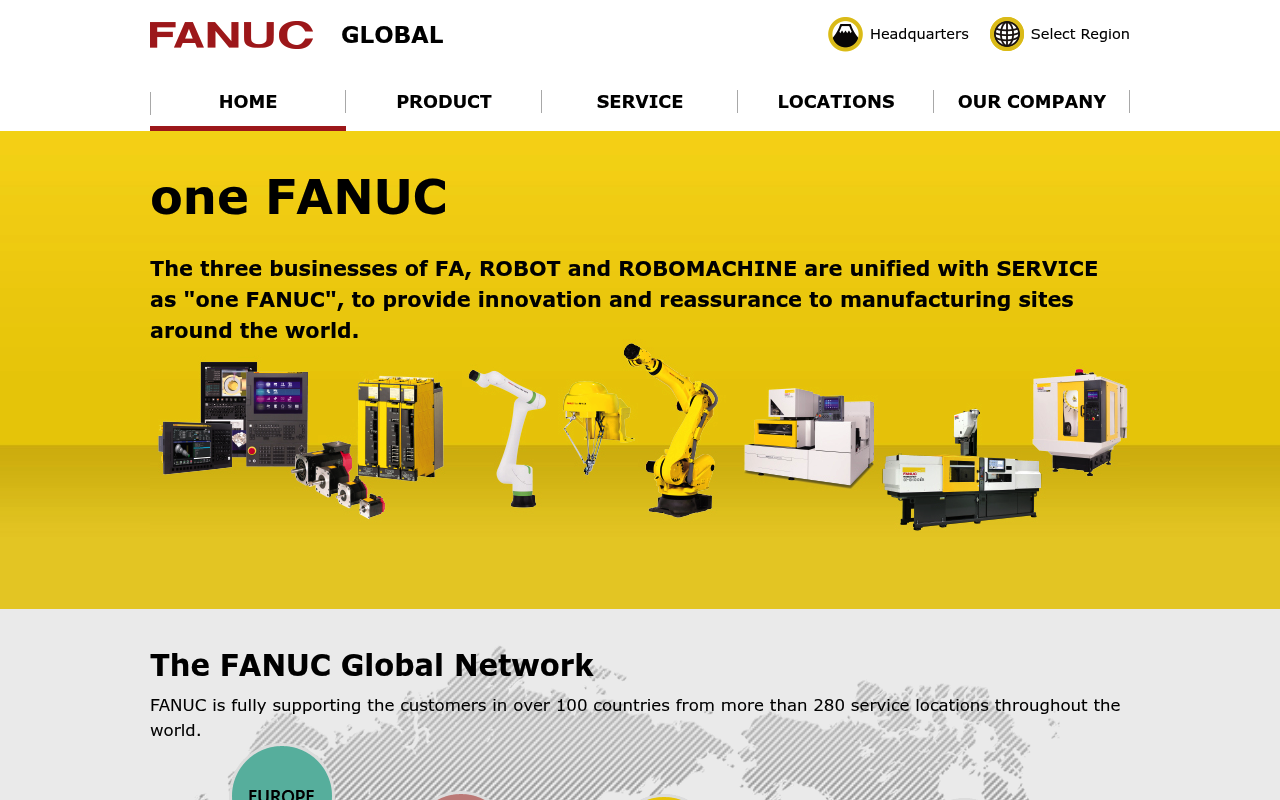
FANUC Corporation is a Japanese multinational headquartered in Oshino, Yamanashi at the base of Mount Fuji, and is one of the world's largest suppliers of factory automation, industrial robots, and CNC (computer numerical control) systems. Founded in 1972 after spinning out of Fujitsu's numerical control division (originated 1955) under Seiuemon Inaba, FANUC pioneered commercial NC and CNC technology and by the early 1980s held roughly half of the global CNC market. The company operates three primary business segments: FA (CNC systems, servo motors, lasers, and PMC controls for machine tools), Robot (industrial arms from the LR Mate and M-series through the heavy-payload M-2000iA, plus the CRX collaborative robot family), and ROBOMACHINE (ROBODRILL machining centers, ROBOCUT wire EDM, and ROBOSHOT all-electric injection molding machines). FANUC's primary developer surface is FOCAS (FANUC Open CNC API Specification), a licensed C/C++ library (fwlib32.dll) used by machine builders and MES/OEE vendors to read CNC state over Ethernet, plus KAREL and Teach Pendant (TP) programming on the robot controllers and a published ROS 2 driver for the CRX collaborative arms. FANUC does not operate a public REST developer portal or publish OpenAPI specifications; integrations are partner-driven through MTConnect adapters, OPC UA servers, FIELD system edge apps, and the FANUC America customer/training portals.
FANUC is profiled on the APIs.io network. Tagged areas include Industrial Robotics, CNC, Factory Automation, Collaborative Robots, and Machine Tools.
The FANUC catalog on APIs.io includes 1 JSON-LD context.
FANUC’s developer surface includes academy / training, GitHub presence, YouTube channel, and 24 more developer resources.
Kin Score
 Kin Score
How this is scored →
Kin Score
How this is scored →scored 2026-10-17 · rubric v0.24.0
Markets this provider is in provisional
The Kin Score Market layer reads a provider inside its market: its position, and how deep its integrations go. Depth is only comparable within a position. Provisional and unweighted: not part of the Kin Score or agent readiness.
| Market | Position | Depth | Registered MCP server | Declares compatibility |
|---|---|---|---|---|
| Industrial Automation and Robotics | undeclared | - | - | - |
Registered MCP server and declares compatibility are report only — not weighted. Undeclared means we found nothing we can read, so there is no number: we never infer integrations.
Standards implemented 1
Standards this provider implements or carries. De facto ones are profiled and measured by the API Commons; formal ones come from the standards directory and are linked by the provider's own tags. The evidence column says how each claim was established — not that it was made.
Semantic Vocabularies 1
JSON-LD contexts and semantic vocabularies used across these APIs.
Fanuc Robotics Context
JSON-LDSecurity Posture 1
Authentication, domain security, vulnerability disclosure, and trust-center signals.
Resources
Get Started 1
Portal, sign-up, and the first successful call
Documentation 1
Reference material describing how the API behaves
Build 1
SDKs, sample code, and the tooling you integrate with
Access & Security 1
Authentication, authorization, and security posture
Learn 2
Tutorials, courses, talks, and written guidance
Operate 1
Status, limits, changes, and where to get help
Company 6
The organization behind the API
Other 14
Properties that don't map to a standard resource type
Scroll for all 14
Source (apis.yml)
Work with this as data
Every provider here is available over the APIs.io API and to AI agents over MCP.