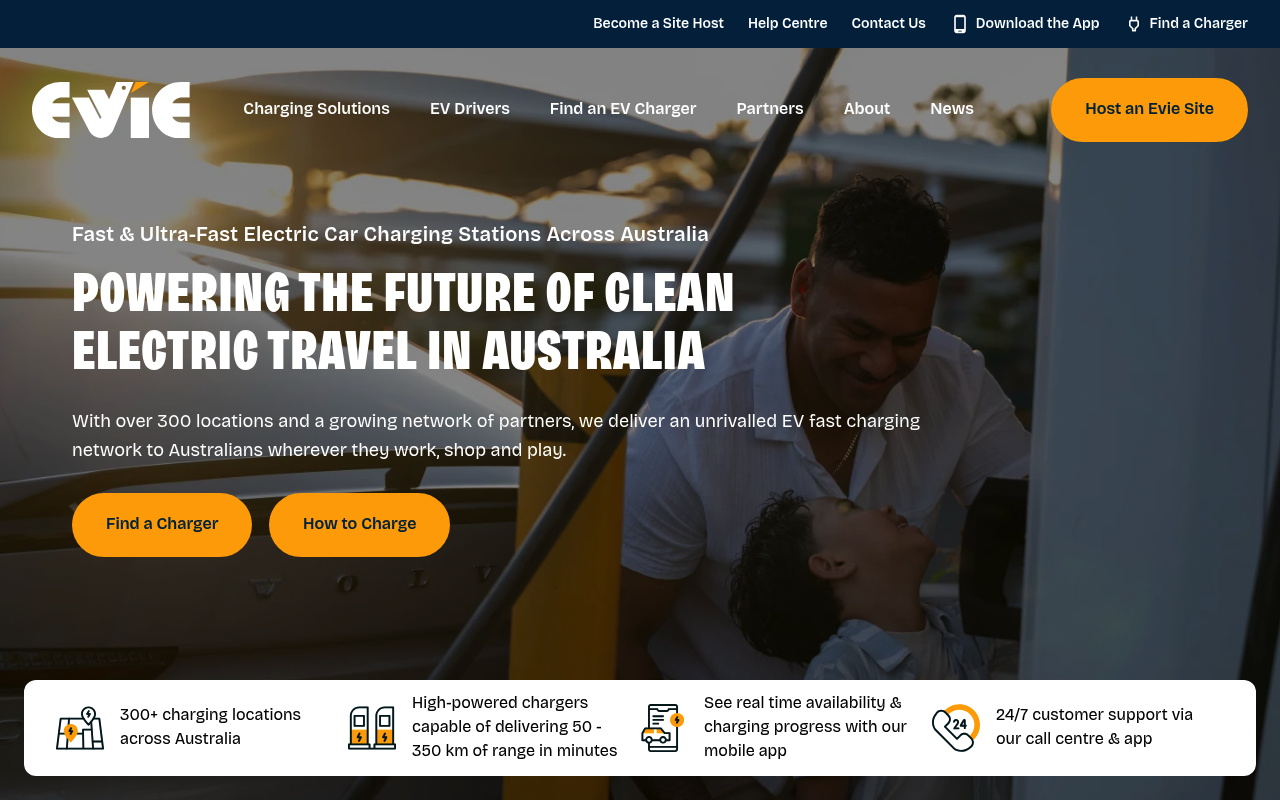
Evie Networks
Evie Networks is an Australian electric-vehicle charging infrastructure company, founded in 2017 and backed by the St Baker Energy Innovation Fund, that owns and operates one of the country's largest DC fast and ultrafast public charging networks across 300+ locations in every state and territory. It sits downstream of the electricity retail market as a charge point operator (CPO) and e-mobility service provider, buying energy and reselling it as charging sessions to drivers and fleets, and it also builds and operates charging assets for site hosts, councils, dealerships and commercial property owners. Its API posture is closed: as of 2026-07-27 there is no developer portal, no published API documentation, no OpenAPI or other machine-readable contract, and no named support for the EV charging interoperability standards (OCPP, OCPI, ISO 15118). Evie is not a designated data holder under Australia's Consumer Data Right energy regime — the CDR Register's public energy data-holder brand summary lists 84 brands and Evie is not among them — so the statutory data mandate that produced identical APIs across Australian banks and energy retailers does not reach the EV charging layer at all. A live production API host exists at api.goevie.com.au serving the Evie Charging mobile app, but it is undocumented, unadvertised and returns a Google Cloud Endpoints 404 to anonymous callers. Neither consumer charging-session data nor network/market data is published through any documented public interface; charger location data reaches developers only through third-party aggregators.
Evie Networks is profiled on the APIs.io network. Tagged areas include Energy, Australia, EV Charging, Electricity, and Utilities.
Evie Networks’ developer surface includes engineering blog, support, FAQ, and 13 more developer resources.
Kin Score
 Kin Score
How this is scored →
Kin Score
How this is scored →scored 2026-10-17 · rubric v0.24.0
Security Posture 1
Authentication, domain security, vulnerability disclosure, and trust-center signals.
Resources
Agent Surfaces 1
MCP servers, agent skills, and machine-readable catalogs
Design & Contract 1
Pagination, idempotency, versioning, errors, and events
Build 1
SDKs, sample code, and the tooling you integrate with
Access & Security 1
Authentication, authorization, and security posture
Operate 3
Status, limits, changes, and where to get help
Commercial 2
Pricing, plans, and the legal terms of use
Company 6
The organization behind the API
Other 1
Properties that don't map to a standard resource type
Source (apis.yml)
Work with this as data
Every provider here is available over the APIs.io API and to AI agents over MCP.