Ericsson
Ericsson (Telefonaktiebolaget LM Ericsson) is a Swedish multinational networking and telecommunications equipment vendor headquartered in Kista, Stockholm. Founded in 1876, the company supplies mobile and fixed network infrastructure to communication service providers worldwide and operates across three product areas: Networks (5G RAN, 5G Core, Cloud RAN, transport), Cloud Software & Services (OSS/BSS, orchestration, billing, charging, analytics), and Enterprise Wireless Solutions (private 5G via Cradlepoint). Ericsson holds more than 60,000 granted patents and operates 21 R&D centers, with networks that carry roughly 40 percent of the world's mobile data traffic. In 2024 Ericsson and twelve major operators — AT&T, Bharti Airtel, Deutsche Telekom, KDDI, Orange, Reliance Jio, Singtel, Telefonica, Telstra, T-Mobile, Verizon, and Vodafone — closed Aduna, a 50:50 joint venture that aggregates CAMARA-aligned network APIs (SIM Swap, Number Verification, Quality on Demand, Device Location, Device Reachability, Scam Signal, Call Forwarding Signal, Connectivity Insights, OTP SMS) and exposes them through hyperscaler and CPaaS channel partners (Microsoft Azure Marketplace, Google Cloud, Vonage, Sinch, Infobip). Ericsson also owns Vonage (acquired 2022), which operates the public-facing developer portal for many of these network capabilities, and runs the Ericsson Intelligent Automation Platform (EIAP) for ORAN-aligned rApp development. Ericsson does not publish a single consolidated developer portal or canonical OpenAPI catalog at ericsson.com — its programmable surface is delivered indirectly through Aduna, Vonage, and channel partners, and most of its public GitHub presence is research tooling and infrastructure software (CodeChecker, CodeCompass, ecchronos) rather than developer-facing APIs.
Ericsson is profiled on the APIs.io network. Tagged areas include Telecommunications, Networks, 5G, 5G RAN, and 5G Core.
Ericsson’s developer surface includes engineering blog, GitHub presence, YouTube channel, and 18 more developer resources.
Kin Score
 Kin Score
How this is scored →
scored 2026-11-06 · rubric v0.27.0
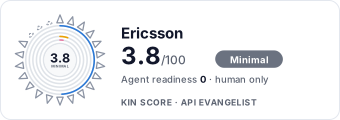 It updates itself when the score changes. Paste this where you link to your API docs:
<a href="https://apis.io/providers/ericsson/"><img src="https://apis.io/badge/ericsson/card.svg" alt="Ericsson on APIs.io — Kin Score by API Evangelist"></a>Other styles, a README pill and a shields.io endpoint are on the badge page.
- Machine-Readable Contract +18 pts — api_specs includes an OpenAPI document
- MCP Server +12 pts — deployment.mode + probe verdict on the mcp/ manifest, not the pointer; an unprobed slug falls back to authorship
- Agentic Access Contract +10 pts — agentic_access artifact present (x-agentic-access), graded by author
- Machine-Readable Auth +10 pts — a served openid-configuration/oauth-authorization-server carrying `issuer` (served), else the securitySchemes class in the provider OpenAPIs — bound (mutualTLS, DPoP, Signature) > negotiable (oauth2 authorizationCode/clientCredentials, openIdConnect) > bearer (http bearer, apiKey)
- Idempotency +9 pts — OpenAPI mutating operations declare an idempotency key — a header, a request-body property, or a named de-duplication token whose own description says so (verified); else common[].type matches /idempoten/i (documented)
- Stable Error Semantics +8 pts — OpenAPI $refs a shared error schema across 4xx/5xx responses (verified), else common[].type includes ErrorCatalog / ErrorCodes / DeclineCodes
- Contract Quality scores 0.0 — up to +25.0 composite points
- Access Clarity scores 0.0 — up to +20.0 composite points
- Developer Ergonomics scores 2.4 — up to +19.5 composite points
Markets this provider is in provisional
The Kin Score Market layer reads a provider inside its market: its position, and how deep its integrations go. Depth is only comparable within a position. Provisional and unweighted: not part of the Kin Score or agent readiness.
| Market | Position | Depth | Registered MCP server | Declares compatibility |
|---|---|---|---|---|
| Network Edge (CDN, networking, peering, edge compute) | standard | 55.4 | - | 1 |
| Vulnerability Disclosure (CVE Numbering Authorities, FIRST member teams; CISA KEV exposure) | standard | 55.4 | - | 1 |
| NIST CMVP FIPS 140 Validated Cryptographic Modules (FIPS 140-1 / 140-2 / 140-3) | standard | 55.4 | - | 1 |
Registered MCP server and declares compatibility are report only — not weighted. Undeclared means we found nothing we can read, so there is no number: we never infer integrations.
Standards implemented 1
Standards this provider implements or carries. De facto ones are profiled and measured by the API Commons; formal ones come from the standards directory and are linked by the provider's own tags. The evidence column says how each claim was established — not that it was made.
Security Posture 1
Authentication, domain security, vulnerability disclosure, and trust-center signals.
Resources
Build 3
SDKs, sample code, and the tooling you integrate with
Access & Security 1
Authentication, authorization, and security posture
Learn 1
Tutorials, courses, talks, and written guidance
Company 10
The organization behind the API
Scroll for all 10
Other 6
Properties that don't map to a standard resource type
Source (apis.yml)
Work with this as data
Every provider here is available over the APIs.io API and to AI agents over MCP.