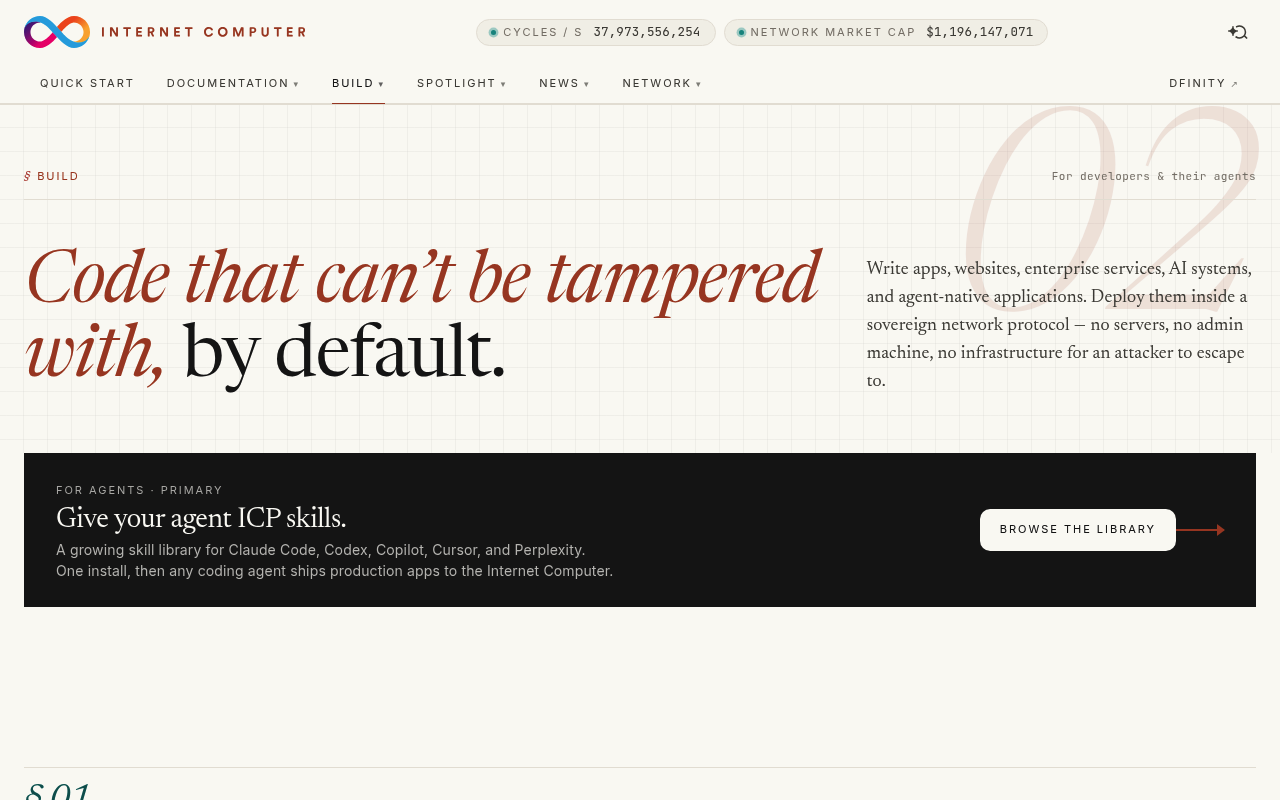
DFINITY
The DFINITY Foundation is a Swiss-based not-for-profit research organization that created and stewards the Internet Computer Protocol (ICP), a public, decentralized "frontier cloud" that hosts software and data entirely inside a mathematical network protocol. Applications run as canisters (WebAssembly smart contracts with persistent state, native HTTP, and a reverse gas model paid in Cycles) that are tamperproof, unstoppable, and free from vendor lock-in. ICP uses Chain Key cryptography and Chain Fusion to transact natively on Bitcoin and Ethereum without bridges, and is governed on-network by the Network Nervous System (NNS). DFINITY publishes first-party developer tooling — JavaScript/TypeScript agent libraries under the @dfinity npm scope, Rust agent and Canister Developer Kit crates, the icp/dfx CLIs, and an AI agent skills library — plus a public HTTP interface for reading from and calling canisters.
DFINITY is listed with 1 API on the APIs.io network. Tagged areas include Company, Blockchain, Internet Computer, ICP, and Web3.
DFINITY’s developer surface includes documentation, API reference, getting-started guide, engineering blog, support, CLI, and 11 more developer resources.
Kin Score
 Kin Score
How this is scored →
Kin Score
How this is scored →scored 2026-10-17 · rubric v0.24.0
APIs 1
Individual APIs this provider publishes, each with its own machine-readable definition.
Internet Computer HTTP Interface
The public HTTP interface (agent/gateway API) for reading state from and submitting calls to Internet Computer canisters, consumed by the @dfinity agent libraries, the Rust ic-a...
MCP Servers 1
Model Context Protocol servers that expose these APIs to AI agents.
Security Posture 2
Authentication, domain security, vulnerability disclosure, and trust-center signals.
Resources
Get Started 2
Portal, sign-up, and the first successful call
Documentation 2
Reference material describing how the API behaves
Agent Surfaces 2
MCP servers, agent skills, and machine-readable catalogs
Build 4
SDKs, sample code, and the tooling you integrate with
Access & Security 3
Authentication, authorization, and security posture
Operate 2
Status, limits, changes, and where to get help
Company 2
The organization behind the API
Source (apis.yml)
Work with this as data
Every provider here is available over the APIs.io API and to AI agents over MCP.