
Datalastic
Datalastic is a maritime data API providing real-time AIS vessel tracking, historical ship movements, vessel specifications, and global port data over a simple REST interface. A database of 750,000+ ships is queryable by MMSI, IMO, or UUID for live position, speed, course, heading, destination, and ETA, plus zone traffic monitoring around any coordinate or port, up to 31 days of historical track per request, vessel and port finder search, and asynchronous bulk reports. Access is subscription-based with a monthly credit model and api-key authentication.
Datalastic publishes 6 API contracts indexed on the APIs.io network, including Historical API, Live Tracking API, Ports API, and 3 more. Tagged areas include Vessel Tracking, Maritime, AIS, Ships, and Ports.
Datalastic’s developer surface includes authentication, documentation, API reference, pricing, engineering blog, and 7 more developer resources.
Kin Score
 Kin Score
How this is scored →
Kin Score
How this is scored →scored 2026-10-23 · rubric v0.25.0
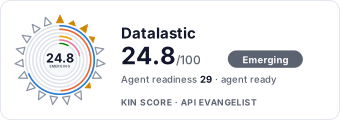 It updates itself when the score changes. Paste this where you link to your API docs:
<a href="https://apis.io/providers/datalastic/"><img src="https://apis.io/badge/datalastic/card.svg" alt="Datalastic on APIs.io — Kin Score by API Evangelist"></a>Other styles, a README pill and a shields.io endpoint are on the badge page.
Markets this provider is in provisional
The Kin Score Market layer reads a provider inside its market: its position, and how deep its integrations go. Depth is only comparable within a position. Provisional and unweighted: not part of the Kin Score or agent readiness.
| Market | Position | Depth | Registered MCP server | Declares compatibility |
|---|---|---|---|---|
| Maritime Logistics (ocean shipping, eBL, ports) | undeclared | - | 1 | - |
Registered MCP server and declares compatibility are report only — not weighted. Undeclared means we found nothing we can read, so there is no number: we never infer integrations.
Standards implemented 1
Standards this provider implements or carries. De facto ones are profiled and measured by the API Commons; formal ones come from the standards directory and are linked by the provider's own tags. The evidence column says how each claim was established — not that it was made.
APIs 6
Individual APIs this provider publishes, each with its own machine-readable definition.
Datalastic Historical API
Past AIS positions for vessels and zones.
Datalastic Live Tracking API
Real-time AIS vessel position and voyage data.
Datalastic Ports API
Global maritime port search.
Datalastic Reports and Usage API
Asynchronous bulk report jobs and account usage statistics.
Datalastic Vessel Data API
Static ship specifications and vessel search.
Datalastic Zone Traffic API
Vessels within a radius of a point, port, or moving vessel.
Open Collections 7
Open, tool-agnostic API collections (OpenAPI-derived and Bruno).
Datalastic Maritime Historical API
OPEN COLLECTIONDatalastic Maritime Historical Live Tracking API
OPEN COLLECTIONDatalastic Maritime Historical Ports API
OPEN COLLECTIONDatalastic Maritime Historical Reports and Usage API
OPEN COLLECTIONDatalastic Maritime Historical Vessel Data API
OPEN COLLECTIONDatalastic Maritime Historical Zone Traffic API
OPEN COLLECTIONDatalastic Maritime API
OPEN COLLECTIONScroll for all 7
MCP Servers 1
Model Context Protocol servers that expose these APIs to AI agents.
Pricing Plans 1
Published pricing tiers and plan structures.
Rate Limits 1
Documented rate limits and quota policies.
Datalastic Rate Limits
RATE LIMITSFinOps 1
Cost, billing, and metering signals for API financial operations.
Datalastic Finops
FINOPSSecurity Posture 2
Authentication, domain security, vulnerability disclosure, and trust-center signals.
Agentic Access 1
Recommended x-agentic-access execution contracts for AI agents.
Resources
Documentation 2
Reference material describing how the API behaves
Agent Surfaces 1
MCP servers, agent skills, and machine-readable catalogs
Access & Security 2
Authentication, authorization, and security posture
Operate 1
Status, limits, changes, and where to get help
Commercial 3
Pricing, plans, and the legal terms of use
Company 3
The organization behind the API
Source (apis.yml)
Work with this as data
Every provider here is available over the APIs.io API and to AI agents over MCP.