DataDome is a real-time bot and online fraud protection platform that inspects every web, mobile, and API request and decides — within milliseconds — whether it should be allowed, challenged, or blocked. The platform combines a JavaScript tag and mobile SDKs (iOS, Android, React Native, Flutter) on the client side with 40+ server-side integrations (Nginx, Apache, IIS, OpenResty, HAProxy, Cloudflare Workers, AWS CloudFront, Fastly, Bunny, Node.js, Python ASGI, Go, Ruby, Java, ASP.NET Core, Kong, Apigee, Tyk, Traefik) that forward signals to DataDome's decisioning service. Products in the platform include Bot Protect, Account Protect, Ad Protect, Page Protect, Priority Protect, Agentic Trust (governing AI agent traffic), and DDoS Protect.
DataDome publishes 17 API contracts indexed on the APIs.io network, including Account API, AccountProtect API, Endpoints API, and 14 more. Tagged areas include Bot Mitigation, Fraud Prevention, Account Protection, Ad Fraud, and DDoS.
The DataDome catalog on APIs.io includes 1 Spectral governance ruleset.
DataDome’s developer surface includes authentication, documentation, API reference, engineering blog, status page, and 12 more developer resources.
Regulatory Posture applies to this provider. Its tags matched the
Horizontal (data, software, accessibility, platform) regime, so
Regulatory Posture carries 15 points of the composite.
If this regime is wrong for your business, say so on your
provider repo — the
applicability map is public and we will correct it.
Create-or-Update Ergonomics applies to this provider. This API accepts writes, so it
carries 10 points of the composite. It is scored from the published contracts
themselves: whether a caller can create-or-update in one call, whether the write accepts a key the caller already
holds, and whether the response says which branch ran. Without that, every write needs a search-and-branch in
front of it, and the first time that check is skipped a duplicate record is created.
Scored against the observed mean rather than raw — a provider at the catalog average is unchanged by this facet,
not penalised by it.
The six quality facets above are damped to 75 points between them,
because the conditional facet above carries the other
25. That is why each facet's contribution is shown against a damped
maximum: raising a quality facet moves the composite by 75% of its nominal
weight, not 100%. The full arithmetic is at apis.io/rating/.
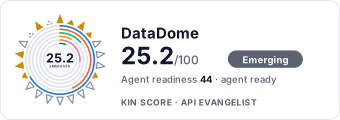
Show this score on your site.
It updates itself when the score changes. Paste this where you link to your API docs:
<a href="https://apis.io/providers/datadome/"><img src="https://apis.io/badge/datadome/card.svg" alt="DataDome on APIs.io — Kin Score by API Evangelist"></a>
Other styles, a README pill and a shields.io endpoint are on the badge page.
Raise your score.
Agent readiness — checks not met, largest first (exact, from this profile):
Idempotency+9 pts — OpenAPI mutating operations declare an idempotency key — a header, a request-body property, or a named de-duplication token whose own description says so (verified); else common[].type matches /idempoten/i (documented)
Stable Error Semantics+8 pts — OpenAPI $refs a shared error schema across 4xx/5xx responses (verified), else common[].type includes ErrorCatalog / ErrorCodes / DeclineCodes
A2A Agent Card+8 pts — a2a/-a2a.yml manifest, graded on conformance.grade against A2A 1.0.0
Request/Response Examples+7 pts — share of operations carrying request/response examples; else an Examples / Code Samples link
Typed Event Surface+6 pts — AsyncAPI document, OR webhooks/callbacks objects in the as-published OpenAPI, OR common[].type includes Webhooks
Documented Reversibility+6 pts — a reversal operation in the contract, graded up when a window is documented too
5 more unmet checks in the Agent Readiness table above.
Kin Score — facets with the most composite points still available (weight × headroom):
The Kin Score Market layer reads a provider inside its market:
its position, and how deep its integrations go. Depth is only comparable within a position. Provisional and unweighted:
not part of the Kin Score or agent readiness.
Registered MCP server and declares compatibility are report only — not weighted.
Undeclared means we found nothing we can read, so there is no number: we never infer integrations.
Standards this provider implements or carries. De facto ones are profiled and measured by the API Commons; formal ones come from the standards directory and are linked by the provider's own tags. The evidence column says how each claim was established — not that it was made.
Bot Protect is DataDome's core bot management product, scoring every request against the platform's threat intelligence and machine-learning models to classify and block automat...
Account Protect targets account takeover, fake account creation, and post-login abuse using behavioral, device, and credential signals layered on top of the Bot Protect decision...
Ad Protect filters invalid traffic from ad-supported properties and protects publishers and advertisers from automated click and impression fraud, leveraging the same signal pip...
Agentic Trust is DataDome's product for managing AI-agent traffic, letting customers identify, authenticate, and govern interactions from autonomous agents and LLM-driven crawle...
DDoS Protect mitigates application-layer denial-of-service attacks using the same edge-distributed signal pipeline as Bot Protect, defending APIs and web properties against high...
The DataDome JS tag collects browser, device, and behavioral signals that are forwarded to the DataDome decisioning service. The tag is configured per property and loaded asynch...
DataDome ships 40+ server-side integrations (web servers, CDNs, application frameworks, API gateways) that forward each request to the DataDome decisioning service and apply the...
Native iOS and Android SDKs (with React Native and Flutter wrappers) integrate with common HTTP libraries (OkHttp, Alamofire, Axios, Dio) so DataDome verdicts can be applied to ...
Not yet checked against DataDome's own pricing page. Compiled by API Evangelist on 2026-05-22; confirm before you rely on a figure. A free plan or tier is listed.
Calls without X-API-Key need no key. Calls with it need a paid plan — get a key.
Get an API key
Free tier, no form to fill in. Signing in shares your email address with us — we
store it to create your key and to recognise you if you sign in with another
provider. See our Privacy Policy and
Terms.
 Kin Score
How this is scored →
 It updates itself when the score changes. Paste this where you link to your API docs: