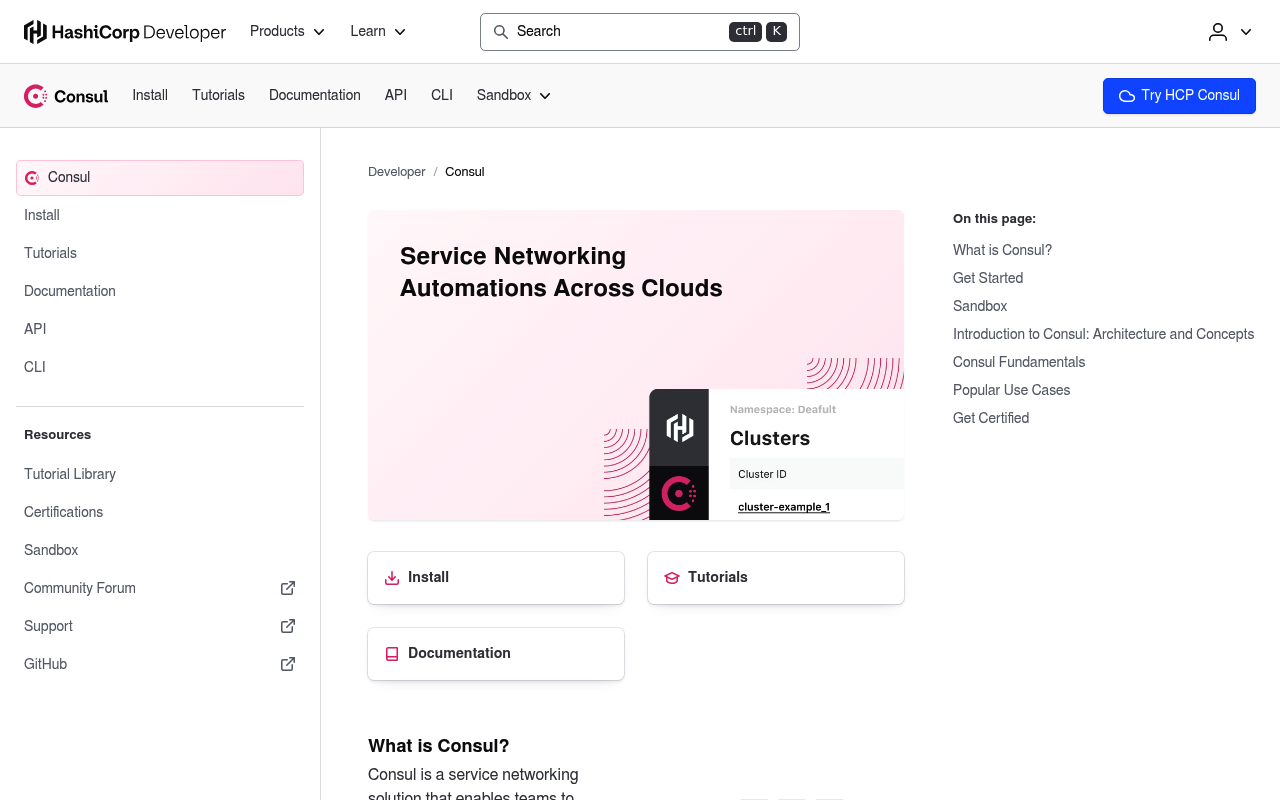
Consul Connect website screenshot

Consul Connect

Consul Connect is the service mesh subsystem of HashiCorp Consul. Connect provides service identity, mTLS, traffic authorization via intentions, and L7 traffic management through Envoy sidecar proxies. Consul Connect ships with a built-in certificate authority that can also be backed by Vault or external PKI, supports mesh, terminating, ingress, and API gateways, and spans virtual machines, Kubernetes, AWS ECS, AWS Lambda, and Nomad runtimes. Operators interact with Connect through the consul CLI, the HTTP API, configuration entries, and Kubernetes Custom Resource Definitions.

Consul Connect publishes 2 APIs on the APIs.io network: CA API and Intentions API. Tagged areas include Consul, Envoy, HashiCorp, Intentions, and Kubernetes.

The Consul Connect catalog on APIs.io includes 1 JSON-LD context and 2 Spectral governance rulesets.

Consul Connect’s developer surface includes authentication, documentation, changelog, engineering blog, and 14 more developer resources.

36.4/100 thin ▬ flat Agent 20/100 agent aware Full breakdown ↓
scored 2026-09-08 · rubric v0.20.0
AccessFreemiumSelf serve⚡ Free to try
1 APIs
ConsulEnvoyHashiCorpIntentionsKubernetesmTLSService MeshSidecarZero Trust

Kin Score

Kin Score Kin Score How this is scored →
scored 2026-09-08 · rubric v0.20.0
Create-or-Update Ergonomics applies to this provider. This API accepts writes, so it carries 10 points of the composite. It is scored from the published contracts themselves: whether a caller can create-or-update in one call, whether the write accepts a key the caller already holds, and whether the response says which branch ran. Without that, every write needs a search-and-branch in front of it, and the first time that check is skipped a duplicate record is created. Scored against the observed mean rather than raw — a provider at the catalog average is unchanged by this facet, not penalised by it.
Improve this rating by publishing the missing artifacts — every area above can be raised, and the full rubric is at apis.io/rating/. Every facet and dimension name above is a link: it opens that measurement's own page — what it means, the exact checks that feed it, how the whole catalog distributes on it, and the providers at the top of it. This rating is computed from github.com/api-evangelist/consul-connect: open an issue to ask a question, or submit a pull request to add artifacts. Submit an artifact on GitHub — free → Manage your own listing — the Influence plan, $499/mo →

APIs 4

Individual APIs this provider publishes, each with its own machine-readable definition.

Consul Connect Configuration Entries

Consul Connect configuration entries (service-defaults, service-resolver, service-router, service-splitter, service-intentions, mesh, proxy-defaults) that declaratively configur...

Consul Connect Gateways

Consul Connect supports four gateway types for traffic flowing into and out of the mesh: mesh gateways for cross-datacenter and cross-partition traffic, ingress gateways for Nor...

Consul Connect CA API

Certificate authority management

Consul Connect Intentions API

Service-to-service traffic authorization

Open Collections 4

Open, tool-agnostic API collections (OpenAPI-derived and Bruno).

API Collection

OPEN COLLECTION

Pricing Plans 1

Published pricing tiers and plan structures.

Rate Limits 1

Documented rate limits and quota policies.

Consul Connect Rate Limits

4 limits

RATE LIMITS

FinOps 1

Cost, billing, and metering signals for API financial operations.

Semantic Vocabularies 1

JSON-LD contexts and semantic vocabularies used across these APIs.

Consul Connect Context

0 classes · 4 properties

JSON-LD

Spectral Rules 2

Spectral governance rulesets for linting and validating these APIs.

Consul Connect API Rules

5 rules · 3 warnings 2 info

SPECTRAL

Consul Connect API Rules

6 rules · 3 errors 3 warnings

SPECTRAL

JSON Schema 1

Standalone JSON Schema definitions for this provider's data models.

Consul Connect Intention

9 properties

JSON SCHEMA

Security Posture 2

Authentication, domain security, vulnerability disclosure, and trust-center signals.

Consul Connect Authentication

apiKey · 1 scheme

SECURITY

Consul Connect Domain Security

TLSv1.3 · HSTS · DMARC

SECURITY

Agentic Access 1

Recommended x-agentic-access execution contracts for AI agents.

Consul Connect Agentic Access

9 operations · 3 acting

9 operations · 3 acting

AGENTIC

Resources

Documentation 4

Reference material describing how the API behaves

Agent Surfaces 1

MCP servers, agent skills, and machine-readable catalogs

Design & Contract 3

Pagination, idempotency, versioning, errors, and events

Build 3

SDKs, sample code, and the tooling you integrate with

Access & Security 2

Authentication, authorization, and security posture

Operate 2

Status, limits, changes, and where to get help

Commercial 1

Pricing, plans, and the legal terms of use

Company 2

The organization behind the API

Source (apis.yml)

apis.yml Raw ↑
aid: consul-connect
url: https://raw.githubusercontent.com/api-evangelist/consul-connect/refs/heads/main/apis.yml
name: Consul Connect
kind: opensource
description: Consul Connect is the service mesh subsystem of HashiCorp Consul. Connect provides service identity, mTLS, traffic
  authorization via intentions, and L7 traffic management through Envoy sidecar proxies. Consul Connect ships with a built-in
  certificate authority that can also be backed by Vault or external PKI, supports mesh, terminating, ingress, and API gateways,
  and spans virtual machines, Kubernetes, AWS ECS, AWS Lambda, and Nomad runtimes. Operators interact with Connect through
  the consul CLI, the HTTP API, configuration entries, and Kubernetes Custom Resource Definitions.
deliveryModel:
  model: unknown
  open_source: unknown
  commercial: false
  callable_host: false
  label: Delivery model not determined — needs a product licence on record
  confidence: low
  source:
  - openapi
  - repository-unlicensed
  generated: '2026-08-28'
  method: derived
accessModel:
  pricing: freemium
  onboarding: self-serve
  trial: false
  try_now: true
  public: false
  label: Freemium · Self-serve signup
  confidence: medium
  source:
  - plans
  - authentication
  - security
  - url: https://www.consul.io/
    status: 308
    note: declared website redirects to https://developer.hashicorp.com/consul — a different registrable domain (consul.io
      -> hashicorp.com), possible rename or acquisition (probed 2026-09-03, roadmap#169)
  generated: '2026-09-03'
  method: derived
image: https://kinlane-images.s3.amazonaws.com/shared/apis-json/icons/consul-connect.png
tags:
- Consul
- Envoy
- HashiCorp
- Intentions
- Kubernetes
- mTLS
- Service Mesh
- Sidecar
- Zero Trust
created: '2025-01-01'
modified: '2026-05-19'
specificationVersion: '0.23'
apis:
- aid: consul-connect:consul-connect-config-entries
  name: Consul Connect Configuration Entries
  description: Consul Connect configuration entries (service-defaults, service-resolver, service-router, service-splitter,
    service-intentions, mesh, proxy-defaults) that declaratively configure mesh behavior. Configuration entries are managed
    via the /v1/config API and via Kubernetes Custom Resource Definitions when running on Kubernetes.
  humanURL: https://developer.hashicorp.com/consul/docs/connect/config-entries
  baseURL: https://developer.hashicorp.com
  tags:
  - Configuration Entries
  - CRD
  - Kubernetes
  - L7 Routing
  properties:
  - type: Documentation
    url: https://developer.hashicorp.com/consul/docs/connect/config-entries
  - type: Reference
    url: https://developer.hashicorp.com/consul/docs/connect/config-entries/service-defaults
  - type: Reference
    url: https://developer.hashicorp.com/consul/docs/connect/config-entries/service-router
  - type: Reference
    url: https://developer.hashicorp.com/consul/docs/connect/config-entries/service-splitter
  x-features:
  - service-defaults to set protocol and timeouts
  - service-router for L7 path/header/method routing
  - service-splitter for canary and blue/green rollouts
  - service-resolver for failover and subsets
  - mesh-wide configuration via the mesh entry
  - Kubernetes CRDs for declarative mesh management
  x-useCases:
  - Implementing canary deployments via service-splitter
  - Routing traffic by header for tenant isolation
  - Centralizing TLS and protocol defaults
- aid: consul-connect:consul-connect-gateways
  name: Consul Connect Gateways
  description: 'Consul Connect supports four gateway types for traffic flowing into and out of the mesh: mesh gateways for
    cross-datacenter and cross-partition traffic, ingress gateways for North-South entry, terminating gateways for access
    to non-mesh services, and the Consul API Gateway implementing the Kubernetes Gateway API.'
  humanURL: https://developer.hashicorp.com/consul/docs/connect/gateways
  baseURL: https://developer.hashicorp.com
  tags:
  - API Gateway
  - Gateways
  - Ingress
  - Mesh Gateway
  - Terminating Gateway
  properties:
  - type: Documentation
    url: https://developer.hashicorp.com/consul/docs/connect/gateways
  - type: Reference
    url: https://developer.hashicorp.com/consul/docs/connect/gateways/mesh-gateway
  - type: Reference
    url: https://developer.hashicorp.com/consul/docs/connect/gateways/ingress-gateway
  - type: Reference
    url: https://developer.hashicorp.com/consul/docs/connect/gateways/terminating-gateway
  - type: Reference
    url: https://developer.hashicorp.com/consul/docs/api-gateway
  x-features:
  - Mesh gateways for WAN federation and partition crossing
  - Ingress gateways for L4/L7 ingress with TLS
  - Terminating gateways for non-mesh service access
  - API Gateway implementing the Kubernetes Gateway API
  x-useCases:
  - Federate Consul across datacenters securely
  - Expose mesh services to external clients with TLS
  - Allow mesh services to call legacy non-mesh endpoints
- aid: consul-connect:consul-connect-ca-api
  name: Consul Connect CA API
  description: Certificate authority management
  humanURL: https://developer.hashicorp.com/consul/api-docs/connect
  baseURL: http://localhost:8500/v1
  tags:
  - CA
  properties:
  - type: OpenAPI
    url: openapi/consul-connect-ca-api-openapi.yml
  - type: Documentation
    url: https://developer.hashicorp.com/consul/api-docs/connect
  - type: Reference
    url: https://developer.hashicorp.com/consul/api-docs/connect/intentions
  - type: Reference
    url: https://developer.hashicorp.com/consul/api-docs/connect/ca
  - type: JSONSchema
    url: json-schema/consul-connect-intention-schema.json
- aid: consul-connect:consul-connect-intentions-api
  name: Consul Connect Intentions API
  description: Service-to-service traffic authorization
  humanURL: https://developer.hashicorp.com/consul/api-docs/connect
  baseURL: http://localhost:8500/v1
  tags:
  - Intentions
  properties:
  - type: OpenAPI
    url: openapi/consul-connect-intentions-api-openapi.yml
  - type: Documentation
    url: https://developer.hashicorp.com/consul/api-docs/connect
  - type: Reference
    url: https://developer.hashicorp.com/consul/api-docs/connect/intentions
  - type: Reference
    url: https://developer.hashicorp.com/consul/api-docs/connect/ca
  - type: JSONSchema
    url: json-schema/consul-connect-intention-schema.json
common:
- type: CodeOfConduct
  url: https://github.com/hashicorp/.github/blob/master/CODE_OF_CONDUCT.md
- type: ContributionGuide
  url: https://github.com/hashicorp/consul/blob/main/.github/CONTRIBUTING.md
- type: AgenticAccess
  url: agentic-access/consul-connect-agentic-access.yml
- type: DomainSecurity
  url: security/consul-connect-domain-security.yml
- type: Authentication
  url: authentication/consul-connect-authentication.yml
- type: Website
  url: https://www.consul.io/
- type: JSONLD
  url: json-ld/consul-connect-context.jsonld
- type: JSONSchema
  url: json-schema/consul-connect-intention-schema.json
- type: Vocabulary
  url: vocabulary/consul-connect-vocabulary.yml
- type: SpectralRules
  url: rules/consul-connect-rules.yml
- type: Documentation
  url: https://developer.hashicorp.com/consul/docs/connect
- type: Documentation
  url: https://developer.hashicorp.com/consul/api-docs/connect
- type: GitHubRepository
  url: https://github.com/hashicorp/consul
- type: GitHubOrganization
  url: https://github.com/hashicorp
- type: Issue Tracker
  url: https://github.com/hashicorp/consul/issues
- type: ChangeLog
  url: https://github.com/hashicorp/consul/releases
- type: License
  url: https://github.com/hashicorp/consul/blob/main/LICENSE
- url: https://www.hashicorp.com/blog/feed.xml
  type: Blog
maintainers:
- FN: Kin Lane
  email: kin@apievangelist.com
x-parent: consul
x-relationship: product

Work with this as data

Every provider here is available over the APIs.io API and to AI agents over MCP.

MCP server

One button, every client — Claude, Cursor, VS Code and the rest.

https://apis.io/mcp

Tools for providers

9 MCP tools reach this
  • find_providersBrowse and filter every provider in the catalog.
  • get_provider_artifactsEvery artifact this provider publishes, grouped by type.
  • get_provider_operationsEvery operation across all of their OpenAPIs — one call instead of parsing every spec.
  • get_provider_toolsEvery MCP tool they ship, with the operation each wraps.
  • get_provider_evidenceHow each part of their score was established. Free — the basis for a claim should not sit behind it.
  • get_provider_ratingPRO — composite, band, trend and facet scores.
  • apis_io_searchSTART HERE — APIs, providers and tags for one query, each with its total.
  • resolveTurn a domain, URL or GitHub org into the provider it belongs to.
  • find_cohortsEvery scored population of providers in the catalog.
All 92 tools →

Call it yourself

curl for this page
This provider
curl "https://apis.io/api/v1/providers/consul-connect"
All providers
curl "https://apis.io/api/v1/providers?limit=25"
Every operation they expose
curl "https://apis.io/api/v1/providers/consul-connect/operations?limit=25"
How their score was established
curl "https://apis.io/api/v1/providers/consul-connect/evidence"

Discovery needs no key. Ratings and market analysis are Pro.

Get an API key

Free tier, no form to fill in. Signing in shares your email address with us — we store it to create your key and to recognise you if you sign in with another provider. See our Privacy Policy and Terms.

A second provider on the same verified email joins the account you already have.
