Conductor OSS
Conductor OSS is the Netflix-founded, Orkes-stewarded open source workflow and agentic AI orchestration platform. It provides a durable, event-driven workflow engine for coordinating microservices, long-running tasks, human approvals, and LLM-powered agents across any language or cloud, with first class support for HTTP, gRPC, Kafka, AMQP, SQS, and MCP-based tool calling.
Conductor OSS publishes 5 API contracts indexed on the APIs.io network, including Events API, Metadata API, Tasks API, and 2 more. Tagged areas include AI Agents, Durable Execution, Event-Driven, Microservices, and Netflix.
The Conductor OSS catalog on APIs.io includes 1 Spectral governance ruleset.
Conductor OSS’s developer surface includes documentation, getting-started guide, GitHub presence, engineering blog, YouTube channel, pricing, developer portal, and 20 more developer resources.
Kin Score
 Kin Score
How this is scored →
scored 2026-11-06 · rubric v0.27.0
 It updates itself when the score changes. Paste this where you link to your API docs:
<a href="https://apis.io/providers/conductor-oss/"><img src="https://apis.io/badge/conductor-oss/card.svg" alt="Conductor OSS on APIs.io — Kin Score by API Evangelist"></a>Other styles, a README pill and a shields.io endpoint are on the badge page.
- MCP Server +12 pts — deployment.mode + probe verdict on the mcp/ manifest, not the pointer; an unprobed slug falls back to authorship
- Idempotency +9 pts — OpenAPI mutating operations declare an idempotency key — a header, a request-body property, or a named de-duplication token whose own description says so (verified); else common[].type matches /idempoten/i (documented)
- Stable Error Semantics +8 pts — OpenAPI $refs a shared error schema across 4xx/5xx responses (verified), else common[].type includes ErrorCatalog / ErrorCodes / DeclineCodes
- A2A Agent Card +8 pts — a2a/
-a2a.yml manifest, graded on conformance.grade against A2A 1.0.0 - Rate-Limit Signaling +7 pts — OpenAPI responses document X-RateLimit-* / RateLimit headers (verified), else a rate_limits artifact or RateLimits link (documented)
- Request/Response Examples +7 pts — share of operations carrying request/response examples; else an Examples / Code Samples link
- Access Clarity scores 23.7 — up to +15.3 composite points
- Contract Quality scores 44.2 — up to +14.0 composite points
- Operational Transparency scores 18.4 — up to +10.6 composite points
Standards implemented 1
Standards this provider implements or carries. De facto ones are profiled and measured by the API Commons; formal ones come from the standards directory and are linked by the provider's own tags. The evidence column says how each claim was established — not that it was made.
APIs 5
Individual APIs this provider publishes, each with its own machine-readable definition.
Conductor MCP Server
Conductor MCP is an official Model Context Protocol server for Orkes Conductor that exposes workflow execution, task management, and metadata operations as MCP tools so that LLM...
Conductor OSS Events API
The Events API from Conductor OSS — 1 operation(s) for events.
Conductor OSS Metadata API
The Metadata API from Conductor OSS — 4 operation(s) for metadata.
Conductor OSS Tasks API
The Tasks API from Conductor OSS — 5 operation(s) for tasks.
Conductor OSS Workflow API
The Workflow API from Conductor OSS — 9 operation(s) for workflow.
Open Collections 5
Open, tool-agnostic API collections (OpenAPI-derived and Bruno).
Conductor OSS REST Events API
OPEN COLLECTIONConductor OSS REST Events Metadata API
OPEN COLLECTIONConductor OSS REST Events Tasks API
OPEN COLLECTIONConductor OSS REST Events Workflow API
OPEN COLLECTIONConductor OSS REST API
OPEN COLLECTIONFeatures 7
Notable capabilities this provider offers.
Durable Workflow Execution
Workflow state is persisted at every step so executions survive worker restarts, server failover, and long human-in-the-loop waits.
Polyglot Workers
Tasks are executed by language-agnostic workers that poll the server, with official SDKs in Java, Python, Go, JavaScript / TypeScript, C#, Clojure, Ruby, and Rust.
System Tasks and Operators
Built-in HTTP, Kafka, JQ, wait, human approval, sub-workflow, fork, join, switch, do-while, and dynamic-fork operators compose workflows without writing code.
Agentic AI and LLM Orchestration
Native LLM tasks for 14+ providers, vector database integrations for RAG, MCP tool calling, and human-in-the-loop checkpoints make Conductor a runtime for agentic AI applications.
Event-Driven Triggers
Event handlers consume from Kafka, AMQP, SQS, NATS, and webhook sources to start workflows or complete tasks from external systems.
Horizontal Scalability
Stateless API servers and worker pools scale horizontally, with pluggable persistence (PostgreSQL, MySQL, Cassandra, Redis) and indexing (OpenSearch / Elasticsearch).
Operational Observability
Built-in metrics, structured logs, distributed tracing, and a Swagger UI on every server expose the workflow surface for operators.
Scroll for all 7
Spectral Rules 1
Spectral governance rulesets for linting and validating these APIs.
Conductor OSS API Rules
SPECTRALSecurity Posture 1
Authentication, domain security, vulnerability disclosure, and trust-center signals.
Agentic Access 1
Recommended x-agentic-access execution contracts for AI agents.
Use Cases 6
What developers build with this provider.
Microservices Orchestration
Coordinate sagas, compensations, retries, and timeouts across distributed microservices without bespoke orchestration code.
AI Agent Orchestration
Run production-grade agentic workflows with reasoning loops, tool calling, MCP integration, RAG retrieval, and human approvals.
Payment and Order Processing
Reliable long-running flows for payments, fulfillment, KYC, and onboarding — the reference example workload shipped by Conductor.
Data and ML Pipelines
Schedule and orchestrate ETL, model training, and inference pipelines with durable retries and conditional branching.
Human-in-the-Loop Approvals
Pause workflows on human tasks, capture approvals via UI or API, and resume execution deterministically.
Event-Driven Integration
Bridge message brokers and SaaS webhooks into deterministic workflows across the enterprise.
Integrations 9
Pre-built integrations with other platforms and tools.
Apache Kafka
System task and event-handler integration for Kafka topics.
AMQP / RabbitMQ
Built-in AMQP system task and event source.
AWS SQS
Native SQS event queue and system task module.
NATS
NATS event queue integration for triggering workflows.
PostgreSQL / MySQL / Cassandra / Redis
Pluggable persistence backends for workflow and task state.
OpenSearch / Elasticsearch
Pluggable indexing backends powering search and history.
AWS S3 / Azure Blob
External payload storage for large workflow inputs and outputs.
Model Context Protocol (MCP)
Official MCP server exposes Conductor to AI agents as tools.
gRPC
gRPC API surface alongside the REST API for high-performance clients.
Scroll for all 9
Solutions 3
Packaged solutions this provider offers.
Conductor OSS
Apache 2.0 open source workflow engine, self-hosted via Docker, Helm, or source build.
Orkes Developer Edition
Free hosted Conductor sandbox by Orkes with all enterprise features enabled for prototyping and learning.
Orkes Enterprise / Cloud
Fully managed Conductor on AWS, Azure, GCP, or on-prem with SOC2, RBAC, SSO, audit logs, and up to 99.99% availability SLA.
Resources
Get Started 3
Portal, sign-up, and the first successful call
Documentation 1
Reference material describing how the API behaves
Agent Surfaces 1
MCP servers, agent skills, and machine-readable catalogs
Build 12
SDKs, sample code, and the tooling you integrate with
Scroll for all 12
Access & Security 1
Authentication, authorization, and security posture
Learn 2
Tutorials, courses, talks, and written guidance
Operate 3
Status, limits, changes, and where to get help
Commercial 2
Pricing, plans, and the legal terms of use
Company 2
The organization behind the API
Source (apis.yml)
Conductor OSS API — frequently asked questions
Does Conductor OSS have an API?
Yes. APIs.io lists 5 APIs from Conductor OSS, including Conductor MCP Server, Conductor OSS Events API and Conductor OSS Metadata API, and 2 more.
Is there an OpenAPI specification for the Conductor OSS API?
Yes. APIs.io indexes 4 OpenAPI specifications for Conductor OSS, each linked for download from this page.
How do I authenticate with the Conductor OSS API?
Conductor OSS uses bearer-token authentication.
Is the Conductor OSS API ready for AI agents?
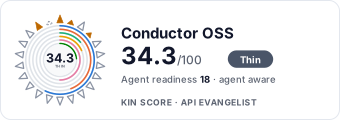
Conductor OSS has a Kin Score of 34.3 out of 100 (thin) and an Agent Readiness score of 18.4 (agent-aware), scored by API Evangelist on 2026-11-06.
Work with this as data
Every provider here is available over the APIs.io API and to AI agents over MCP.