Cloudability (an IBM Apptio product) is a cloud cost management and FinOps platform providing cost visibility, optimization recommendations, anomaly detection, and governance across AWS, Azure, Google Cloud, and other multi-cloud environments. The Cloudability API v3 is REST-oriented with JSON responses, HTTP basic authentication using an API token, cursor-style limit/offset pagination, and operations for reporting, business mappings, rightsizing recommendations, anomalies, vendor credentials, and views.
Cloudability is listed with 7 APIs on the APIs.io network, including API v3, and 6 more. Tagged areas include Cloud Cost Management, Cost Optimization, FinOps, Multi-Cloud, and Recommendations.
The Cloudability catalog on APIs.io includes 1 JSON-LD context and 1 Spectral governance ruleset.
Cloudability’s developer surface includes documentation, GitHub presence, training material, API reference, getting-started guide, support, engineering blog, and 34 more developer resources.
Regulatory Posture applies to this provider. Its tags matched the
Horizontal (data, software, accessibility, platform) regime, so
Regulatory Posture carries 15 points of the composite.
If this regime is wrong for your business, say so on your
provider repo — the
applicability map is public and we will correct it.
Create-or-Update Ergonomics could not be measured. We hold no machine-readable contract for
this provider to read, so there is nothing to measure a write surface against. Excluded rather than scored zero:
never-measured and measured-empty are different facts. Publishing an OpenAPI is what makes this facet — and
several others — scorable at all.
The six quality facets above are damped to 85 points between them,
because the conditional facet above carries the other
15. That is why each facet's contribution is shown against a damped
maximum: raising a quality facet moves the composite by 85% of its nominal
weight, not 100%. The full arithmetic is at apis.io/rating/.
Show this score on your site.
It updates itself when the score changes. Paste this where you link to your API docs:
<a href="https://apis.io/providers/cloudability/"><img src="https://apis.io/badge/cloudability/card.svg" alt="Cloudability on APIs.io — Kin Score by API Evangelist"></a>
Other styles, a README pill and a shields.io endpoint are on the badge page.
Raise your score.
Agent readiness — checks not met, largest first (exact, from this profile):
Idempotency+9 pts — OpenAPI mutating operations declare an idempotency key — a header, a request-body property, or a named de-duplication token whose own description says so (verified); else common[].type matches /idempoten/i (documented)
A2A Agent Card+8 pts — a2a/-a2a.yml manifest, graded on conformance.grade against A2A 1.0.0
Request/Response Examples+7 pts — share of operations carrying request/response examples; else an Examples / Code Samples link
10 more unmet checks in the Agent Readiness table above.
Kin Score — facets with the most composite points still available (weight × headroom):
The Kin Score Market layer reads a provider inside its market:
its position, and how deep its integrations go. Depth is only comparable within a position. Provisional and unweighted:
not part of the Kin Score or agent readiness.
Registered MCP server and declares compatibility are report only — not weighted.
Undeclared means we found nothing we can read, so there is no number: we never infer integrations.
Standards this provider implements or carries. De facto ones are profiled and measured by the API Commons; formal ones come from the standards directory and are linked by the provider's own tags. The evidence column says how each claim was established — not that it was made.
The Cloudability v3 API is the modern REST interface for the platform. It exposes resource-oriented endpoints for reporting, dimensions and metrics, business mappings, anomalies...
The legacy v1 API remains available for older integrations covering cost reporting and dimensions. Apptio recommends migrating to v3 for new integrations. v1 uses an api_key que...
Business Mappings define rule-based dimensions that allocate spend to cost centers, products, environments, or applications. The API lets callers list, create, update and delete...
The Rightsizing API surfaces machine-learning generated downsizing, modernization and termination recommendations for AWS EC2, RDS, EBS, Azure VMs and disks, and Google Compute ...
The Anomalies API exposes detected cost anomalies on dimensions such as service, account, and business mapping. Callers can query open anomalies, retrieve baseline / actual cost...
The Vendor Credentials API manages connections to AWS payer accounts, Azure billing scopes, GCP billing projects, OCI tenancies and other cloud vendors. It supports listing exis...
aid: cloudability
url: https://raw.githubusercontent.com/api-evangelist/cloudability/refs/heads/main/apis.yml
name: Cloudability
deliveryModel:
  model: unknown
  open_source: false
  commercial: false
  callable_host: false
  label: Delivery model not determined — needs a product licence on record
  confidence: low
  source:
  - none
  generated: '2026-08-28'
  method: derived
accessModel:
  pricing: unknown
  onboarding: unknown
  trial: false
  try_now: false
  public: false
  label: Unknown
  confidence: low
  source:
  - authentication
  - rate-limits
  - security
  generated: '2026-11-06'
  method: derived
created: '2026-03-27'
modified: '2026-09-05'
type: Index
access: 3rd-Party
position: Consuming
specificationVersion: '0.23'
image: https://kinlane-images.s3.amazonaws.com/shared/apis-json/icons/cloudability.png
kind: company
tags:
- Cloud Cost Management
- Cost Optimization
- FinOps
- Multi-Cloud
- Recommendations
- Reporting
description: Cloudability (an IBM Apptio product) is a cloud cost management and FinOps platform providing cost visibility,
  optimization recommendations, anomaly detection, and governance across AWS, Azure, Google Cloud, and other multi-cloud environments.
  The Cloudability API v3 is REST-oriented with JSON responses, HTTP basic authentication using an API token, cursor-style
  limit/offset pagination, and operations for reporting, business mappings, rightsizing recommendations, anomalies, vendor
  credentials, and views.
apis:
- aid: cloudability:api-v3
  name: Cloudability API v3
  tags:
  - Cloud Cost Management
  - FinOps
  - Recommendations
  - Reporting
  image: https://kinlane-images.s3.amazonaws.com/shared/apis-json/apis-json-logo.jpg
  baseURL: https://api.cloudability.com/v3
  humanURL: https://www.ibm.com/docs/en/cloudability-commercial/cloudability-premium/saas?topic=api-getting-started-cloudability-v3
  properties:
  - url: https://www.ibm.com/docs/en/cloudability-commercial/cloudability-premium/saas?topic=api-getting-started-cloudability-v3
    type: Documentation
  - url: https://www.ibm.com/docs/en/cloudability-commercial/cloudability-premium/saas?topic=api-getting-started-cloudability-v3
    type: GettingStarted
  - url: https://www.ibm.com/docs/en/cloudability-commercial/cloudability-premium/saas?topic=cloudability-api
    type: APIReference
  - url: https://github.com/IBM/Apptio-Tools/tree/main/cloudability/postman-collection
    type: Postman
  - url: authentication/cloudability-authentication.yml
    type: Authentication
  - url: conventions/cloudability-conventions.yml
    type: Conventions
  - url: errors/cloudability-problem-types.yml
    type: ErrorCatalog
  description: The Cloudability v3 API is the modern REST interface for the platform. It exposes resource-oriented endpoints
    for reporting, dimensions and metrics, business mappings, anomalies, rightsizing recommendations, vendor credentials,
    views, dashboards, and budgets. Responses default to JSON (CSV available via Accept header), pagination uses limit and
    offset together, and sort accepts +attribute / -attribute syntax. Authentication uses HTTP basic auth with an API token
    issued from the Cloudability portal.
- aid: cloudability:api-v1
  name: Cloudability API v1 (Legacy)
  tags:
  - Cloud Cost Management
  - FinOps
  - Legacy
  image: https://kinlane-images.s3.amazonaws.com/shared/apis-json/apis-json-logo.jpg
  baseURL: https://app.cloudability.com/api/v1
  humanURL: https://community.ibm.com/community/user/discussion/apis-getting-started-with-cloudability-apis
  properties:
  - url: https://community.ibm.com/community/user/discussion/apis-getting-started-with-cloudability-apis
    type: Documentation
  description: The legacy v1 API remains available for older integrations covering cost reporting and dimensions. Apptio recommends
    migrating to v3 for new integrations. v1 uses an api_key query parameter for authentication.
- aid: cloudability:reporting
  name: Cloudability Reporting API
  tags:
  - Cost Reporting
  - Dimensions
  - FinOps
  - Metrics
  image: https://kinlane-images.s3.amazonaws.com/shared/apis-json/apis-json-logo.jpg
  baseURL: https://api.cloudability.com/v3/reporting
  humanURL: https://www.ibm.com/docs/en/cloudability-commercial/cloudability-premium/saas
  properties:
  - url: https://www.ibm.com/docs/en/cloudability-commercial/cloudability-premium/saas
    type: Documentation
  description: The Reporting endpoints under v3 build cost-and-usage queries against Cloudability's normalized billing dataset.
    Callers select metrics (unblended cost, amortized cost, usage_quantity), dimensions (vendor, account_id, service_name,
    business_mapping, region), filters, and date ranges to produce tabular results that can be exported as JSON or CSV.
- aid: cloudability:business-mappings
  name: Cloudability Business Mappings API
  tags:
  - Allocations
  - Business Mappings
  - Showback
  - Tagging
  tags_raw:
  - Allocation
  - Business Mappings
  - Showback
  - Tagging
  image: https://kinlane-images.s3.amazonaws.com/shared/apis-json/apis-json-logo.jpg
  baseURL: https://api.cloudability.com/v3/business-mappings
  humanURL: https://www.ibm.com/docs/en/cloudability-commercial/cloudability-premium/saas
  properties:
  - url: https://www.ibm.com/docs/en/cloudability-commercial/cloudability-premium/saas
    type: Documentation
  description: Business Mappings define rule-based dimensions that allocate spend to cost centers, products, environments,
    or applications. The API lets callers list, create, update and delete mappings, manage rule order and statements, and
    preview the resulting allocation against billing data.
- aid: cloudability:rightsizing
  name: Cloudability Rightsizing Recommendations API
  tags:
  - Cost Optimization
  - Recommendations
  - Rightsizing
  image: https://kinlane-images.s3.amazonaws.com/shared/apis-json/apis-json-logo.jpg
  baseURL: https://api.cloudability.com/v3/rightsizing
  humanURL: https://www.ibm.com/docs/en/cloudability-commercial/cloudability-premium/saas
  properties:
  - url: https://www.ibm.com/docs/en/cloudability-commercial/cloudability-premium/saas
    type: Documentation
  description: The Rightsizing API surfaces machine-learning generated downsizing, modernization and termination recommendations
    for AWS EC2, RDS, EBS, Azure VMs and disks, and Google Compute Engine instances, including estimated savings, confidence,
    and supporting utilization metrics.
- aid: cloudability:anomalies
  name: Cloudability Anomaly Detection API
  tags:
  - Alerts
  - Anomaly Detection
  - Cost Optimization
  image: https://kinlane-images.s3.amazonaws.com/shared/apis-json/apis-json-logo.jpg
  baseURL: https://api.cloudability.com/v3/anomalies
  humanURL: https://www.ibm.com/docs/en/cloudability-commercial/cloudability-premium/saas
  properties:
  - url: https://www.ibm.com/docs/en/cloudability-commercial/cloudability-premium/saas
    type: Documentation
  description: The Anomalies API exposes detected cost anomalies on dimensions such as service, account, and business mapping.
    Callers can query open anomalies, retrieve baseline / actual cost deltas, classify anomalies, and acknowledge them through
    the API.
- aid: cloudability:vendor-credentials
  name: Cloudability Vendor Credentials API
  tags:
  - Amazon Web Services
  - Microsoft Azure
  - GCP
  - Onboarding
  tags_raw:
  - AWS
  - Azure
  - GCP
  - Onboarding
  image: https://kinlane-images.s3.amazonaws.com/shared/apis-json/apis-json-logo.jpg
  baseURL: https://api.cloudability.com/v3/vendors
  humanURL: https://www.ibm.com/docs/en/cloudability-commercial/cloudability-premium/saas
  properties:
  - url: https://www.ibm.com/docs/en/cloudability-commercial/cloudability-premium/saas
    type: Documentation
  description: The Vendor Credentials API manages connections to AWS payer accounts, Azure billing scopes, GCP billing projects,
    OCI tenancies and other cloud vendors. It supports listing existing credentials, validating connectivity, rotating secrets,
    and onboarding new accounts.
common:
- type: DomainSecurity
  url: security/cloudability-domain-security.yml
- type: Website
  url: https://www.apptio.com/products/cloudability/
- type: Documentation
  url: https://www.ibm.com/docs/en/cloudability-commercial/cloudability-premium/saas
- type: GitHub
  url: https://github.com/cloudability
- type: Training
  url: https://education.apptio.com/courses/ibm-cloudability-api
- type: JSONLD
  url: json-ld/cloudability-context.jsonld
- type: Spectral
  url: rules/cloudability-rules.yml
- type: Integrations
  url: https://www.apptio.com/company/partners/
- type: DeveloperPortal
  url: https://www.ibm.com/docs/en/cloudability-commercial
- type: APIReference
  url: https://www.ibm.com/docs/en/cloudability-commercial/cloudability-premium/saas?topic=cloudability-api
- type: GettingStarted
  url: https://www.ibm.com/docs/en/cloudability-commercial/cloudability-premium/saas?topic=api-getting-started-cloudability-v3
- type: Postman
  url: https://github.com/IBM/Apptio-Tools/tree/main/cloudability/postman-collection
- type: GitHubOrganization
  url: https://github.com/cloudability
- type: Support
  url: https://www.ibm.com/support/pages/node/7032143
- type: HelpCenter
  url: https://community.ibm.com/community/user/groups/community-home?CommunityKey=15c0e07d-35c0-49de-a84b-019253d13376
- type: Blog
  url: https://www.apptio.com/blog/
- type: Roadmap
  url: https://automation-management.ideas.ibm.com/?project=CLOUDY
- type: SignUp
  url: https://frontdoor.apptio.com/login
- type: TermsOfService
  url: https://www.ibm.com/terms
- type: PrivacyPolicy
  url: https://www.apptio.com/company/data-privacy/
- type: StatusPage
  url: https://status.cloudability.com/
- type: Packages
  url: packages/cloudability-packages.yml
- type: SDKs
  url: packages/cloudability-packages.yml
- type: WellKnown
  url: well-known/cloudability-well-known.yml
- type: SecurityTxt
  url: well-known/cloudability-security.txt
- type: Security
  url: security/cloudability-vulnerability-disclosure.yml
- type: VulnerabilityDisclosure
  url: security/cloudability-vulnerability-disclosure.yml
- type: TrustCenter
  url: security/cloudability-trust-center.yml
- type: Compliance
  url: security/cloudability-trust-center.yml
- type: Conformance
  url: conformance/cloudability-conformance.yml
- type: Authentication
  url: authentication/cloudability-authentication.yml
- type: Conventions
  url: conventions/cloudability-conventions.yml
- type: ErrorCatalog
  url: errors/cloudability-problem-types.yml
- type: Lifecycle
  url: lifecycle/cloudability-lifecycle.yml
- type: Deprecation
  url: lifecycle/cloudability-lifecycle.yml
- type: ChangeLog
  url: changelog/cloudability-changelog.yml
- type: Plans
  url: plans/cloudability-plans-pricing.yml
- type: RateLimits
  url: rate-limits/cloudability-rate-limits.yml
- type: FinOps
  url: finops/cloudability-finops.yml
- type: LLMsTxt
  url: llms/cloudability-llms.txt
- type: X-MCPServerCandidate
  url: mcp/cloudability-mcp.yml
- type: DataModel
  url: data-model/cloudability-data-model.yml
integrations:
- name: Apptio
- name: ApptioCareers-Employee[1]
maintainers:
- FN: Kin Lane
  email: kin@apievangelist.com
x-enrichment:
  date: '2026-09-05'
  status: enriched
  artifacts_added: 1
  pass: local-v3
x-parent: apptio
x-relationship: acquisition
x-acquired: 2019
Cloudability API — frequently asked questions
Does Cloudability have an API?
Yes. APIs.io lists 7 APIs from Cloudability, including Cloudability API v3, Cloudability API v1 (Legacy) and Cloudability Reporting API, and 4 more.
How do I authenticate with the Cloudability API?
Cloudability uses bearer-token authentication (2 schemes). The details are profiled on APIs.io as Cloudability Authentication.
Is the Cloudability API ready for AI agents?
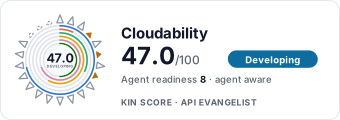
Cloudability has a Kin Score of 47.0 out of 100 (developing) and an Agent Readiness score of 7.9 (agent-aware), scored by API Evangelist on 2026-11-06.
Calls without X-API-Key need no key. Calls with it need a paid plan — get a key.
Get an API key
Free tier, no form to fill in. Signing in shares your email address with us — we
store it to create your key and to recognise you if you sign in with another
provider. See our Privacy Policy and
Terms.
 Kin Score
How this is scored →
 It updates itself when the score changes. Paste this where you link to your API docs: