Cargolux
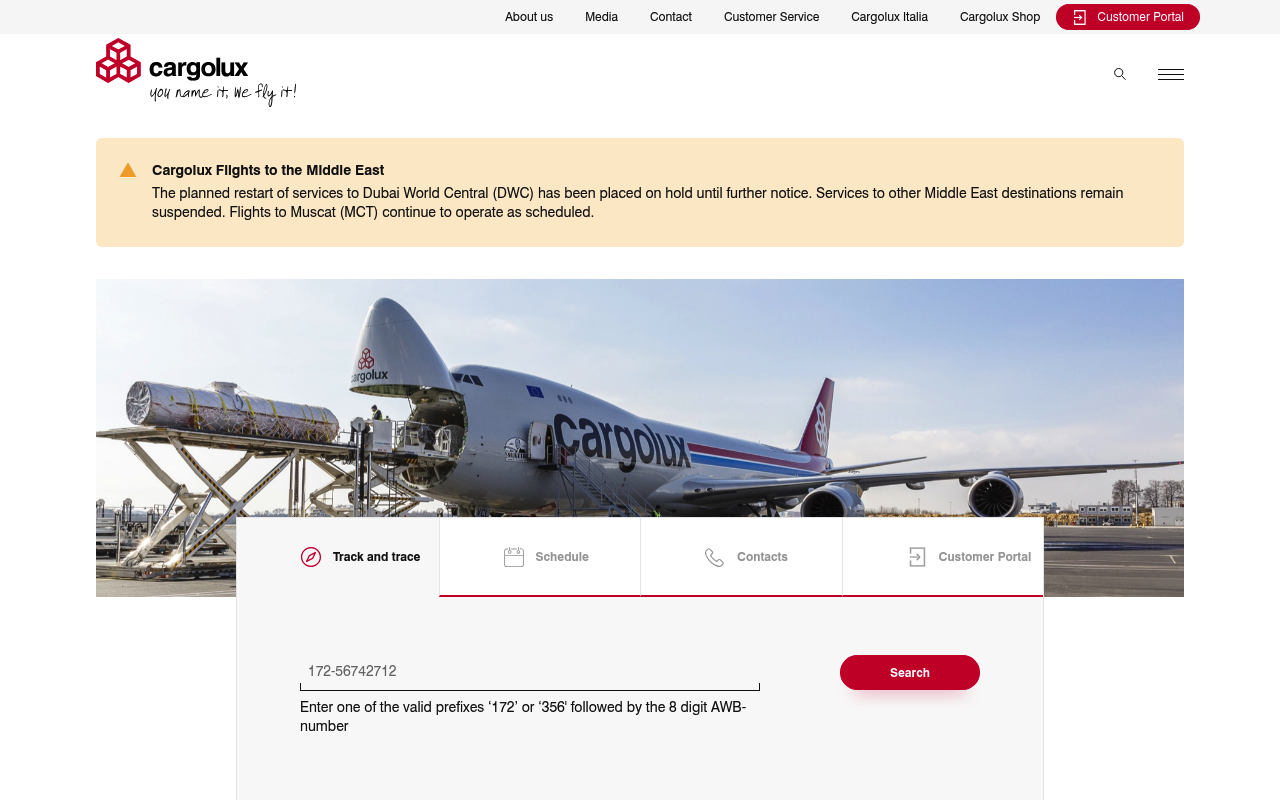
Cargolux Airlines International S.A. is Europe's largest all-cargo airline, headquartered at Luxembourg Findel Airport in Luxembourg and operating a global Boeing 747 freighter network under IATA designator CV and air waybill prefix 172 (with Cargolux Italia on prefix 356). In the logistics chain Cargolux is the main-leg air carrier: it sells capacity to freight forwarders and general sales agents rather than to shippers, hands cargo to terminal and ground handling operators such as its Luxcargo Handling subsidiary, and files customs and security data on behalf of the contracted forwarder. Its API posture is honestly a customer-contract one. Cargolux publishes no developer portal and no machine-readable contract of any kind — developer.cargolux.com, developers.cargolux.com and docs.cargolux.com do not resolve, and /developers, /api, /openapi.json, /swagger.json, /api-docs and /.well-known/ all return 404 on www.cargolux.com. The only public self-service surfaces are HTML: a track-and-trace widget and a flight scheduler on the marketing site, plus a login-walled Customer Portal at my.cargolux.com. A real quote-and- booking API exists, but it is a bilateral, commercially negotiated forwarder interface — piloted with Kuehne+Nagel in 2021 and extended to DB Schenker — with no published reference, and it is complemented by indirect distribution through the cargo.one, CargoAi and WebCargo by Freightos marketplaces. Underneath, Cargolux runs IBS Software's iCargo SaaS cargo management system and holds a large minority stake in Luxembourg's CHAMP Cargosystems, whose developer.champ.aero portal is the developer surface Cargolux's ecosystem actually reads — CHAMP's, not Cargolux's. IATA e-AWB "Single Process" is documented; no IATA ONE Record or Cargo-XML publication was found.
Cargolux is profiled on the APIs.io network. Tagged areas include Logistics, Supply Chain, Luxembourg, Air Cargo, and Airlines.
Cargolux’s developer surface includes documentation, engineering blog, and 17 more developer resources.
Kin Score
 Kin Score
How this is scored →
Kin Score
How this is scored →scored 2026-10-23 · rubric v0.25.0
 It updates itself when the score changes. Paste this where you link to your API docs:
<a href="https://apis.io/providers/cargolux/"><img src="https://apis.io/badge/cargolux/card.svg" alt="Cargolux on APIs.io — Kin Score by API Evangelist"></a>Other styles, a README pill and a shields.io endpoint are on the badge page.
Resources
Get Started 1
Portal, sign-up, and the first successful call
Documentation 2
Reference material describing how the API behaves
Build 1
SDKs, sample code, and the tooling you integrate with
Operate 1
Status, limits, changes, and where to get help
Commercial 3
Pricing, plans, and the legal terms of use
Company 5
The organization behind the API
Other 6
Properties that don't map to a standard resource type
Source (apis.yml)
Work with this as data
Every provider here is available over the APIs.io API and to AI agents over MCP.