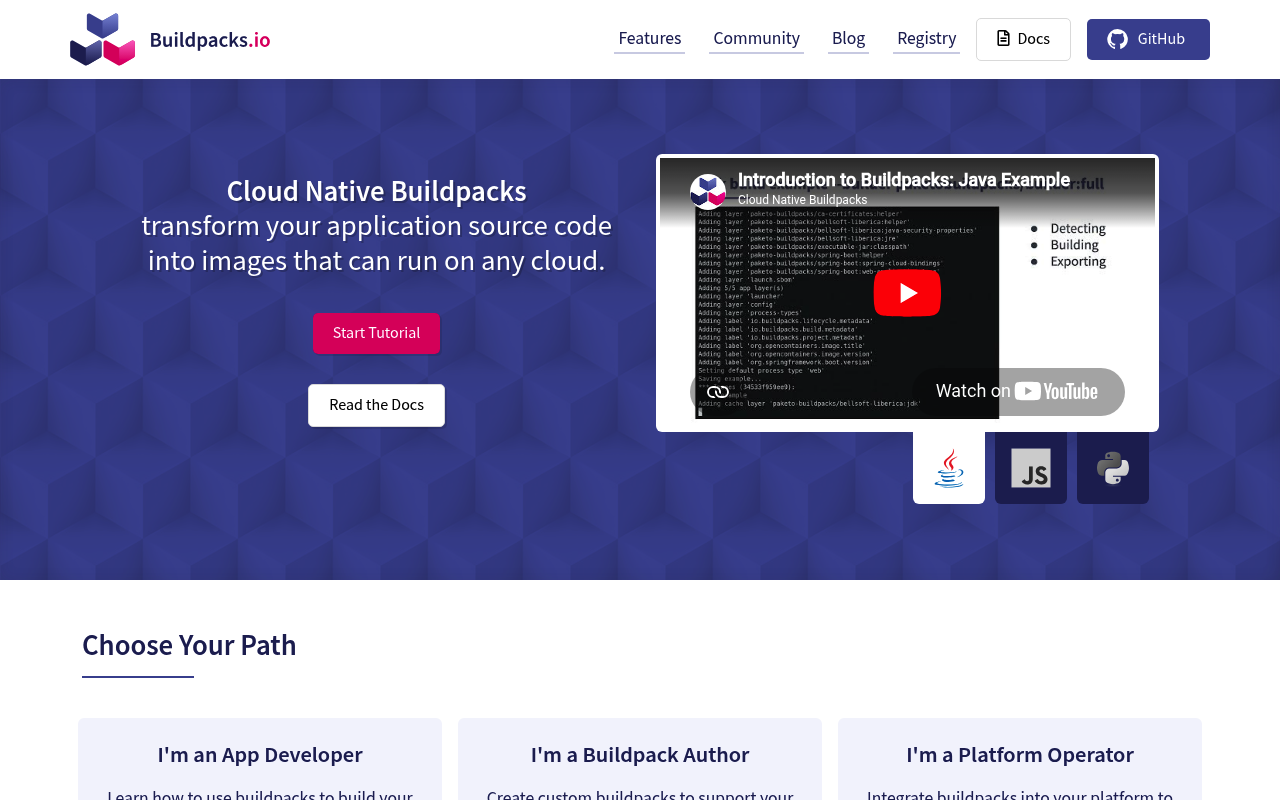
Cloud Native Buildpacks website screenshot

Cloud Native Buildpacks

Cloud Native Buildpacks (CNBs) transform application source code into OCI-compliant container images that can run on any cloud, without requiring Dockerfiles. Initiated by Pivotal and Heroku in January 2018, CNB joined the CNCF as a Sandbox project in October 2018 and GRADUATED on 11 August 2026, the foundation's highest maturity tier. It is licensed Apache-2.0. CNB is primarily a specification project: three independently versioned contracts — Buildpack API 0.12, Platform API 0.15 and Distribution API 0.3 — plus reference implementations (the pack CLI and the lifecycle). It centralizes container expertise through composable buildpacks, enables layer rebasing for efficient OS updates, and generates Software Bills of Materials in CycloneDX, SPDX and Syft formats. The pack CLI, the kpack Kubernetes operator and the public Buildpack Registry API are the primary integration points.

Cloud Native Buildpacks publishes 1 API on the APIs.io network: kpack. Tagged areas include Build Tools, CI/CD, Cloud-Native, CNCF, and Container Images.

Cloud Native Buildpacks’ developer surface includes documentation, engineering blog, CLI, authentication, changelog, API reference, getting-started guide, and 40 more developer resources.

47.4/100 developing ▬ flat Agent 25/100 agent aware self hosted · Apache-2.0 Full breakdown ↓
scored 2026-09-08 · rubric v0.20.0
AccessFree⚡ Free to try
10 APIs 5 Features 4 Use Cases
Build ToolsCI/CDCloud-NativeCNCFContainer ImagesContainersOCIOpen-Source

Kin Score

Kin Score Kin Score How this is scored →
scored 2026-09-08 · rubric v0.20.0
Open Source Surface applies to this provider. This product is open source and we read its repository directly, so Open Source Surface carries 10 points of the composite. It is scored from what the repository actually publishes — a security policy, a contribution guide, a release history, a code of conduct — read live from the provider rather than inferred from our own catalog pointers. This facet adds; nothing was taken away to make room for it. An open-source project is not excused from the commercial facets, because exemption would strip it of the points it does earn. If we have the wrong repository, or this product is not open source, say so on your provider repo and we will drop the facet rather than have you publish against it.
Create-or-Update Ergonomics applies to this provider. This API accepts writes, so it carries 10 points of the composite. It is scored from the published contracts themselves: whether a caller can create-or-update in one call, whether the write accepts a key the caller already holds, and whether the response says which branch ran. Without that, every write needs a search-and-branch in front of it, and the first time that check is skipped a duplicate record is created. Scored against the observed mean rather than raw — a provider at the catalog average is unchanged by this facet, not penalised by it.
The six quality facets above are damped to 80 points between them, because the conditional facet above carries the other 20. That is why each facet's contribution is shown against a damped maximum: raising a quality facet moves the composite by 80% of its nominal weight, not 100%. The full arithmetic is at apis.io/rating/.
Improve this rating by publishing the missing artifacts — every area above can be raised, and the full rubric is at apis.io/rating/. Every facet and dimension name above is a link: it opens that measurement's own page — what it means, the exact checks that feed it, how the whole catalog distributes on it, and the providers at the top of it. This rating is computed from github.com/api-evangelist/buildpacks: open an issue to ask a question, or submit a pull request to add artifacts. Submit an artifact on GitHub — free → Manage your own listing — the Influence plan, $499/mo →

APIs 10

Individual APIs this provider publishes, each with its own machine-readable definition.

Buildpack API Specification

The Buildpack API is the contract between a buildpack and the lifecycle. It defines the detect and build executables, layers, build-plan provisions and requirements, and image e...

Platform API Specification

The Platform API is the contract between the CNB lifecycle and a platform such as pack, kpack, or a CI runner. It defines how builders, stacks, run images, and inputs are passed...

Distribution API Specification

The Distribution API specifies how buildpacks and builders are packaged as OCI artifacts, signed, and distributed through OCI registries. It also covers how meta-buildpacks comp...

pack CLI

pack is the reference command-line interface for Cloud Native Buildpacks. It implements the Platform API to build OCI images from source on a developer's workstation, manages bu...

CNB Lifecycle

The CNB Lifecycle is the reference implementation of the Buildpack and Platform APIs. It runs the detect, analyze, restore, build, export, and rebase phases used by all CNB plat...

kpack

kpack is a community Kubernetes-native implementation of Cloud Native Buildpacks. It exposes Image, Builder, ClusterBuilder, and ClusterStack custom resources for declaring cont...

Buildpack Registry

The Cloud Native Buildpacks registry indexes published buildpacks for discovery and reuse. It mirrors metadata for buildpack packages stored in OCI registries and exposes a brow...

Buildpack API

The Buildpack API is the contract between a buildpack and the lifecycle. It defines the detect and build executables, layers, build-plan provisions and requirements, and image e...

Platform API

The Platform API is the contract between the CNB lifecycle and a platform such as pack, kpack, or a CI runner. It defines how builders, stacks, run images, and inputs are passed...

Distribution API

The Distribution API specifies how buildpacks and builders are packaged as OCI artifacts, signed, and distributed through OCI registries. It also covers how meta-buildpacks comp...

Scroll for all 10

Pricing Plans 1

Published pricing tiers and plan structures.

Rate Limits 1

Documented rate limits and quota policies.

Buildpacks Rate Limits

0 limits

RATE LIMITS

FinOps 1

Cost, billing, and metering signals for API financial operations.

Features 5

Notable capabilities this provider offers.

pack build

pack builder

pack rebase

pack sbom download

Buildpack Registry

Security Posture 4

Authentication, domain security, vulnerability disclosure, and trust-center signals.

Buildpacks Authentication

0 schemes

SECURITY

Buildpacks Domain Security

TLSv1.3 · HSTS

SECURITY

Buildpacks Trust Center

trust center published

SECURITY

Use Cases 4

What developers build with this provider.

App Developer Image Building

Platform Operator Integration

Buildpack Authoring

OS-Level Security Patching

Resources

Get Started 3

Portal, sign-up, and the first successful call

Documentation 5

Reference material describing how the API behaves

Agent Surfaces 2

MCP servers, agent skills, and machine-readable catalogs

Design & Contract 6

Pagination, idempotency, versioning, errors, and events

Build 5

SDKs, sample code, and the tooling you integrate with

Access & Security 6

Authentication, authorization, and security posture

Operate 8

Status, limits, changes, and where to get help

Scroll for all 8

Commercial 4

Pricing, plans, and the legal terms of use

Company 3

The organization behind the API

Other 5

Properties that don't map to a standard resource type

Source (apis.yml)

apis.yml Raw ↑
aid: buildpacks
name: Cloud Native Buildpacks
description: 'Cloud Native Buildpacks (CNBs) transform application source code into OCI-compliant container images that can
  run on any cloud, without requiring Dockerfiles. Initiated by Pivotal and Heroku in January 2018, CNB joined the CNCF as
  a Sandbox project in October 2018 and GRADUATED on 11 August 2026, the foundation''s highest maturity tier. It is licensed
  Apache-2.0. CNB is primarily a specification project: three independently versioned contracts — Buildpack API 0.12, Platform
  API 0.15 and Distribution API 0.3 — plus reference implementations (the pack CLI and the lifecycle). It centralizes container
  expertise through composable buildpacks, enables layer rebasing for efficient OS updates, and generates Software Bills of
  Materials in CycloneDX, SPDX and Syft formats. The pack CLI, the kpack Kubernetes operator and the public Buildpack Registry
  API are the primary integration points.'
type: Index
deliveryModel:
  model: self-hosted
  license: Apache-2.0
  open_source: true
  commercial: false
  callable_host: false
  label: Self-hosted open source · you run it yourself
  confidence: high
  source:
  - license
  generated: '2026-08-28'
  method: derived
accessModel:
  pricing: free
  onboarding: none
  trial: false
  try_now: true
  public: true
  label: Free open source · no account, no plans
  confidence: high
  source:
  - plans
  - license
  - probe
  generated: '2026-09-05'
  method: searched
  note: Apache-2.0 CNCF Graduated project. No plans, no pricing page, no account and no API key exist (plans/buildpacks-plans-pricing.yml,
    plan_count 0). The Buildpack Registry API at registry.buildpacks.io/api/v1 answers anonymously with HTTP 200, so try_now
    and public are true. This replaces a `freemium` value derived from the 2026-05-04 scaffold that asserted a fabricated
    free tier.
image: https://kinlane-images.s3.amazonaws.com/shared/apis-json/icons/buildpacks.png
url: https://raw.githubusercontent.com/api-evangelist/buildpacks/refs/heads/main/apis.yml
created: '2025-01-01'
modified: '2026-09-05'
specificationVersion: '0.23'
tags:
- Build Tools
- CI/CD
- Cloud-Native
- CNCF
- Container Images
- Containers
- OCI
- Open-Source
tags_raw:
- Build Tools
- CI/CD
- Cloud Native
- CNCF
- Container Images
- Containers
- OCI
- Open Source
apis:
- aid: buildpacks:buildpack-api
  name: Buildpack API Specification
  description: The Buildpack API is the contract between a buildpack and the lifecycle. It defines the detect and build executables,
    layers, build-plan provisions and requirements, and image extension lifecycle that buildpack authors implement to participate
    in a CNB build.
  humanURL: https://buildpacks.io/docs/reference/spec/buildpack-api/
  tags:
  - API Specification
  - Buildpacks
  - Container Images
  - OCI
  - Specification
  properties:
  - type: Documentation
    url: https://buildpacks.io/docs/reference/spec/buildpack-api/
  - type: GitHubRepository
    url: https://github.com/buildpacks/spec
  - url: https://github.com/buildpacks/spec/blob/main/buildpack.md
    type: Specification
  - url: https://buildpacks.io/docs/for-buildpack-authors/
    type: Documentation
  image: https://kinlane-images.s3.amazonaws.com/shared/apis-json/apis-json-logo.jpg
- aid: buildpacks:platform-api
  name: Platform API Specification
  description: The Platform API is the contract between the CNB lifecycle and a platform such as pack, kpack, or a CI runner.
    It defines how builders, stacks, run images, and inputs are passed to the lifecycle phases (analyze, detect, restore,
    build, export, and rebase) and how outputs are consumed.
  humanURL: https://buildpacks.io/docs/reference/spec/platform-api/
  tags:
  - API Specification
  - Container Images
  - Lifecycle
  - Platform
  - Platforms
  - Specification
  properties:
  - type: Documentation
    url: https://buildpacks.io/docs/reference/spec/platform-api/
  - type: GitHubRepository
    url: https://github.com/buildpacks/spec
  - url: https://github.com/buildpacks/spec/blob/main/platform.md
    type: Specification
  - url: https://buildpacks.io/docs/for-platform-operators/
    type: Documentation
  image: https://kinlane-images.s3.amazonaws.com/shared/apis-json/apis-json-logo.jpg
- aid: buildpacks:distribution-api
  name: Distribution API Specification
  description: The Distribution API specifies how buildpacks and builders are packaged as OCI artifacts, signed, and distributed
    through OCI registries. It also covers how meta-buildpacks compose other buildpacks and how stacks and run images are
    referenced.
  humanURL: https://buildpacks.io/docs/reference/spec/distribution-api/
  tags:
  - API Specification
  - Distribution
  - OCI
  - Packaging
  - Registries
  - Specification
  properties:
  - type: Documentation
    url: https://buildpacks.io/docs/reference/spec/distribution-api/
  - type: GitHubRepository
    url: https://github.com/buildpacks/spec
  - url: https://github.com/buildpacks/spec/blob/main/distribution.md
    type: Specification
  image: https://kinlane-images.s3.amazonaws.com/shared/apis-json/apis-json-logo.jpg
- aid: buildpacks:pack-cli
  name: pack CLI
  tags:
  - CLI
  - Tooling
  image: https://kinlane-images.s3.amazonaws.com/shared/apis-json/apis-json-logo.jpg
  humanURL: https://buildpacks.io/docs/for-app-developers/how-to/build-inputs/
  properties:
  - url: https://buildpacks.io/docs/for-app-developers/how-to/build-inputs/
    type: Documentation
  - url: https://github.com/buildpacks/pack
    type: Source Code
  - type: CLI
    url: cli/buildpacks-cli.yml
  description: pack is the reference command-line interface for Cloud Native Buildpacks. It implements the Platform API to
    build OCI images from source on a developer's workstation, manages builders and buildpack packages, and integrates with
    Docker and OCI registries.
- aid: buildpacks:lifecycle
  name: CNB Lifecycle
  tags:
  - Lifecycle
  - Reference Implementation
  image: https://kinlane-images.s3.amazonaws.com/shared/apis-json/apis-json-logo.jpg
  humanURL: https://github.com/buildpacks/lifecycle
  properties:
  - url: https://github.com/buildpacks/lifecycle
    type: Source Code
  - url: https://buildpacks.io/docs/for-platform-operators/concepts/lifecycle/
    type: Documentation
  description: The CNB Lifecycle is the reference implementation of the Buildpack and Platform APIs. It runs the detect, analyze,
    restore, build, export, and rebase phases used by all CNB platforms to produce reproducible OCI images.
- aid: buildpacks:kpack
  name: kpack
  tags:
  - Kubernetes
  - Server-side Builds
  image: https://kinlane-images.s3.amazonaws.com/shared/apis-json/apis-json-logo.jpg
  humanURL: https://github.com/buildpacks-community/kpack
  properties:
  - url: https://github.com/buildpacks-community/kpack
    type: Source Code
  - url: https://github.com/buildpacks-community/kpack/blob/main/docs/image.md
    type: Documentation
  - type: OpenAPI
    url: openapi/buildpacks-kpack-swagger.json
  - type: Overlay
    url: overlays/buildpacks-kpack-overlay.yaml
  - type: DataModel
    url: data-model/buildpacks-data-model.yml
  - type: AgentSkill
    url: skills/buildpacks-build-an-image-with-kpack.md
  description: kpack is a community Kubernetes-native implementation of Cloud Native Buildpacks. It exposes Image, Builder,
    ClusterBuilder, and ClusterStack custom resources for declaring continuously rebuilt OCI images using CNB.
  baseURL: https://{kubernetes-apiserver}/apis/kpack.io/v1alpha1
- aid: buildpacks:registry
  name: Buildpack Registry
  tags:
  - Discovery
  - Registry
  image: https://kinlane-images.s3.amazonaws.com/shared/apis-json/apis-json-logo.jpg
  humanURL: https://registry.buildpacks.io/
  properties:
  - url: https://registry.buildpacks.io/
    type: Registry
  - url: https://github.com/buildpacks/registry-api
    type: Source Code
  - type: Documentation
    url: https://github.com/buildpacks/registry-api
  - type: APIReference
    url: https://github.com/buildpacks/registry-api#endpoints
  - type: Specification
    url: https://github.com/buildpacks/spec/blob/main/extensions/buildpack-registry.md
  - type: AgentSkill
    url: skills/buildpacks-publish-a-buildpack-to-the-registry.md
  description: The Cloud Native Buildpacks registry indexes published buildpacks for discovery and reuse. It mirrors metadata
    for buildpack packages stored in OCI registries and exposes a browseable catalog at registry.buildpacks.io.
  baseURL: https://registry.buildpacks.io/api/v1
- aid: buildpacks:buildpack-api
  name: Buildpack API
  tags:
  - Buildpacks
  - Specification
  image: https://kinlane-images.s3.amazonaws.com/shared/apis-json/apis-json-logo.jpg
  humanURL: https://github.com/buildpacks/spec/blob/main/buildpack.md
  properties:
  - url: https://github.com/buildpacks/spec/blob/main/buildpack.md
    type: Specification
  - url: https://buildpacks.io/docs/for-buildpack-authors/
    type: Documentation
  description: The Buildpack API is the contract between a buildpack and the lifecycle. It defines the detect and build executables,
    layers, build-plan provisions and requirements, and image extension lifecycle that buildpack authors implement to participate
    in a CNB build.
- aid: buildpacks:platform-api
  name: Platform API
  tags:
  - Lifecycle
  - Platform
  - Specification
  image: https://kinlane-images.s3.amazonaws.com/shared/apis-json/apis-json-logo.jpg
  humanURL: https://github.com/buildpacks/spec/blob/main/platform.md
  properties:
  - url: https://github.com/buildpacks/spec/blob/main/platform.md
    type: Specification
  - url: https://buildpacks.io/docs/for-platform-operators/
    type: Documentation
  description: The Platform API is the contract between the CNB lifecycle and a platform such as pack, kpack, or a CI runner.
    It defines how builders, stacks, run images, and inputs are passed to the lifecycle phases (analyze, detect, restore,
    build, export, and rebase) and how outputs are consumed.
- aid: buildpacks:distribution-api
  name: Distribution API
  tags:
  - Distribution
  - Registries
  - Specification
  image: https://kinlane-images.s3.amazonaws.com/shared/apis-json/apis-json-logo.jpg
  humanURL: https://github.com/buildpacks/spec/blob/main/distribution.md
  properties:
  - url: https://github.com/buildpacks/spec/blob/main/distribution.md
    type: Specification
  description: The Distribution API specifies how buildpacks and builders are packaged as OCI artifacts, signed, and distributed
    through OCI registries. It also covers how meta-buildpacks compose other buildpacks and how stacks and run images are
    referenced.
common:
- type: IssueTracker
  url: https://github.com/buildpacks/spec/issues
- type: Releases
  url: https://github.com/buildpacks/spec/releases
- type: CodeOfConduct
  url: https://github.com/buildpacks/.github/blob/main/CODE_OF_CONDUCT.md
- type: ContributionGuide
  url: https://github.com/buildpacks/spec/blob/main/CONTRIBUTING.md
- type: License
  name: Apache-2.0
  url: https://github.com/buildpacks/spec/blob/main/LICENSE
- type: DomainSecurity
  url: security/buildpacks-domain-security.yml
- type: Website
  url: https://buildpacks.io
- type: Documentation
  url: https://buildpacks.io/docs/
- type: GitHubOrganization
  url: https://github.com/buildpacks
- type: Blog
  url: https://medium.com/buildpacks
- url: https://medium.com/feed/buildpacks
  type: BlogRSS
  description: Discovered RSS/Atom feed for https://medium.com/buildpacks
- type: Community
  url: https://buildpacks.io/community/
- type: Registry
  url: https://registry.buildpacks.io/
- type: Specification
  url: https://github.com/buildpacks/spec/blob/main/buildpack.md
- type: MailingList
  url: https://lists.cncf.io/g/cncf-buildpacks/join
- type: Slack
  url: https://slack.cncf.io
- type: CNCF
  url: https://www.cncf.io/projects/buildpacks/
- type: DevStats
  url: https://buildpacks.devstats.cncf.io/
- name: Use Cases
  type: UseCases
  data:
  - name: App Developer Image Building
    url: https://buildpacks.io/docs/for-app-developers/
    features:
    - No Dockerfile Required
    - Automatic Dependency Detection
    - Multi-Language Support
    - Reproducible Builds
    - ARM Container Support
    - Windows Container Support
  - name: Platform Operator Integration
    url: https://buildpacks.io/docs/for-platform-operators/
    features:
    - CI/CD Pipeline Integration
    - pack CLI Integration
    - kpack Kubernetes Operator
    - Tekton Pipeline Support
    - CircleCI Integration
    - GitLab CI Integration
    - Custom Builder Creation
  - name: Buildpack Authoring
    url: https://buildpacks.io/docs/for-buildpack-authors/
    features:
    - Custom Language Support
    - Framework-Specific Buildpacks
    - Buildpack Packaging
    - Registry Distribution
    - Extension Authoring
    - Composable Buildpack Groups
  - name: OS-Level Security Patching
    url: https://buildpacks.io/docs/reference/spec/platform-api/
    features:
    - Layer Rebasing
    - Base Image Updates Without Rebuild
    - Minimal Rebuild Surface
    - Stack Switching
- name: Features
  type: Features
  data:
  - name: pack build
    url: https://buildpacks.io/docs/for-platform-operators/how-to/integrate-ci/pack/cli/
    features:
    - Source-to-Image Conversion
    - Builder Selection
    - Environment Variable Injection
    - Volume Mount Support
    - Cache Integration
  - name: pack builder
    url: https://buildpacks.io/docs/for-platform-operators/how-to/integrate-ci/pack/cli/
    features:
    - Create Custom Builders
    - Inspect Builder Contents
    - Trust Builder Configuration
    - Suggest Default Builders
  - name: pack rebase
    url: https://buildpacks.io/docs/for-platform-operators/how-to/integrate-ci/pack/cli/
    features:
    - Update Base Image Layers
    - No Source Rebuild Required
    - Fast Security Patching
  - name: pack sbom download
    url: https://buildpacks.io/docs/for-platform-operators/how-to/integrate-ci/pack/cli/
    features:
    - Software Bill of Materials
    - Dependency Inventory
    - Security Auditing
    - License Tracking
  - name: Buildpack Registry
    url: https://registry.buildpacks.io/
    features:
    - Community Buildpack Discovery
    - Namespace Registration
    - Version Tracking
    - Verified Buildpacks
- type: Packages
  url: packages/buildpacks-packages.yml
- type: SDKs
  url: packages/buildpacks-packages.yml
- type: CLI
  url: cli/buildpacks-cli.yml
- type: Conventions
  url: conventions/buildpacks-conventions.yml
- type: Idempotency
  url: conventions/buildpacks-conventions.yml
- type: Authentication
  url: authentication/buildpacks-authentication.yml
- type: ErrorCatalog
  url: errors/buildpacks-problem-types.yml
- type: Lifecycle
  url: lifecycle/buildpacks-lifecycle.yml
- type: Deprecation
  url: lifecycle/buildpacks-lifecycle.yml
- type: ChangeLog
  url: changelog/buildpacks-changelog.yml
- type: Conformance
  url: conformance/buildpacks-conformance.yml
- type: Compliance
  url: conformance/buildpacks-conformance.yml
- type: DataModel
  url: data-model/buildpacks-data-model.yml
- type: VulnerabilityDisclosure
  url: security/buildpacks-vulnerability-disclosure.yml
- type: Security
  url: security/buildpacks-vulnerability-disclosure.yml
- type: TrustCenter
  url: security/buildpacks-trust-center.yml
- type: LLMsTxt
  url: llms/buildpacks-llms.txt
- type: Overlay
  url: overlays/buildpacks-kpack-overlay.yaml
- type: AgentSkill
  url: skills/_index.yml
- type: Plans
  url: plans/buildpacks-plans-pricing.yml
- type: RateLimits
  url: rate-limits/buildpacks-rate-limits.yml
- type: FinOps
  url: finops/buildpacks-finops.yml
- type: OpenAPI
  url: openapi/buildpacks-kpack-swagger.json
- type: DeveloperPortal
  url: https://buildpacks.io/docs/
- type: APIReference
  url: https://buildpacks.io/docs/reference/spec/
- type: GettingStarted
  url: https://buildpacks.io/docs/app-journey
- type: PrivacyPolicy
  url: https://www.linuxfoundation.org/privacy/
- type: Support
  url: https://buildpacks.io/community/
- type: x-RFCs
  url: https://github.com/buildpacks/rfcs
maintainers:
- FN: Kin Lane
  email: kin@apievangelist.com
x-enrichment:
  date: '2026-09-05'
  status: enriched
  artifacts_added: 19
  pass: local-v3

Work with this as data

Every provider here is available over the APIs.io API and to AI agents over MCP.

MCP server

One button, every client — Claude, Cursor, VS Code and the rest.

https://apis.io/mcp

Tools for providers

9 MCP tools reach this
  • find_providersBrowse and filter every provider in the catalog.
  • get_provider_artifactsEvery artifact this provider publishes, grouped by type.
  • get_provider_operationsEvery operation across all of their OpenAPIs — one call instead of parsing every spec.
  • get_provider_toolsEvery MCP tool they ship, with the operation each wraps.
  • get_provider_evidenceHow each part of their score was established. Free — the basis for a claim should not sit behind it.
  • get_provider_ratingPRO — composite, band, trend and facet scores.
  • apis_io_searchSTART HERE — APIs, providers and tags for one query, each with its total.
  • resolveTurn a domain, URL or GitHub org into the provider it belongs to.
  • find_cohortsEvery scored population of providers in the catalog.
All 92 tools →

Call it yourself

curl for this page
This provider
curl "https://apis.io/api/v1/providers/buildpacks"
All providers
curl "https://apis.io/api/v1/providers?limit=25"
Every operation they expose
curl "https://apis.io/api/v1/providers/buildpacks/operations?limit=25"
How their score was established
curl "https://apis.io/api/v1/providers/buildpacks/evidence"

Discovery needs no key. Ratings and market analysis are Pro.

Get an API key

Free tier, no form to fill in. Signing in shares your email address with us — we store it to create your key and to recognise you if you sign in with another provider. See our Privacy Policy and Terms.

A second provider on the same verified email joins the account you already have.
