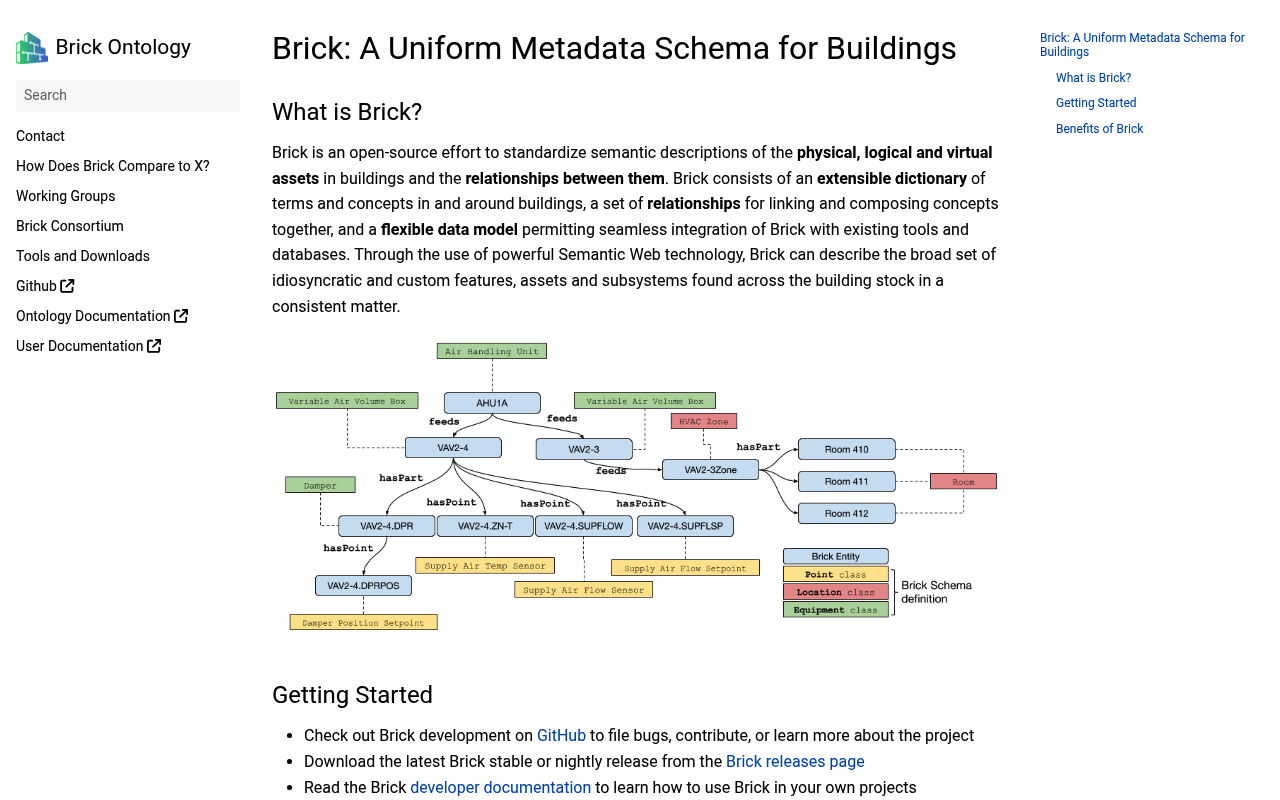
BRICK Schema website screenshot

BRICK Schema

BRICK is an open-source community-driven ontology standard for standardizing semantic descriptions of physical, logical, and virtual assets in buildings and the relationships between them. Using Semantic Web (RDF/OWL) technology, BRICK v1.4.4 enables interoperability across building management systems, reducing the cost of deploying analytics and energy efficiency initiatives. It supports HVAC, lighting, fire, security, and other building subsystems under a unified extensible vocabulary with SHACL-based validation.

BRICK Schema publishes 1 API on the APIs.io network: Brick Example Server. Tagged areas include Building Information Modeling, BIM, Smart Buildings, Ontology, and Semantic Web.

BRICK Schema’s developer surface includes authentication, documentation, CLI, changelog, API reference, getting-started guide, and 21 more developer resources.

37.3/100 thin ▬ flat Agent 28/100 agent aware self hosted · BSD-3-Clause Full breakdown ↓
scored 2026-09-08 · rubric v0.20.0
AccessFreemium
1 APIs
Building Information ModelingBIMSmart BuildingsOntologySemantic WebIoTHVACEnergy Management

Kin Score

Kin Score Kin Score How this is scored →
scored 2026-09-08 · rubric v0.20.0
Regulatory Posture applies to this provider. Its tags matched the Energy & Utilities regime, so Regulatory Posture carries 15 points of the composite. If this regime is wrong for your business, say so on your provider repo — the applicability map is public and we will correct it.
Open Source Surface applies to this provider. This product is open source and we read its repository directly, so Open Source Surface carries 10 points of the composite. It is scored from what the repository actually publishes — a security policy, a contribution guide, a release history, a code of conduct — read live from the provider rather than inferred from our own catalog pointers. This facet adds; nothing was taken away to make room for it. An open-source project is not excused from the commercial facets, because exemption would strip it of the points it does earn. If we have the wrong repository, or this product is not open source, say so on your provider repo and we will drop the facet rather than have you publish against it.
Create-or-Update Ergonomics applies to this provider. This API accepts writes, so it carries 10 points of the composite. It is scored from the published contracts themselves: whether a caller can create-or-update in one call, whether the write accepts a key the caller already holds, and whether the response says which branch ran. Without that, every write needs a search-and-branch in front of it, and the first time that check is skipped a duplicate record is created. Scored against the observed mean rather than raw — a provider at the catalog average is unchanged by this facet, not penalised by it.
The six quality facets above are damped to 65 points between them, because both conditional facets apply and carry 35 points together. That is why each facet's contribution is shown against a damped maximum: raising a quality facet moves the composite by 65% of its nominal weight, not 100%. The full arithmetic is at apis.io/rating/.
Improve this rating by publishing the missing artifacts — every area above can be raised, and the full rubric is at apis.io/rating/. Every facet and dimension name above is a link: it opens that measurement's own page — what it means, the exact checks that feed it, how the whole catalog distributes on it, and the providers at the top of it. This rating is computed from github.com/api-evangelist/brick: open an issue to ask a question, or submit a pull request to add artifacts. Submit an artifact on GitHub — free → Manage your own listing — the Influence plan, $499/mo →

APIs 2

Individual APIs this provider publishes, each with its own machine-readable definition.

BRICK Ontology

The BRICK ontology v1.4.4 defines a standardized vocabulary of building system concepts, relationships, and data model for smart building analytics. Available as RDF/OWL files, ...

Brick Example Server

The Brick Example Server is the BrickSchema organisation's self-hostable HTTP contract, documented at docs.brickschema.org as "demonstrating how a Brick model can be abstracted ...

Pricing Plans 1

Published pricing tiers and plan structures.

Brick Plans Pricing

0 plans

PLANS

Rate Limits 1

Documented rate limits and quota policies.

Brick Rate Limits

0 limits

RATE LIMITS

FinOps 1

Cost, billing, and metering signals for API financial operations.

Brick Finops

FINOPS

Security Posture 2

Authentication, domain security, vulnerability disclosure, and trust-center signals.

Brick Authentication

http · 1 scheme

SECURITY

Brick Domain Security

TLSv1.3

SECURITY

Resources

Get Started 1

Portal, sign-up, and the first successful call

Documentation 3

Reference material describing how the API behaves

Agent Surfaces 2

MCP servers, agent skills, and machine-readable catalogs

Design & Contract 6

Pagination, idempotency, versioning, errors, and events

Build 6

SDKs, sample code, and the tooling you integrate with

Access & Security 2

Authentication, authorization, and security posture

Operate 4

Status, limits, changes, and where to get help

Commercial 1

Pricing, plans, and the legal terms of use

Company 1

The organization behind the API

Other 1

Properties that don't map to a standard resource type

Source (apis.yml)

apis.yml Raw ↑
aid: brick
url: https://raw.githubusercontent.com/api-evangelist/brick/refs/heads/main/apis.yml
name: BRICK Schema
tags:
- Building Information Modeling
- BIM
- Smart Buildings
- Ontology
- Semantic Web
- IoT
- HVAC
- Energy Management
type: Index
kind: standard
deliveryModel:
  model: self-hosted
  license: BSD-3-Clause
  open_source: true
  commercial: false
  callable_host: false
  label: Self-hosted open source · you run it yourself
  confidence: high
  source:
  - license
  generated: '2026-08-28'
  method: derived
accessModel:
  pricing: freemium
  onboarding: unknown
  trial: false
  try_now: false
  public: false
  label: Freemium
  confidence: medium
  source:
  - plans
  generated: '2026-07-22'
  method: derived
image: https://kinlane-images.s3.amazonaws.com/shared/apis-json/icons/brick.png
access: Open
created: '2025-02-17'
modified: '2026-09-04'
position: Consuming
description: BRICK is an open-source community-driven ontology standard for standardizing semantic descriptions of physical,
  logical, and virtual assets in buildings and the relationships between them. Using Semantic Web (RDF/OWL) technology, BRICK
  v1.4.4 enables interoperability across building management systems, reducing the cost of deploying analytics and energy
  efficiency initiatives. It supports HVAC, lighting, fire, security, and other building subsystems under a unified extensible
  vocabulary with SHACL-based validation.
apis:
- aid: brick:ontology
  name: BRICK Ontology
  tags:
  - Ontology
  - RDF
  - OWL
  - Building Systems
  - Semantic Web
  humanURL: https://brickschema.org/
  baseURL: https://brickschema.org/schema/
  image: https://kinlane-images.s3.amazonaws.com/shared/apis-json/icons/brick.png
  properties:
  - url: https://brickschema.org/
    type: Website
  - url: https://docs.brickschema.org/
    type: Documentation
  - url: https://ontology.brickschema.org/
    type: OntologyBrowser
  - url: https://github.com/BrickSchema/Brick
    type: GitHubRepository
  description: The BRICK ontology v1.4.4 defines a standardized vocabulary of building system concepts, relationships, and
    data model for smart building analytics. Available as RDF/OWL files, BRICK describes sensors, equipment, locations, and
    control points in HVAC, lighting, fire safety, and security systems. Includes SHACL shapes for ontology validation and
    Python tooling via the brickschema Python package.
- aid: brick:server
  name: Brick Example Server
  tags:
  - Building Systems
  - Timeseries
  - SPARQL
  - Actuation
  - Self-Hosted
  humanURL: https://github.com/BrickSchema/brick-example-server
  baseURL: https://{brick-server-host}/brickapi/v1
  image: https://kinlane-images.s3.amazonaws.com/shared/apis-json/icons/brick.png
  properties:
  - url: openapi/brick-brick-server-openapi.yml
    type: OpenAPI
  - url: openapi/_original/brick-brick-server-openapi.json
    type: OpenAPI
    name: Original harvested contract (verbatim)
  - url: overlays/brick-brick-server-overlay.yaml
    type: Overlay
  - url: https://github.com/BrickSchema/brick-example-server
    type: SourceCode
  - url: https://docs.brickschema.org/software/interfaces.html
    type: Documentation
  description: 'The Brick Example Server is the BrickSchema organisation''s self-hostable HTTP contract, documented at docs.brickschema.org
    as "demonstrating how a Brick model can be abstracted by an HTTP API". OpenAPI 3.0.2, nineteen operations under /brickapi/v1/
    covering timeseries read/write/delete, Turtle model upload, entity lookup, a relationship-filtered entity list keyed on
    the Brick object properties, raw SQL and raw SPARQL queries, physical actuation, Grafana dashboard provisioning, and application-token
    issue and revoke. Authentication is a bearer JWT with no scopes. The baseURL is TEMPLATED on purpose: BrickSchema operates
    no hosted instance and the harvested contract declares no servers block, so the host is supplied by whoever runs the software.
    The /brickapi/v1 path prefix is the provider''s own and appears on every operation.'
common:
- type: Authentication
  url: authentication/brick-authentication.yml
- type: IssueTracker
  url: https://github.com/BrickSchema/Brick/issues
- type: Releases
  url: https://github.com/BrickSchema/Brick/releases
- type: ContributionGuide
  url: https://github.com/BrickSchema/Brick/blob/master/CONTRIBUTING.md
- type: License
  name: BSD-3-Clause
  url: https://github.com/BrickSchema/Brick/blob/master/LICENSE
- type: DomainSecurity
  url: security/brick-domain-security.yml
- type: Website
  url: https://brickschema.org/
- type: Documentation
  url: https://docs.brickschema.org/
- type: GitHubOrganization
  url: https://github.com/BrickSchema
- type: GitHubRepository
  url: https://github.com/BrickSchema/Brick
- type: OntologyBrowser
  url: https://ontology.brickschema.org/
- type: Community
  url: https://groups.google.com/g/brickschema
- type: PyPIPackage
  url: https://pypi.org/project/brickschema/
- type: Vocabulary
  url: vocabulary/brick-vocabulary.yml
- type: Packages
  url: packages/brick-packages.yml
- type: SDKs
  url: packages/brick-packages.yml
- type: CLI
  url: cli/brick-cli.yml
- type: Conventions
  url: conventions/brick-conventions.yml
- type: DataModel
  url: data-model/brick-data-model.yml
- type: ErrorCatalog
  url: errors/brick-problem-types.yml
- type: Lifecycle
  url: lifecycle/brick-lifecycle.yml
- type: ChangeLog
  url: changelog/brick-changelog.yml
- type: Conformance
  url: conformance/brick-conformance.yml
- type: LLMsTxt
  url: llms/brick-llms.txt
- type: AgentSkill
  url: skills/_index.yml
- type: APIReference
  name: brickschema Python library API reference
  url: https://brickschema.readthedocs.io/
- type: GettingStarted
  name: Creating a Brick Model
  url: https://docs.brickschema.org/lifecycle/creation.html
maintainers:
- FN: Kin Lane
  email: info@apievangelist.com
specificationVersion: '0.23'
x-enrichment:
  date: '2026-09-04'
  status: enriched
  artifacts_added: 21
  pass: local-v3
x-coverage:
  state: covered

Work with this as data

Every provider here is available over the APIs.io API and to AI agents over MCP.

MCP server

One button, every client — Claude, Cursor, VS Code and the rest.

https://apis.io/mcp

Tools for providers

9 MCP tools reach this
  • find_providersBrowse and filter every provider in the catalog.
  • get_provider_artifactsEvery artifact this provider publishes, grouped by type.
  • get_provider_operationsEvery operation across all of their OpenAPIs — one call instead of parsing every spec.
  • get_provider_toolsEvery MCP tool they ship, with the operation each wraps.
  • get_provider_evidenceHow each part of their score was established. Free — the basis for a claim should not sit behind it.
  • get_provider_ratingPRO — composite, band, trend and facet scores.
  • apis_io_searchSTART HERE — APIs, providers and tags for one query, each with its total.
  • resolveTurn a domain, URL or GitHub org into the provider it belongs to.
  • find_cohortsEvery scored population of providers in the catalog.
All 92 tools →

Call it yourself

curl for this page
This provider
curl "https://apis.io/api/v1/providers/brick"
All providers
curl "https://apis.io/api/v1/providers?limit=25"
Every operation they expose
curl "https://apis.io/api/v1/providers/brick/operations?limit=25"
How their score was established
curl "https://apis.io/api/v1/providers/brick/evidence"

Discovery needs no key. Ratings and market analysis are Pro.

Get an API key

Free tier, no form to fill in. Signing in shares your email address with us — we store it to create your key and to recognise you if you sign in with another provider. See our Privacy Policy and Terms.

A second provider on the same verified email joins the account you already have.
