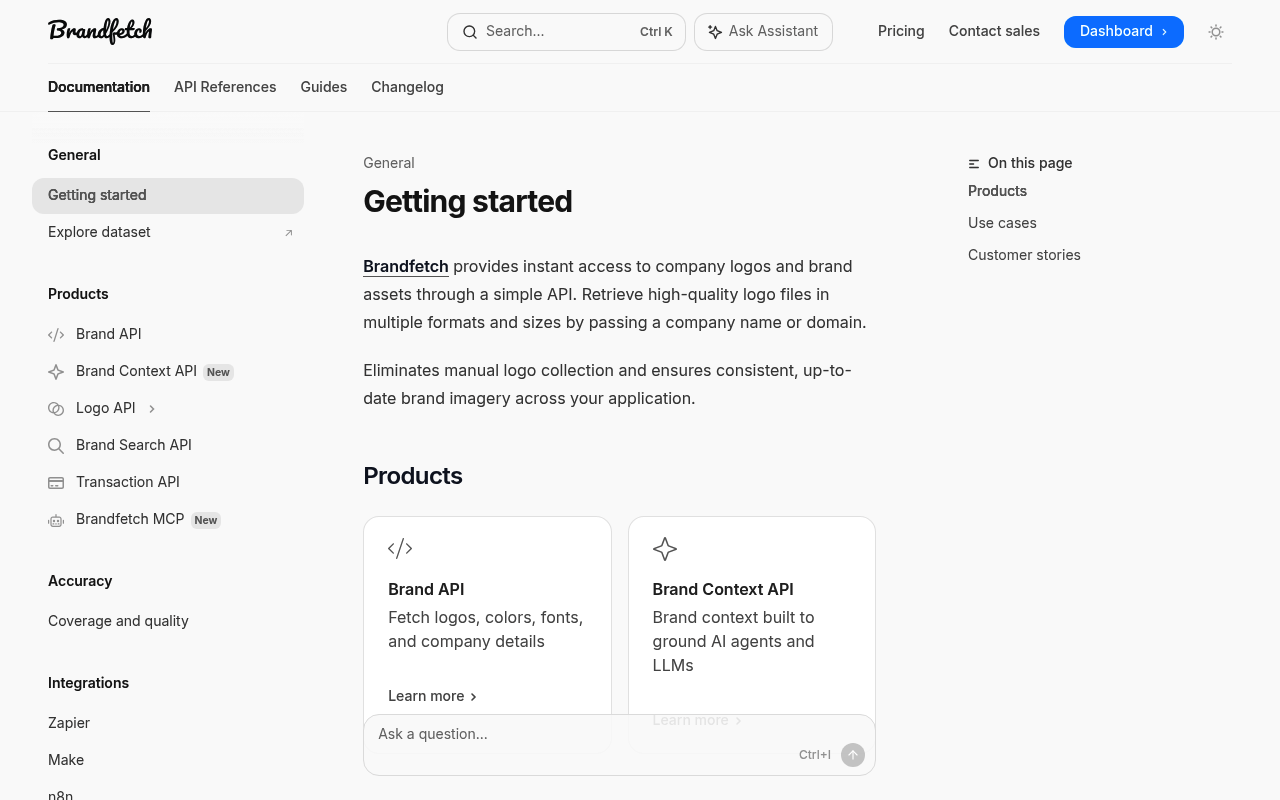
Brandfetch provides programmatic access to brand assets and company data through a suite of APIs. The Brand API retrieves logos, color schemes, fonts, images, and firmographic information for any company via domain, stock ticker, ISIN code, or crypto symbol. The Logo Link API serves logos via CDN with support for multiple formats, themes, and sizes. The Brand Search API enables autocomplete experiences by matching brand names to their domains and identifiers. The Brand Context API returns an LLM-ready narrative profile — identity, positioning, voice and visual style — for grounding agents, and the Transaction API resolves raw payment descriptors into merchant identity. A hosted MCP server at mcp.brandfetch.io exposes the same capabilities as seven agent tools over OAuth, and an Enterprise GraphQL endpoint carries the account, webhook and brand-monitoring plane. REST authenticates with Bearer API keys; the Logo and Search APIs use a public, embeddable Client ID.
Brand API (Brandfetch) publishes 8 API contracts indexed on the APIs.io network, including Brands API, Context API, Search API, and 5 more. Tagged areas include Brands, Logo, Brand Assets, Company Data, and Firmographics.
The Brand API (Brandfetch) catalog on APIs.io includes 1 event-driven AsyncAPI specification.
Brand API (Brandfetch)’s developer surface includes authentication, sandbox, API reference, getting-started guide, engineering blog, pricing, support, and 36 more developer resources.
Regulatory Posture applies to this provider. Its tags matched the
Payments regime, so
Regulatory Posture carries 15 points of the composite.
If this regime is wrong for your business, say so on your
provider repo — the
applicability map is public and we will correct it.
Create-or-Update Ergonomics applies to this provider. This API accepts writes, so it
carries 10 points of the composite. It is scored from the published contracts
themselves: whether a caller can create-or-update in one call, whether the write accepts a key the caller already
holds, and whether the response says which branch ran. Without that, every write needs a search-and-branch in
front of it, and the first time that check is skipped a duplicate record is created.
Scored against the observed mean rather than raw — a provider at the catalog average is unchanged by this facet,
not penalised by it.
The six quality facets above are damped to 75 points between them,
because the conditional facet above carries the other
25. That is why each facet's contribution is shown against a damped
maximum: raising a quality facet moves the composite by 75% of its nominal
weight, not 100%. The full arithmetic is at apis.io/rating/.
Improve this rating by publishing the missing artifacts — every area above can be raised, and the full rubric is at apis.io/rating/. Every facet and dimension name above is a link: it opens that measurement's own page — what it means, the exact checks that feed it, how the whole catalog distributes on it, and the providers at the top of it. This rating is computed from github.com/api-evangelist/brand-api: open an issue to ask a question, or submit a pull request to add artifacts.
Submit an artifact on GitHub — free →Manage your own listing — the Influence plan, $499/mo →
Enterprise GraphQL endpoint carrying the account plane the REST API does not expose — organizations, API keys, request logs, quotas, billing, webhook registration and delivery h...
Logo Link delivers brand logos directly via CDN URL embedding. Supports lookup by domain, stock ticker, crypto symbol, or ISIN. Parameters include logo type (icon, symbol, logo)...
Brand Search API matches brand names to their corresponding domain URLs and unique identifiers, enabling rich autocomplete experiences. Endpoint: GET https://api.brandfetch.io/v...
The Brands API from Brand API (Brandfetch) — the tag-split refinement of the earlier single-operation harvest, superseded by the full nine-operation spec on the Brandfetch API e...
Overlays applied on top of this provider's contracts. Each card says who wrote it: a document the provider publishes, or one API Evangelist derived or generated.
Discovery needs no key. Ratings and market analysis are Pro.
Get an API key
Free tier, no form to fill in. Signing in shares your email address with us — we
store it to create your key and to recognise you if you sign in with another
provider. See our Privacy Policy and
Terms.
 Kin Score
How this is scored →
Kin Score
How this is scored →