BizVerify

BizVerify is a business entity verification (KYB) API built for AI agents as much as for developers. It confirms business registrations, status, good standing and available public company details across supported US and international jurisdictions, through a REST API and a hosted MCP server that exposes the same capability as nine tools. The agent surface is the unusual part for a provider this size: alongside the OpenAPI it publishes an llms.txt, a proper RFC 9727 API catalog served as application/linkset+json, per-vendor tool manifests at /tools/openai.json and /tools/anthropic.json, and an open-source MCP client repository. Access is credit-based with a free-tier allowance, and the MCP server answers tools/list without credentials.

BizVerify publishes 1 API on the APIs.io network. Tagged areas include Business Verification, KYB, Know Your Business, Entity Verification, and Compliance.

BizVerify’s developer surface includes documentation and 9 more developer resources.

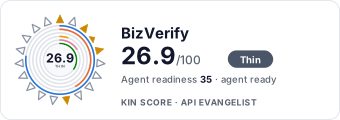
26.5/100 emerging ▬ flat Agent 28/100 agent aware Full breakdown ↓
scored 2026-08-05 · rubric v0.9.1
2 APIs
Business VerificationKYBKnow Your BusinessEntity VerificationComplianceMCPAgent-nativeDeveloper Tools

Kin Score

Kin Score Kin Score How this is scored →
scored 2026-08-05 · rubric v0.9.1
Composite quality — 26.5/100 · emerging
Contract Quality 12.8 / 25
Developer Ergonomics 1.7 / 20
Commercial Clarity 4.2 / 20
Operational Transparency 0.0 / 13
Governance 0.0 / 12
Discoverability 7.8 / 10
Agent readiness — 28/100 · agent aware
Machine-Readable Contract 18 / 18
Agentic Access Contract 0 / 10
MCP Server 0 / 12
Machine-Readable Auth 0 / 10
Idempotency 9 / 9
Stable Error Semantics 0 / 8
Request/Response Examples 0 / 7
Rate-Limit Signaling 0 / 7
Typed Event Surface 0 / 6
Agent Skills 0 / 5
Well-Known Catalog 4 / 4
Consent & Bot Identity 0 / 3
A2A Agent Card 0 / 8
Dry-Run / Simulate Mode 0 / 4
Improve this rating by publishing the missing artifacts — every area above can be raised, and the full rubric is at apis.io/rating/. This rating is computed from github.com/api-evangelist/bizverify: open an issue to ask a question, or submit a pull request to add artifacts. Want it done for you? Prioritized profiling — $2,500 →

APIs 2

Individual APIs this provider publishes, each with its own machine-readable definition.

BizVerify API

REST API for business entity verification. 21 operations across 20 paths covering verification submission and job status, entity lookup and history, jurisdiction discovery, acco...

BizVerify MCP Server

Hosted MCP server over Streamable HTTP exposing nine tools — get_config, list_jurisdictions, verify_business, search_entities, check_job_status, get_entity, get_entity_history, ...

Resources

Documentation 1

Reference material describing how the API behaves

Agent Surfaces 4

MCP servers, agent skills, and machine-readable catalogs

Commercial 2

Pricing, plans, and the legal terms of use

Company 1

The organization behind the API

Other 2

Properties that don't map to a standard resource type

Source (apis.yml)

apis.yml Raw ↑
name: BizVerify
description: 'BizVerify is a business entity verification (KYB) API built for AI agents as much as for developers. It confirms
  business registrations, status, good standing and available public company details across supported US and international
  jurisdictions, through a REST API and a hosted MCP server that exposes the same capability as nine tools. The agent surface
  is the unusual part for a provider this size: alongside the OpenAPI it publishes an llms.txt, a proper RFC 9727 API catalog
  served as application/linkset+json, per-vendor tool manifests at /tools/openai.json and /tools/anthropic.json, and an open-source
  MCP client repository. Access is credit-based with a free-tier allowance, and the MCP server answers tools/list without
  credentials.'
url: https://bizverify.apievangelist.com/apis.yml
created: '2026-08-02'
modified: '2026-08-02'
specificationVersion: '0.21'
tags:
- Business Verification
- KYB
- Know Your Business
- Entity Verification
- Compliance
- MCP
- Agent-native
- Developer Tools
apis:
- name: BizVerify API
  description: REST API for business entity verification. 21 operations across 20 paths covering verification submission and
    job status, entity lookup and history, jurisdiction discovery, account and credit management, and access-request auth.
    OpenAPI 3.0.3. Authenticates with an API key in the X-API-Key header or a bearer token.
  humanURL: https://docs.bizverify.co
  baseURL: https://api.bizverify.co
  tags:
  - Business Verification
  - KYB
  - Entity Verification
  - Compliance
  properties:
  - type: OpenAPI
    url: openapi/bizverify-openapi.json
  - type: OpenAPI
    url: https://api.bizverify.co/v1/openapi.json
  - type: Documentation
    url: https://docs.bizverify.co
  - type: SignUp
    url: https://bizverify.co
- name: BizVerify MCP Server
  description: 'Hosted MCP server over Streamable HTTP exposing nine tools — get_config, list_jurisdictions, verify_business,
    search_entities, check_job_status, get_entity, get_entity_history, get_account and purchase_credits. Discovery is public:
    tools/list answers without credentials. An open-source client repository is published separately.'
  humanURL: https://github.com/BizVerify/bizverify-mcp
  baseURL: https://api.bizverify.co/mcp
  tags:
  - MCP
  - Agent-native
  - Business Verification
  - KYB
  properties:
  - type: MCP
    url: https://api.bizverify.co/mcp
  - type: MCPTools
    url: mcp/bizverify-mcp-tools.json
  - type: SourceCode
    url: https://github.com/BizVerify/bizverify-mcp
common:
- type: Website
  url: https://bizverify.co
- type: Documentation
  url: https://docs.bizverify.co
- type: LLMSTxt
  url: llms/bizverify-llms.txt
- type: LLMSTxt
  url: https://bizverify.co/llms.txt
- type: APICatalog
  url: well-known/bizverify-api-catalog.json
- type: APICatalog
  url: https://bizverify.co/.well-known/api-catalog
- type: AgentSkills
  url: https://api.bizverify.co/tools/openai.json
- type: AgentSkills
  url: https://api.bizverify.co/tools/anthropic.json
- type: PrivacyPolicy
  url: https://bizverify.co/privacy
- type: TermsOfService
  url: https://bizverify.co/terms
maintainers:
- FN: BizVerify
  url: https://bizverify.co
x-evidence:
  harvested: '2026-08-02'
  request: api-search/inbox#1
  probes:
  - https://api.bizverify.co/v1/openapi.json -> HTTP 200, OpenAPI 3.0.3, 20 paths / 21 ops
  - https://bizverify.co/llms.txt -> HTTP 200, 5,871 bytes, text/plain
  - https://bizverify.co/.well-known/api-catalog -> HTTP 200, application/linkset+json, 808 bytes
  - https://api.bizverify.co/mcp tools/list -> HTTP 200, 9 tools, no credentials required
  - https://api.bizverify.co/tools/openai.json -> HTTP 200
  - https://api.bizverify.co/tools/anthropic.json -> HTTP 200
  - https://docs.bizverify.co, /privacy, /terms -> HTTP 200
  - https://bizverify.co/this-does-not-exist-xyz789 -> HTTP 404, 0 bytes (no catch-all; the 200s above are real)
  defects_found:
    empty_servers: 'The published OpenAPI declares `servers: []`. Nothing in the document says the API is served from https://api.bizverify.co,
      so it is not callable as published. The baseURL recorded here comes from the API catalog linkset and from the live host,
      not from the spec.'
    no_schemas: 21 operations and zero `components.schemas`. Request and response bodies are undescribed, which is the single
      largest gap in the contract and the highest-leverage thing to fix.
    user_agent_gate: https://api.bizverify.co/v1/openapi.json returns HTTP 403 to `Python-urllib/3.14` while returning 200
      to curl, to an empty user-agent, and to `python-requests/2.32.3`. So the block is specific to urllib rather than to
      automated clients generally — narrower than it first appeared, but still enough to silently starve any harvester built
      on urllib, which would record nothing and understate the provider. Harvested here with curl.
  note: Built from the provider's own published artifacts, all fetched and measured. The MCP property is emitted because the
    server is hosted and answers tools/list unauthenticated — unlike a local-stdio install, which is described in prose only.
    Pricing is credit-based with a free tier per the MCP get_config tool, but no machine-readable rate card was found, so
    plans and rate limits are not asserted.