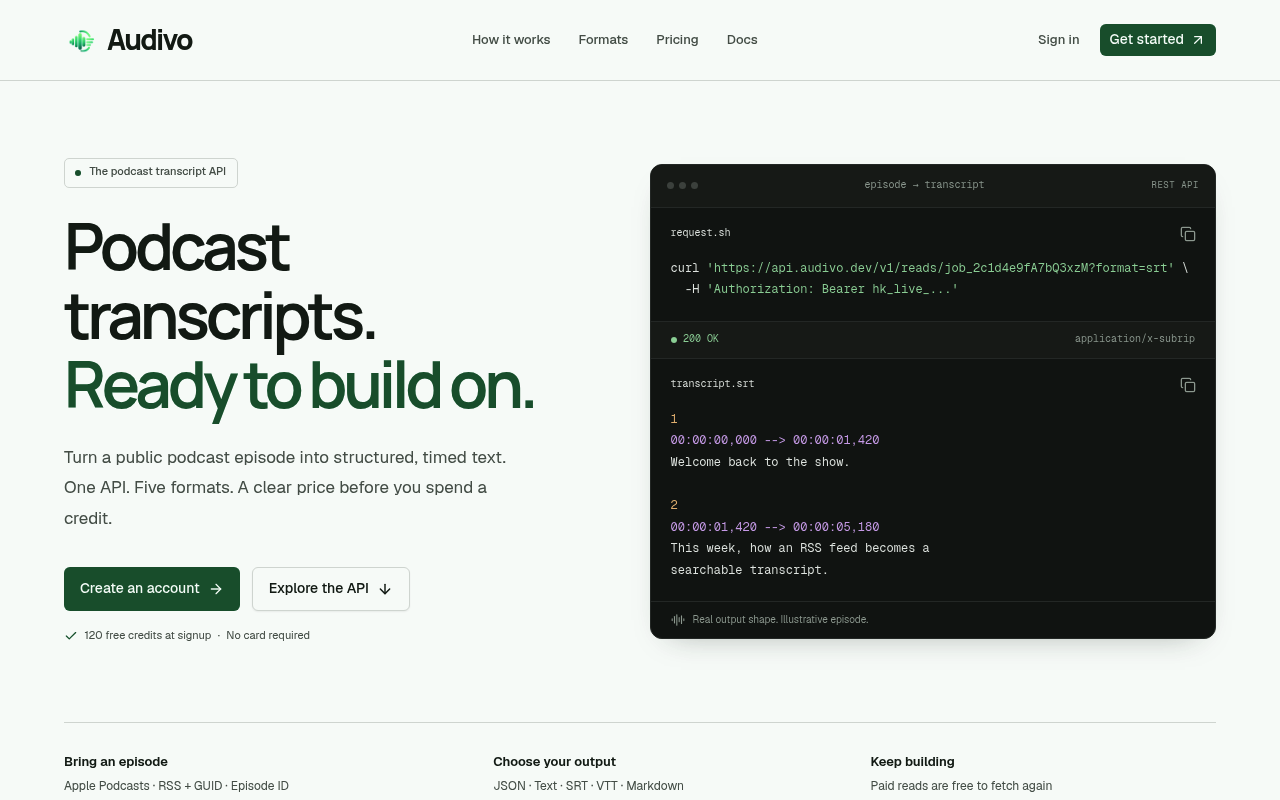
audivo-dev website screenshot

audivo-dev

Audivo provides a podcast transcript API that transforms public podcast episodes into structured, timed text in multiple formats such as JSON, SRT, VTT, and Markdown. The service offers a clear pricing model with free credits on signup, supports various input methods like RSS feeds and episode IDs, and includes features like caching, quoting, and rate limits. Audivo aims to simplify integration of podcast content for developers building searchable or analytical applications.

audivo-dev publishes 11 API contracts indexed on the APIs.io network, including Account API, API Keys API, Billing API, and 8 more. Tagged areas include Company, Podcasts, Transcripts, and Audio.

The audivo-dev catalog on APIs.io includes 1 JSON-LD context and 1 Spectral governance ruleset.

audivo-dev’s developer surface includes changelog, authentication, documentation, API reference, getting-started guide, support, and 26 more developer resources.

Pull audivo-dev's APIs, OpenAPI, scores and pricing into your own code or AI agent with a free APIs.io key — sign in with GitHub, Google or LinkedIn. No form to fill in; signing in shares your email address with us (Privacy).
45.7/100 developing ▬ flat Agent 64/100 agent native Full breakdown ↓
scored 2026-11-21 · rubric v0.28.1 · Show this score on your site →
1 published contract 5 Agent Skills
CompanyPodcastsTranscriptsAudio

Kin Score

Kin Score Kin Score How this is scored →
scored 2026-11-21 · rubric v0.28.1

Regulatory Posture applies to this provider. Its tags matched the Horizontal (data, software, accessibility, platform) regime, so Regulatory Posture carries 15 points of the composite. If this regime is wrong for your business, say so on your provider repo — the applicability map is public and we will correct it.
Create-or-Update Ergonomics applies to this provider. This API accepts writes, so it carries 10 points of the composite. It is scored from the published contracts themselves: whether a caller can create-or-update in one call, whether the write accepts a key the caller already holds, and whether the response says which branch ran. Without that, every write needs a search-and-branch in front of it, and the first time that check is skipped a duplicate record is created. Scored against the observed mean rather than raw — a provider at the catalog average is unchanged by this facet, not penalised by it.
The six quality facets above are damped to 75 points between them, because the conditional facet above carries the other 25. That is why each facet's contribution is shown against a damped maximum: raising a quality facet moves the composite by 75% of its nominal weight, not 100%. The full arithmetic is at apis.io/rating/.
Show this score on your site. Kin Score badge preview for audivo-dev It updates itself when the score changes. Paste this where you link to your API docs:
<a href="https://apis.io/providers/audivo-dev/"><img src="https://apis.io/badge/audivo-dev/card.svg" alt="audivo-dev on APIs.io — Kin Score by API Evangelist"></a>
Other styles, a README pill and a shields.io endpoint are on the badge page.
Raise your score.
Agent readiness — checks not met, largest first (exact, from this profile):
  • MCP Server +12 pts — deployment.mode + probe verdict on the mcp/ manifest, not the pointer; an unprobed slug falls back to authorship Ask about this →
  • Documented Reversibility +6 pts — a reversal operation in the contract, graded up when a window is documented too Ask about this →
  • Typed Event Surface +6 pts — AsyncAPI document, OR webhooks/callbacks objects in the as-published OpenAPI, OR common[].type includes Webhooks Ask about this →
  • Agentic Commerce Well-Known Document +5 pts — a parsing /.well-known/ucp (the IANA-registered path, probed first) or ucp.json / acp.json declaring a version and at least one service, OR (0.27) a live x402 payment challenge from _data/x402-adoption.json — `self` when its endpoints are on the provider's own domain, `platform` when they are on a vendor's Ask about this →
  • Well-Known Catalog +4 pts — a served RFC 9727 api-catalog, an AAuth resource document, or (0.28.1) a served AI Catalog (/.well-known/ai-catalog.json with an entries list) or MCP Server Card (/.well-known/mcp/server-card.json); a WellKnown/APICatalog pointer counts only for a never-probed provider Ask about this →
  • Onboarding Descriptor Published +3 pts — the provider page carries onboarding_descriptor.published (an APIOnboarding pointer, provider- or API-level, or a saved /.well-known/api-onboarding body with an `aod` key, build.py _onboarding_descriptor_meta) Ask about this →
1 more unmet check in the Agent Readiness table above.
Kin Score — facets with the most composite points still available (weight × headroom):
Each check links to what satisfies it. Publish the artifact, or tell us where it already lives, and the score moves on the next scoring run.
Not sure how this applies to your stack? Ask about any one item. Kin Lane reads every question, looks at your profile and your situation, and replies with what a fix would take — scoped to that one area, priced up front, yours whether you ship it or not. Ask a question →
Ask about:
Audivo Dev · a person reads this and replies by email.
or email info@apis.io
Improve this rating by publishing the missing artifacts — every area above can be raised, and the full rubric is at apis.io/rating/. Every facet and dimension name above is a link: it opens that measurement's own page — what it means, the exact checks that feed it, how the whole catalog distributes on it, and the providers at the top of it. This rating is computed from the provider profile at artifacts.apis.io/audivo-dev/apis.yml: open an issue on github.com/api-evangelist/audivo-dev to ask a question or point us at an artifact you publish. Submit an artifact on GitHub — free → Manage your own listing — the Influence plan, $499/mo →

Standards implemented 4

Standards this provider implements or carries. De facto ones are profiled and measured by the API Commons; formal ones come from the standards directory and are linked by the provider's own tags. The evidence column says how each claim was established — not that it was made.

measured — observed by APIs.io (conformant)
measured — observed by APIs.io (verified)
measured — observed by APIs.io (published)

APIs 11

Individual APIs this provider publishes, each with its own machine-readable definition.

audivo-dev Account API

Usage, limits, and supported languages for the calling account.

audivo-dev API Keys API

Dashboard-JWT key lifecycle management.

audivo-dev Billing API

Dashboard-JWT Stripe Checkout, Customer Portal, invoices, and refunds.

audivo-dev Catalog API

Public podcast show/episode search, charts, detail, and resolution. Every metadata/search/list call in this tag costs 1 credit; no catalog response echoes `credits_charged`, so ...

audivo-dev Connected Apps API

Dashboard-JWT consent for an assistant connecting to the MCP server through OAuth, and the account's connected apps, each revocable.

audivo-dev Data API

Dashboard-JWT portable export and account deletion.

audivo-dev Groups API

The job group: what one confirm created. A group holds N ≥ 1 members, each a transcription job or a settled cache read; a single-episode `POST /v1/transcripts` is a group of one...

audivo-dev Quotes API

Price a selection before spending. A quote resolves every episode in it, records what it resolved under a short TTL, and reserves nothing; the confirm that follows is the operat...

audivo-dev Session API

Dashboard-JWT session establishment. One operation, called by the dashboard's backend-for-frontend whenever it turns a Cognito sign-in into a Audivo session, and the one place a...

audivo-dev Transcripts API

Create, poll, retrieve, and cancel transcription jobs.

audivo-dev Uploads API

Audio the caller puts in Audivo's bucket and names as a source (ADR-0031).

Scroll for all 11

Agent Skills 5

Packaged agent skills for driving this provider's APIs from an AI assistant.

Terms of Service 1

What its API terms permit and prohibit, quoted from its own page.

audivo-dev

9 quoted statements, read from audivo-dev's own page on 2026-11-09.

TERMS

Privacy & Data 1

Its role, the data it processes, retention and transfers, quoted from its own privacy page.

audivo-dev

20 quoted statements, read from audivo-dev's own page on 2026-11-09.

PRIVACY

Eligibility 1

Who may sign up and where, quoted from its own terms.

audivo-dev

4 quoted statements, read from audivo-dev's own page on 2026-11-09.

ELIGIBILITY

AI Preferences 1

Its stance on AI training, inference and agents, quoted from its own pages.

audivo-dev

2 quoted statements, read from audivo-dev's own page on 2026-11-09.

AI PREFS

Data License 1

How its data and outputs may be reused, quoted from its own terms.

audivo-dev

1 quoted statement, read from audivo-dev's own page on 2026-11-09.

LICENSE

Semantic Vocabularies 1

JSON-LD contexts and semantic vocabularies used across these APIs.

Audivo Dev Context

94 classes · 199 properties

JSON-LD

Spectral Rules 1

Spectral governance rulesets for linting and validating these APIs. Counts are the severity each rule declares, not results of running them.

audivo-dev API Rules

62 rules · 54 error-severity 7 warn-severity 1 info-severity

SPECTRAL

JSON Schema 22

Standalone JSON Schema definitions for this provider's data models.

ApiKeyCreateRequest

2 properties

JSON SCHEMA

ApiKeyCreateResponse

7 properties

JSON SCHEMA

ApiKeysListResponse

1 properties

JSON SCHEMA

AutoRechargeResponse

7 properties

JSON SCHEMA

ChartResponse

5 properties

JSON SCHEMA

ConnectedAppsListResponse

1 properties

JSON SCHEMA

CreateUploadRequest

5 properties

JSON SCHEMA

DataDeletionReceipt

3 properties

JSON SCHEMA

DataExportResponse

2 properties

JSON SCHEMA

EpisodesListResponse

2 properties

JSON SCHEMA

JobGroupResponse

13 properties

JSON SCHEMA

JobStatus

17 properties

JSON SCHEMA

OAuthDecisionRequest

1 properties

JSON SCHEMA

OAuthDecision

2 properties

JSON SCHEMA

OAuthRequestView

6 properties

JSON SCHEMA

QuoteResponse

14 properties

JSON SCHEMA

ResolveResult

6 properties

JSON SCHEMA

SessionResponse

3 properties

JSON SCHEMA

ShowSearchResponse

3 properties

JSON SCHEMA

TranscriptRead

9 properties

JSON SCHEMA

UploadCreated

9 properties

JSON SCHEMA

UsageResponse

10 properties

JSON SCHEMA

Scroll for all 22

Security Posture 2

Authentication, domain security, vulnerability disclosure, and trust-center signals.

audivo-dev Authentication

2 schemes

SECURITY

audivo-dev Domain Security

TLSv1.3 · HSTS

SECURITY

Agentic Access (API Evangelist recommendations) 1

Recommended x-agentic-access execution contracts for AI agents.

audivo-dev Agentic Access

36 operations · 17 acting · 2 human-in-the-loop

36 operations · 17 acting

AGENTIC

Resources

Get Started 2

Portal, sign-up, and the first successful call

Documentation 3

Reference material describing how the API behaves

Agent Surfaces 4

MCP servers, agent skills, and machine-readable catalogs

Design & Contract 8

Pagination, idempotency, versioning, errors, and events

Scroll for all 8

Access & Security 2

Authentication, authorization, and security posture

Operate 3

Status, limits, changes, and where to get help

Commercial 4

Pricing, plans, and the legal terms of use

Company 1

The organization behind the API

Other 5

Properties that don't map to a standard resource type

Source (apis.yml)

apis.yml Raw ↑
aid: audivo-dev
name: audivo-dev
accessModel:
  pricing: unknown
  onboarding: unknown
  trial: false
  try_now: false
  public: false
  label: Unknown
  confidence: low
  source:
  - authentication
  - security
  generated: '2026-11-20'
  method: derived
image: https://audivo.dev/opengraph-image?94d944e67a07dad7
description: Audivo provides a podcast transcript API that transforms public podcast episodes into structured, timed text
  in multiple formats such as JSON, SRT, VTT, and Markdown. The service offers a clear pricing model with free credits on
  signup, supports various input methods like RSS feeds and episode IDs, and includes features like caching, quoting, and
  rate limits. Audivo aims to simplify integration of podcast content for developers building searchable or analytical applications.
url: https://artifacts.apis.io/audivo-dev/apis.yml
x-type: company
x-source: harvest:mcp-registry
x-tier: profiled
x-tier-reason: enrichment pass 2026-10-30 (modular-v1; was harvest)
specificationVersion: '0.20'
created: '2026-10-30'
modified: '2026-10-30'
tags:
- Company
- Podcasts
- Transcripts
- Audio
tags_raw:
- Company
- Podcast
- Transcripts
- API
- Audio
maintainers:
- FN: Kin Lane
  email: kin@apievangelist.com
- FN: APIs.json
  email: info@apis.io
common:
- type: AgenticAccess
  url: agentic-access/audivo-dev-agentic-access.yml
- type: Spectral
  url: rules/audivo-dev-rules.yml
- type: JSONLD
  url: json-ld/audivo-dev-context.jsonld
- type: Vocabulary
  url: vocabulary/audivo-dev-vocabulary.yml
- type: AgentSkill
  url: skills/_index.yml
- type: DataModel
  url: data-model/audivo-dev-data-model.yml
- type: ChangeLog
  url: changelog/audivo-dev-changelog.yml
- type: Idempotency
  url: conventions/audivo-dev-conventions.yml
- type: Conventions
  url: conventions/audivo-dev-conventions.yml
- type: Authentication
  url: authentication/audivo-dev-authentication.yml
- type: ErrorCatalog
  url: errors/audivo-dev-problem-types.yml
- type: Conformance
  url: conformance/audivo-dev-conformance.yml
- type: LLMsTxt
  url: llms/audivo-dev-llms.txt
- type: AgentCard
  url: a2a/audivo-dev-a2a.yml
- type: WellKnown
  url: well-known/audivo-dev-well-known.yml
- type: Hosts
  url: hosts/audivo-dev-hosts.yml
- type: Vendors
  url: vendors/audivo-dev-vendors.yml
- type: Login
  url: https://dash.audivo.dev/signin
- type: ChangeLog
  url: https://docs.audivo.dev/changelog
- type: DomainSecurity
  url: security/audivo-dev-domain-security.yml
- type: Website
  url: https://audivo.dev/
- type: Documentation
  url: https://docs.audivo.dev/
- type: APIReference
  url: https://docs.audivo.dev/api-reference/
- type: GettingStarted
  url: https://docs.audivo.dev/quickstart
- type: Support
  url: https://audivo.dev/support
- type: PrivacyPolicy
  url: https://audivo.dev/privacy
- type: TermsOfService
  url: https://audivo.dev/terms
- type: UsageTerms
  url: terms/audivo-dev-terms-of-service.yml
- type: DataProcessing
  url: privacy/audivo-dev-privacy-policy.yml
- type: Eligibility
  url: eligibility/audivo-dev-eligibility.yml
- type: AIPreferences
  url: ai-preferences/audivo-dev-ai-preferences.yml
- type: DataLicense
  url: data-license/audivo-dev-data-license.yml
apis:
- aid: audivo-dev:audivo-dev-account-api
  name: audivo-dev Account API
  description: Usage, limits, and supported languages for the calling account.
  humanURL: https://docs.audivo.dev
  baseURL: https://api.audivo.dev
  tags:
  - Account
  properties:
  - type: OpenAPI
    url: openapi/audivo-dev-account-api-openapi.yml
  - type: JSONSchema
    url: json-schema/audivo-dev-usage-response-schema.json
- aid: audivo-dev:audivo-dev-api-keys-api
  name: audivo-dev API Keys API
  description: Dashboard-JWT key lifecycle management.
  humanURL: https://docs.audivo.dev
  baseURL: https://api.audivo.dev
  tags:
  - APIKeys
  tags_raw:
  - API Keys
  properties:
  - type: OpenAPI
    url: openapi/audivo-dev-api-keys-api-openapi.yml
  - type: JSONSchema
    url: json-schema/audivo-dev-api-key-create-response-schema.json
  - type: JSONSchema
    url: json-schema/audivo-dev-api-key-create-request-schema.json
  - type: JSONSchema
    url: json-schema/audivo-dev-api-keys-list-response-schema.json
- aid: audivo-dev:audivo-dev-billing-api
  name: audivo-dev Billing API
  description: Dashboard-JWT Stripe Checkout, Customer Portal, invoices, and refunds.
  humanURL: https://docs.audivo.dev
  baseURL: https://api.audivo.dev
  tags:
  - Billing
  properties:
  - type: OpenAPI
    url: openapi/audivo-dev-billing-api-openapi.yml
  - type: JSONSchema
    url: json-schema/audivo-dev-auto-recharge-response-schema.json
- aid: audivo-dev:audivo-dev-catalog-api
  name: audivo-dev Catalog API
  description: 'Public podcast show/episode search, charts, detail, and resolution. Every metadata/search/list call in this
    tag costs 1 credit; no catalog response echoes `credits_charged`, so the charge is stated here rather than per-response.
    Not yet applied: the discovery operations shipped in 0.2.0 (`GET /v1/search/shows`, `GET /v1/charts`) are metered by request
    rate only and write no credit-bearing row; the per-call charge lands with the catalog reads that bill.'
  humanURL: https://docs.audivo.dev
  baseURL: https://api.audivo.dev
  tags:
  - Catalog
  properties:
  - type: OpenAPI
    url: openapi/audivo-dev-catalog-api-openapi.yml
  - type: JSONSchema
    url: json-schema/audivo-dev-resolve-result-schema.json
  - type: JSONSchema
    url: json-schema/audivo-dev-chart-response-schema.json
  - type: JSONSchema
    url: json-schema/audivo-dev-show-search-response-schema.json
  - type: JSONSchema
    url: json-schema/audivo-dev-episodes-list-response-schema.json
- aid: audivo-dev:audivo-dev-connected-apps-api
  name: audivo-dev Connected Apps API
  description: Dashboard-JWT consent for an assistant connecting to the MCP server through OAuth, and the account's connected
    apps, each revocable.
  humanURL: https://docs.audivo.dev
  baseURL: https://api.audivo.dev
  tags:
  - Connected Apps
  properties:
  - type: OpenAPI
    url: openapi/audivo-dev-connected-apps-api-openapi.yml
  - type: JSONSchema
    url: json-schema/audivo-dev-oauth-request-view-schema.json
  - type: JSONSchema
    url: json-schema/audivo-dev-oauth-decision-schema.json
  - type: JSONSchema
    url: json-schema/audivo-dev-connected-apps-list-response-schema.json
  - type: JSONSchema
    url: json-schema/audivo-dev-oauth-decision-request-schema.json
- aid: audivo-dev:audivo-dev-data-api
  name: audivo-dev Data API
  description: Dashboard-JWT portable export and account deletion.
  humanURL: https://docs.audivo.dev
  baseURL: https://api.audivo.dev
  tags:
  - Data
  properties:
  - type: OpenAPI
    url: openapi/audivo-dev-data-api-openapi.yml
  - type: JSONSchema
    url: json-schema/audivo-dev-data-deletion-receipt-schema.json
  - type: JSONSchema
    url: json-schema/audivo-dev-data-export-response-schema.json
- aid: audivo-dev:audivo-dev-groups-api
  name: audivo-dev Groups API
  description: 'The job group: what one confirm created. A group holds N ≥ 1 members, each a transcription job or a settled
    cache read; a single-episode `POST /v1/transcripts` is a group of one. A caller reads a group''s rollup, lists their own
    groups newest first, and cancels a group, which cancels every member not yet started and releases each reservation exactly
    once.'
  humanURL: https://docs.audivo.dev
  baseURL: https://api.audivo.dev
  tags:
  - Group
  tags_raw:
  - Groups
  properties:
  - type: OpenAPI
    url: openapi/audivo-dev-groups-api-openapi.yml
  - type: JSONSchema
    url: json-schema/audivo-dev-job-group-response-schema.json
- aid: audivo-dev:audivo-dev-quotes-api
  name: audivo-dev Quotes API
  description: Price a selection before spending. A quote resolves every episode in it, records what it resolved under a short
    TTL, and reserves nothing; the confirm that follows is the operation that spends, and it answers with a job group.
  humanURL: https://docs.audivo.dev
  baseURL: https://api.audivo.dev
  tags:
  - Quotes
  properties:
  - type: OpenAPI
    url: openapi/audivo-dev-quotes-api-openapi.yml
  - type: JSONSchema
    url: json-schema/audivo-dev-quote-response-schema.json
  - type: JSONSchema
    url: json-schema/audivo-dev-job-group-response-schema.json
- aid: audivo-dev:audivo-dev-session-api
  name: audivo-dev Session API
  description: Dashboard-JWT session establishment. One operation, called by the dashboard's backend-for-frontend whenever
    it turns a Cognito sign-in into a Audivo session, and the one place a caller who does not yet have an account is served.
  humanURL: https://docs.audivo.dev
  baseURL: https://api.audivo.dev
  tags:
  - Sessions
  tags_raw:
  - Session
  properties:
  - type: OpenAPI
    url: openapi/audivo-dev-session-api-openapi.yml
  - type: JSONSchema
    url: json-schema/audivo-dev-session-response-schema.json
- aid: audivo-dev:audivo-dev-transcripts-api
  name: audivo-dev Transcripts API
  description: Create, poll, retrieve, and cancel transcription jobs.
  humanURL: https://docs.audivo.dev
  baseURL: https://api.audivo.dev
  tags:
  - Transcripts
  properties:
  - type: OpenAPI
    url: openapi/audivo-dev-transcripts-api-openapi.yml
  - type: JSONSchema
    url: json-schema/audivo-dev-job-status-schema.json
  - type: JSONSchema
    url: json-schema/audivo-dev-transcript-read-schema.json
- aid: audivo-dev:audivo-dev-uploads-api
  name: audivo-dev Uploads API
  description: Audio the caller puts in Audivo's bucket and names as a source (ADR-0031).
  humanURL: https://docs.audivo.dev
  baseURL: https://api.audivo.dev
  tags:
  - Uploads
  properties:
  - type: OpenAPI
    url: openapi/audivo-dev-uploads-api-openapi.yml
  - type: JSONSchema
    url: json-schema/audivo-dev-upload-created-schema.json
  - type: JSONSchema
    url: json-schema/audivo-dev-create-upload-request-schema.json
x-enrichment:
  date: '2026-10-30'
  status: enriched
  artifacts_added: 43
  pass: modular-v1
  engine: identity=local,contract=local,surfaces=local,docs=local,regulatory=local

audivo-dev API — frequently asked questions

Does audivo-dev have an API?

Yes. APIs.io lists 11 APIs from audivo-dev, including audivo-dev Account API, audivo-dev API Keys API and audivo-dev Billing API, and 8 more.

Is there an OpenAPI specification for the audivo-dev API?

Yes. APIs.io indexes 11 OpenAPI specifications for audivo-dev, each linked for download from this page.

How do I authenticate with the audivo-dev API?

audivo-dev documents its authentication (2 schemes). The details are profiled on APIs.io as audivo-dev Authentication.

Is the audivo-dev API ready for AI agents?

audivo-dev has a Kin Score of 45.7 out of 100 (developing) and an Agent Readiness score of 64.4 (agent-native), scored by API Evangelist on 2026-11-21.

Work with this as data

Every provider here is available over the APIs.io API and to AI agents over MCP.

MCP server

One button, every client — Claude, Cursor, VS Code and the rest.

https://apis.io/mcp

Tools for providers

9 MCP tools reach this
  • find_providersBrowse and filter every provider in the catalog.
  • get_provider_artifactsEvery artifact this provider publishes, grouped by type.
  • get_provider_operationsEvery operation across all of their OpenAPIs — one call instead of parsing every spec.
  • get_provider_toolsEvery MCP tool they ship, with the operation each wraps.
  • get_provider_evidenceHow each part of their score was established. Free — the basis for a claim should not sit behind it.
  • get_provider_ratingPRO — composite, band, trend and facet scores.
  • apis_io_searchSTART HERE — APIs, providers and tags for one query, each with its total.
  • resolveTurn a domain, URL or GitHub org into the provider it belongs to.
  • find_cohortsEvery scored population of providers in the catalog.
All 92 tools →

Call it yourself

curl for this page
This provider
curl "https://apis.io/api/v1/providers/audivo-dev"
All providers
curl "https://apis.io/api/v1/providers?limit=25"
Every operation they expose
curl "https://apis.io/api/v1/providers/audivo-dev/operations?limit=25"
How their score was established
curl "https://apis.io/api/v1/providers/audivo-dev/evidence"

Calls without X-API-Key need no key. Calls with it need a paid plan — get a key.

Get an API key

Free tier, no form to fill in. Signing in shares your email address with us — we store it to create your key and to recognise you if you sign in with another provider. By signing up you are subscribing to the APIs.io and API Evangelist newsletters — you can unsubscribe from any issue. See our Privacy Policy and Terms.

A second provider on the same verified email joins the account you already have.
