APIANT
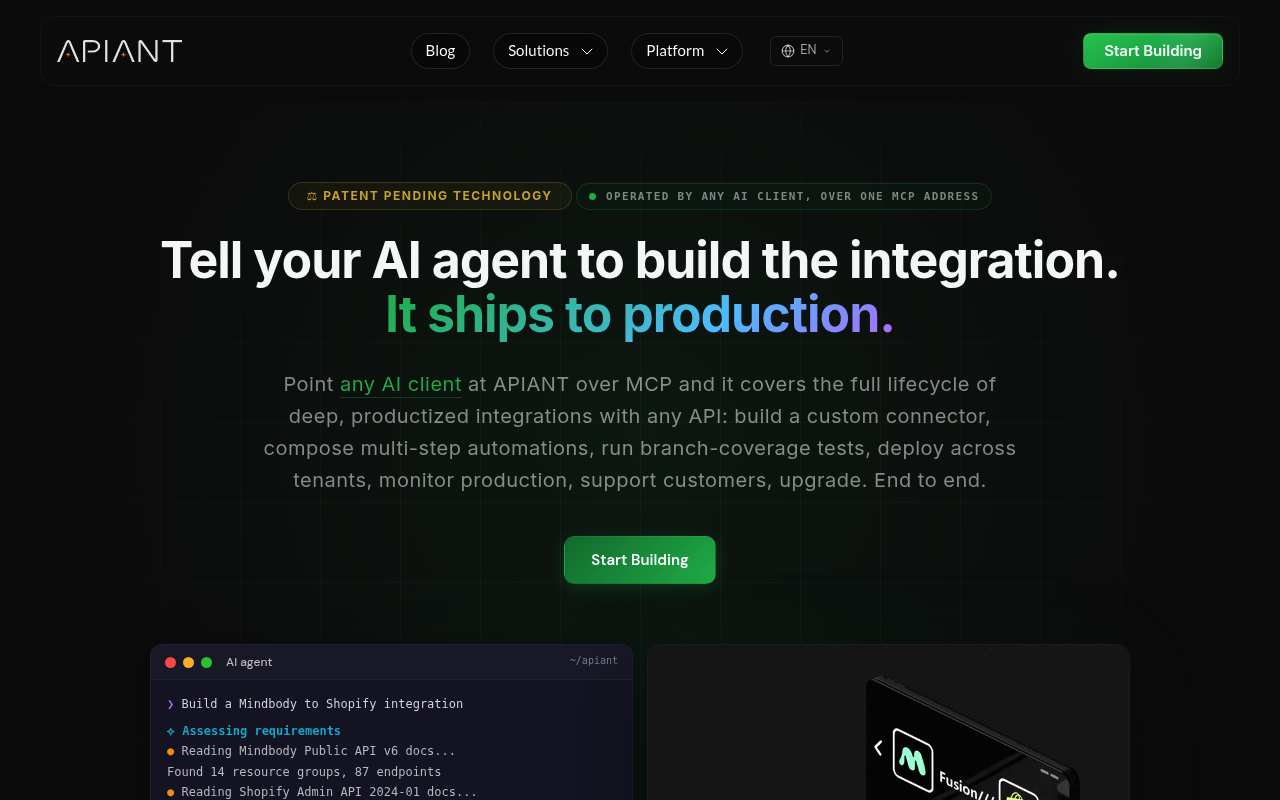
APIANT provides an AI‑driven integration platform that lets users build, test, and run API integrations automatically. The service offers a visual editor, automation and assembly tools, and a marketplace of pre‑built connectors for SaaS applications like Mindbody, Shopify, and many others. Users can start for free, connect their APIs, define workflows, and deploy them to production with monitoring and error handling. APIANT targets SaaS companies, system integrators, and enterprises seeking to accelerate integration development with AI assistance.
APIANT is profiled on the APIs.io network. Tagged areas include Company, Integration, Artificial Intelligence, Automation, and Software-as-a-Service.
APIANT’s developer surface includes authentication, support, documentation, API reference, getting-started guide, engineering blog, pricing, and 17 more developer resources.
Kin Score
 Kin Score
How this is scored →
scored 2026-11-21 · rubric v0.28.1
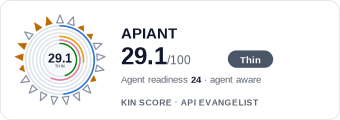 It updates itself when the score changes. Paste this where you link to your API docs:
<a href="https://apis.io/providers/apiant/"><img src="https://apis.io/badge/apiant/card.svg" alt="APIANT on APIs.io — Kin Score by API Evangelist"></a>Other styles, a README pill and a shields.io endpoint are on the badge page.
- Machine-Readable Contract +18 pts — api_specs includes an OpenAPI document Ask about this →
- MCP Server +12 pts — deployment.mode + probe verdict on the mcp/ manifest, not the pointer; an unprobed slug falls back to authorship Ask about this →
- Agentic Access Contract +10 pts — agentic_access artifact present (x-agentic-access), graded by author Ask about this →
- Idempotency +9 pts — OpenAPI mutating operations declare an idempotency key — a header, a request-body property, or a named de-duplication token whose own description says so (verified); else common[].type matches /idempoten/i (documented) Ask about this →
- A2A Agent Card +8 pts — a2a/
-a2a.yml manifest, graded on conformance.grade against A2A 1.0.0 Ask about this → - Stable Error Semantics +8 pts — OpenAPI $refs a shared error schema across 4xx/5xx responses (verified), else common[].type includes ErrorCatalog / ErrorCodes / DeclineCodes Ask about this →
- Contract Quality scores 0.0 — up to +25.0 composite points Ask about this →
- Contract Governance scores 0.0 — up to +12.0 composite points Ask about this →
- Operational Transparency scores 23.8 — up to +9.9 composite points Ask about this →
Used by apps
1 of the reference apps in Applications, across 1 category, integrate with this provider, read from each app's own code, build or integrations page.
- Mindbody Salon & Spa Management
Standards implemented 2
Standards this provider implements or carries. De facto ones are profiled and measured by the API Commons; formal ones come from the standards directory and are linked by the provider's own tags. The evidence column says how each claim was established — not that it was made.
APIANT pricing
Rate limits
- default connection rate limit: 150 API calls per minute
Rate Limits 1
Documented rate limits and quota policies.
APIANT Rate Limits
RATE LIMITSTerms of Service 1
What its API terms permit and prohibit, quoted from its own page.
Privacy & Data 1
Its role, the data it processes, retention and transfers, quoted from its own privacy page.
Eligibility 1
Who may sign up and where, quoted from its own terms.
AI Preferences 1
Its stance on AI training, inference and agents, quoted from its own pages.
Data License 1
How its data and outputs may be reused, quoted from its own terms.
Security Posture 2
Authentication, domain security, vulnerability disclosure, and trust-center signals.
Resources
Get Started 3
Portal, sign-up, and the first successful call
Documentation 3
Reference material describing how the API behaves
Agent Surfaces 2
MCP servers, agent skills, and machine-readable catalogs
Build 1
SDKs, sample code, and the tooling you integrate with
Access & Security 2
Authentication, authorization, and security posture
Operate 2
Status, limits, changes, and where to get help
Commercial 5
Pricing, plans, and the legal terms of use
Company 2
The organization behind the API
Other 4
Properties that don't map to a standard resource type
Source (apis.yml)
APIANT — frequently asked questions
How do I authenticate with the APIANT?
APIANT documents its authentication (2 schemes). The details are profiled on APIs.io as APIANT Authentication.
Is the APIANT ready for AI agents?
APIANT has a Kin Score of 29.9 out of 100 (thin) and an Agent Readiness score of 20.8 (agent-aware), scored by API Evangelist on 2026-11-21.
Work with this as data
Every provider here is available over the APIs.io API and to AI agents over MCP.