Alliance for OpenUSD
The Alliance for OpenUSD (AOUSD) is a Linux Foundation project dedicated to promoting interoperability of 3D content through Universal Scene Description (OpenUSD). Founded by Pixar, Adobe, Apple, Autodesk, and NVIDIA, AOUSD standardizes 3D content ecosystems for film, gaming, architecture, industrial design, and the metaverse. OpenUSD provides a high-performance extensible software platform for collaboratively constructing animated 3D scenes with schemas for geometry, shading, lighting, physics, and volume rendering.
Alliance for OpenUSD is listed with 2 APIs on the APIs.io network. Tagged areas include 3D, Interoperability, Linux Foundation, Metaverse, and OpenUSD.
The Alliance for OpenUSD catalog on APIs.io includes 1 JSON-LD context and 1 Spectral governance ruleset.
Alliance for OpenUSD’s developer surface includes developer portal, documentation, getting-started guide, engineering blog, and 14 more developer resources.
Kin Score
 Kin Score
How this is scored →
scored 2026-11-06 · rubric v0.27.0
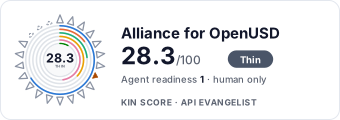 It updates itself when the score changes. Paste this where you link to your API docs:
<a href="https://apis.io/providers/aousd/"><img src="https://apis.io/badge/aousd/card.svg" alt="Alliance for OpenUSD on APIs.io — Kin Score by API Evangelist"></a>Other styles, a README pill and a shields.io endpoint are on the badge page.
- Machine-Readable Contract +18 pts — api_specs includes an OpenAPI document
- MCP Server +12 pts — deployment.mode + probe verdict on the mcp/ manifest, not the pointer; an unprobed slug falls back to authorship
- Agentic Access Contract +10 pts — agentic_access artifact present (x-agentic-access), graded by author
- Machine-Readable Auth +10 pts — a served openid-configuration/oauth-authorization-server carrying `issuer` (served), else the securitySchemes class in the provider OpenAPIs — bound (mutualTLS, DPoP, Signature) > negotiable (oauth2 authorizationCode/clientCredentials, openIdConnect) > bearer (http bearer, apiKey)
- Idempotency +9 pts — OpenAPI mutating operations declare an idempotency key — a header, a request-body property, or a named de-duplication token whose own description says so (verified); else common[].type matches /idempoten/i (documented)
- Stable Error Semantics +8 pts — OpenAPI $refs a shared error schema across 4xx/5xx responses (verified), else common[].type includes ErrorCatalog / ErrorCodes / DeclineCodes
- Contract Quality scores 14.7 — up to +21.3 composite points
- Access Clarity scores 7.9 — up to +18.4 composite points
- Developer Ergonomics scores 47.6 — up to +10.5 composite points
Markets this provider is in provisional
The Kin Score Market layer reads a provider inside its market: its position, and how deep its integrations go. Depth is only comparable within a position. Provisional and unweighted: not part of the Kin Score or agent readiness.
| Market | Position | Depth | Registered MCP server | Declares compatibility |
|---|---|---|---|---|
| XR & Graphics (XR, 3D, GPU graphics) | undeclared | - | - | - |
| Film & Media Identifiers (EIDR, ISAN, MovieLabs, DPP) | undeclared | - | - | - |
Registered MCP server and declares compatibility are report only — not weighted. Undeclared means we found nothing we can read, so there is no number: we never infer integrations.
Standards implemented 2
Standards this provider implements or carries. De facto ones are profiled and measured by the API Commons; formal ones come from the standards directory and are linked by the provider's own tags. The evidence column says how each claim was established — not that it was made.
APIs 2
Individual APIs this provider publishes, each with its own machine-readable definition.
OpenUSD C++ API
The OpenUSD C++ API is the primary interface for working with Universal Scene Description data. Provides access to USD core (scene composition and asset management), UsdImaging ...
OpenUSD Python Bindings
OpenUSD provides comprehensive Python bindings for all major C++ modules, enabling scripting and pipeline integration in Python-based DCC workflows. Python bindings cover the fu...
Alliance for OpenUSD API pricing
Not yet checked against Alliance for OpenUSD's own pricing page. Compiled by API Evangelist on 2026-05-04; confirm before you rely on a figure. A free plan or tier is listed.
| Plan | Price |
|---|---|
| Free freemium | Free |
| Professional paid | Free |
| Enterprise enterprise | — |
Plan details, limits and sources →
Rate limits
- Free Tier Default: 10 requests per minute
- Free Tier Monthly Quota: 1000 requests per month
- Professional Tier Default: 100 requests per minute
Compiled by API Evangelist, not yet checked against Alliance for OpenUSD's documentation. All 5 limits →
Pricing Plans 1
Published pricing tiers and plan structures.
Aousd Plans Pricing
PLANSRate Limits 1
Documented rate limits and quota policies.
Aousd Rate Limits
RATE LIMITSFinOps 1
Cost, billing, and metering signals for API financial operations.
Aousd Finops
FINOPSFeatures 5
Notable capabilities this provider offers.
Scene Composition
USD's composition arcs (references, payloads, variants, instancing, and specializes) enable non-destructive scene assembly from multiple asset layers with override workflows.
Schema-Driven Extensibility
OpenUSD's schema system allows studios and tool vendors to extend the core specification with domain-specific schemas for physics, simulation, characters, and environments.
Hydra Rendering Architecture
The Hydra rendering delegate architecture enables pluggable render backends including Storm (OpenGL), Arnold, RenderMan, and others.
Multiple File Formats
OpenUSD supports human-readable ASCII (.usda), binary (.usdb), and packaged archive (.usdz) file formats for different use cases.
Asset Resolution
The ArResolver system enables customizable asset path resolution for integrating USD with studio asset management systems.
Semantic Vocabularies 1
JSON-LD contexts and semantic vocabularies used across these APIs.
Aousd Context
JSON-LDSpectral Rules 1
Spectral governance rulesets for linting and validating these APIs.
JSON Schema 2
Standalone JSON Schema definitions for this provider's data models.
JSON Structure 2
JSON Structure definitions describing this provider's data shapes.
Aousd Usd Layer Structure
JSON STRUCTUREAousd Usd Prim Structure
JSON STRUCTUREExamples 2
Example request and response payloads for these APIs.
Aousd Usd Layer Example
EXAMPLEAousd Usd Prim Example
EXAMPLESecurity Posture 1
Authentication, domain security, vulnerability disclosure, and trust-center signals.
Use Cases 5
What developers build with this provider.
Film and Visual Effects Production
Exchange complex animated scenes between DCC tools (Maya, Houdini, Blender, Katana) and render farms using OpenUSD as the common format.
Game Development
Use OpenUSD as an interchange format between game engines like Unreal Engine and Unity and DCC content creation tools.
Architecture and Design Visualization
Share 3D building models, materials, and lighting between architectural design tools and real-time visualization platforms.
Metaverse and XR
Enable interoperability of 3D assets and scenes across XR platforms, spatial computing devices, and virtual world applications.
Industrial Digital Twins
Represent complex mechanical assemblies and simulation environments for industrial digital twin applications using USD schemas.
Integrations 5
Pre-built integrations with other platforms and tools.
Autodesk Maya / 3ds Max
Import and export USD files via Autodesk's official USD plugins for Maya and 3ds Max, enabling OpenUSD-based pipelines.
SideFX Houdini
Native USD integration in Houdini via LOPs (Layout Object Primitives) for creating and editing USD scenes and assets.
Apple Reality Composer Pro
Apple's spatial computing tools use .usdz as the primary format for augmented reality and visionOS content.
NVIDIA Omniverse
NVIDIA Omniverse is built on OpenUSD, using it as the foundation for collaborative 3D design and industrial digital twin workflows.
Pixar RenderMan
RenderMan natively reads USD scenes, making it the primary production renderer for USD-based feature film pipelines.
Resources
Get Started 2
Portal, sign-up, and the first successful call
Documentation 3
Reference material describing how the API behaves
Design & Contract 1
Pagination, idempotency, versioning, errors, and events
Build 3
SDKs, sample code, and the tooling you integrate with
Access & Security 2
Authentication, authorization, and security posture
Operate 3
Status, limits, changes, and where to get help
Commercial 2
Pricing, plans, and the legal terms of use
Company 2
The organization behind the API
Source (apis.yml)
Alliance for OpenUSD API — frequently asked questions
Does Alliance for OpenUSD have an API?
Yes. APIs.io lists 2 APIs from Alliance for OpenUSD, including OpenUSD C++ API and OpenUSD Python Bindings.
How much does the Alliance for OpenUSD API cost?
APIs.io lists 3 pricing plans for Alliance for OpenUSD, with each plan's price, limits and inclusions under Pricing on this page.
Is the Alliance for OpenUSD API ready for AI agents?
Alliance for OpenUSD has a Kin Score of 28.3 out of 100 (thin) and an Agent Readiness score of 0.6 (human-only), scored by API Evangelist on 2026-11-06.
Work with this as data
Every provider here is available over the APIs.io API and to AI agents over MCP.