Zed
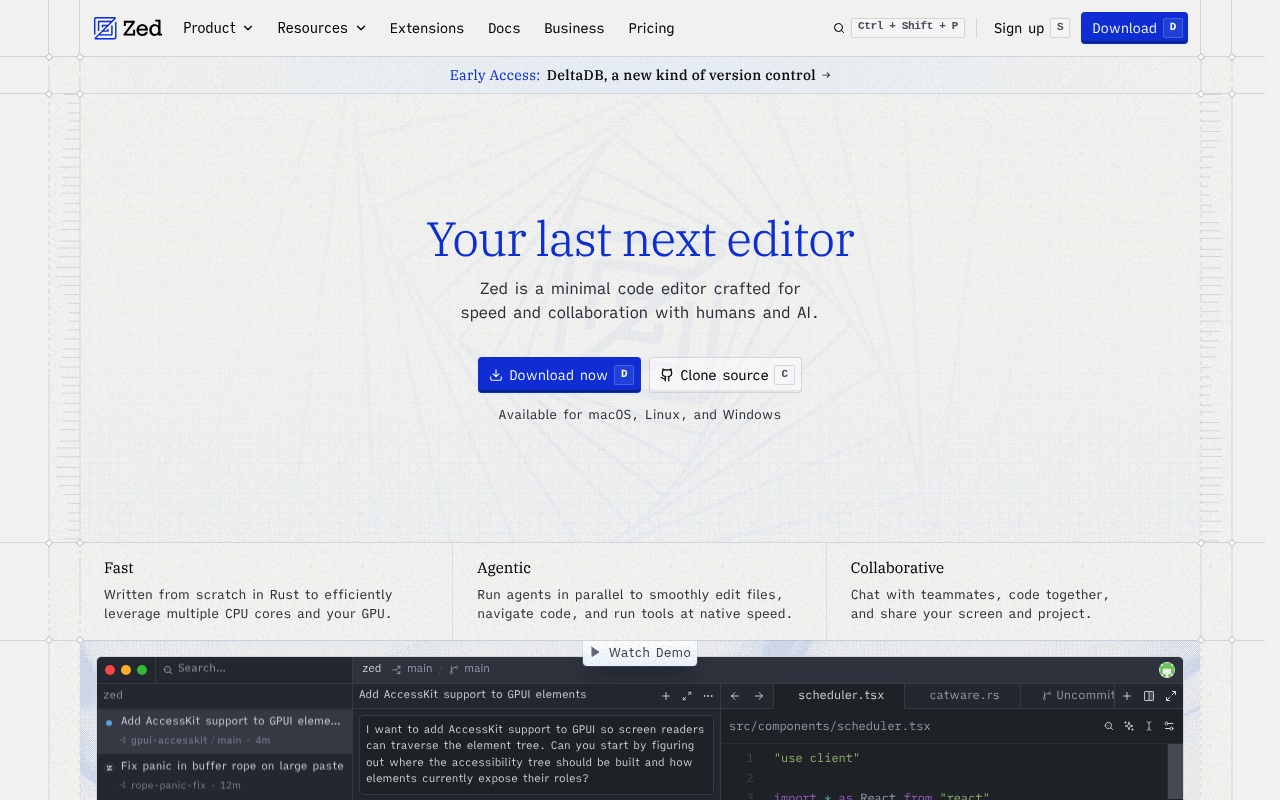
Zed is an open-source, high-performance multiplayer code editor written from scratch in Rust and built around GPU-accelerated rendering through its own GPUI framework. Created by Zed Industries — founded by Nathan Sobo, Antonio Scandurra, and Max Brunsfeld, the team behind Atom, Electron, and Tree-sitter — Zed combines a native desktop editor with real-time collaboration, native Git integration, Language Server Protocol and Debug Adapter Protocol support, and a first-class AI agent surface that includes edit prediction powered by the open-weight Zeta2 model, an inline assistant, parallel agents, and integrations with external coding agents (Claude, Codex, OpenCode) via the Agent Client Protocol (ACP) and Model Context Protocol (MCP). The editor itself is free and triple-licensed (AGPL / Apache-2.0 / GPL-3.0) with paid Pro and Business tiers that bundle hosted AI capabilities, edit prediction quotas, organization controls, and data governance. Zed runs on macOS, Linux, and Windows and exposes a WASM-based extension API (themes, languages, debuggers, snippets, MCP servers, agent servers) with extensions published through the zed-industries/extensions repository.
Zed is profiled on the APIs.io network. Tagged areas include Code Editor, Developer Tools, IDE, Rust, and GPU Accelerated.
Zed’s developer surface includes documentation, pricing, release notes, status page, engineering blog, support, FAQ, and 40 more developer resources.
Kin Score
 Kin Score
How this is scored →
Kin Score
How this is scored →scored 2026-10-17 · rubric v0.24.0
Security Posture 1
Authentication, domain security, vulnerability disclosure, and trust-center signals.
Resources
Get Started 3
Portal, sign-up, and the first successful call
Documentation 2
Reference material describing how the API behaves
Build 7
SDKs, sample code, and the tooling you integrate with
Scroll for all 7
Access & Security 2
Authentication, authorization, and security posture
Learn 1
Tutorials, courses, talks, and written guidance
Operate 10
Status, limits, changes, and where to get help
Scroll for all 10
Commercial 5
Pricing, plans, and the legal terms of use
Company 7
The organization behind the API
Scroll for all 7
Other 10
Properties that don't map to a standard resource type
Scroll for all 10
Source (apis.yml)
Work with this as data
Every provider here is available over the APIs.io API and to AI agents over MCP.