Yarn is an open-source JavaScript package manager and project manager originally created at Facebook in 2016 and now developed as a fully independent community project (Yarn Berry, currently v4) on github.com/yarnpkg/berry. Yarn was the first package manager designed around workspaces and introduced Plug'n'Play (a node_modules-free module resolution strategy), Zero-Installs (committable caches for instant clones), Constraints (a cross-workspace policy DSL), and a rich protocol system covering npm, git, github, file, link, portal, patch, exec, and workspace dependencies. It is distributed via Corepack and licensed under BSD-2-Clause.
Yarn is listed with 10 APIs on the APIs.io network. Tagged areas include Package Manager, JavaScript, Node.js, Monorepo, and Workspace.
The Yarn catalog on APIs.io includes 1 JSON-LD context and 1 Spectral governance ruleset.
Yarn’s developer surface includes developer portal, getting-started guide, documentation, changelog, and 35 more developer resources.
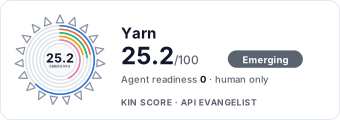
25.3/100emerging▬ flatAgent0/100human onlyFront door AI1/6
silent
Heartbeat44/100
alive
library · BSD-2-Clause License
Full breakdown ↓
scored 2026-11-13 · rubric v0.28.0 · Show this score on your site →
Regulatory Posture applies to this provider. Its tags matched the
Horizontal (data, software, accessibility, platform) regime, so
Regulatory Posture carries 15 points of the composite.
If this regime is wrong for your business, say so on your
provider repo — the
applicability map is public and we will correct it.
Create-or-Update Ergonomics could not be measured. We hold no machine-readable contract for
this provider to read, so there is nothing to measure a write surface against. Excluded rather than scored zero:
never-measured and measured-empty are different facts. Publishing an OpenAPI is what makes this facet — and
several others — scorable at all.
The six quality facets above are damped to 85 points between them,
because the conditional facet above carries the other
15. That is why each facet's contribution is shown against a damped
maximum: raising a quality facet moves the composite by 85% of its nominal
weight, not 100%. The full arithmetic is at apis.io/rating/.
Show this score on your site.
It updates itself when the score changes. Paste this where you link to your API docs:
<a href="https://apis.io/providers/yarn-pkg/"><img src="https://apis.io/badge/yarn-pkg/card.svg" alt="Yarn on APIs.io — Kin Score by API Evangelist"></a>
Other styles, a README pill and a shields.io endpoint are on the badge page.
Raise your score.
Agent readiness — checks not met, largest first (exact, from this profile):
Machine-Readable Auth+10 pts — a served openid-configuration/oauth-authorization-server carrying `issuer` (served), else the securitySchemes class in the provider OpenAPIs — bound (mutualTLS, DPoP, Signature) > negotiable (oauth2 authorizationCode/clientCredentials, openIdConnect) > bearer (http bearer, apiKey) Ask about this →
Idempotency+9 pts — OpenAPI mutating operations declare an idempotency key — a header, a request-body property, or a named de-duplication token whose own description says so (verified); else common[].type matches /idempoten/i (documented) Ask about this →
Stable Error Semantics+8 pts — OpenAPI $refs a shared error schema across 4xx/5xx responses (verified), else common[].type includes ErrorCatalog / ErrorCodes / DeclineCodes Ask about this →
13 more unmet checks in the Agent Readiness table above.
Kin Score — facets with the most composite points still available (weight × headroom):
Each check links to what satisfies it. Publish the artifact, or tell us where it already lives, and the score moves on the next scoring run.
Not sure how this applies to your stack? Ask about any one item. Kin Lane reads every question, looks at your profile and your situation, and replies with what a fix would take — scoped to that one area, priced up front, yours whether you ship it or not. Ask a question →
Yarn was the first package manager built specifically around workspaces. `yarn workspace`, `yarn workspaces foreach`, `yarn workspaces focus`, and `yarn workspaces list` provide...
Plug'n'Play (PnP) is Yarn's alternative to the traditional node_modules folder. Yarn generates a single `.pnp.cjs` file containing the exact dependency tree which Node.js consul...
Zero-Installs commit Yarn's package cache (`.yarn/cache`) into the repository alongside the `.pnp.cjs` file. Clones of the repository can start working immediately without runni...
Yarn Constraints let you declare cross-workspace rules — required fields in `package.json`, forbidden dependencies, version pinning, and consistency requirements — using a JavaS...
Yarn ships with a full plugin API exposed by `@yarnpkg/core`. Plugins can register commands, resolvers, fetchers, linkers, and lifecycle hooks. Plugins are installed with `yarn ...
Yarn provides a release-workflow primitive for monorepos. Contributors declare per-workspace version bumps as deferred decisions (`yarn version check --interactive`) and the pro...
First-class dependency patching — `yarn patch ` extracts a temporary editable copy of a dependency and `yarn patch-commit` saves the resulting diff as a `patch:` protocol entry ...
The yarn dlx command runs a package in an isolated temporary environment without permanently installing it. Yarn's equivalent of npx, used for one-shot tools, code generators, a...
Calls without X-API-Key need no key. Calls with it need a paid plan — get a key.
Get an API key
Free tier, no form to fill in. Signing in shares your email address with us — we
store it to create your key and to recognise you if you sign in with another
provider. See our Privacy Policy and
Terms.
 Kin Score
How this is scored →
 It updates itself when the score changes. Paste this where you link to your API docs: