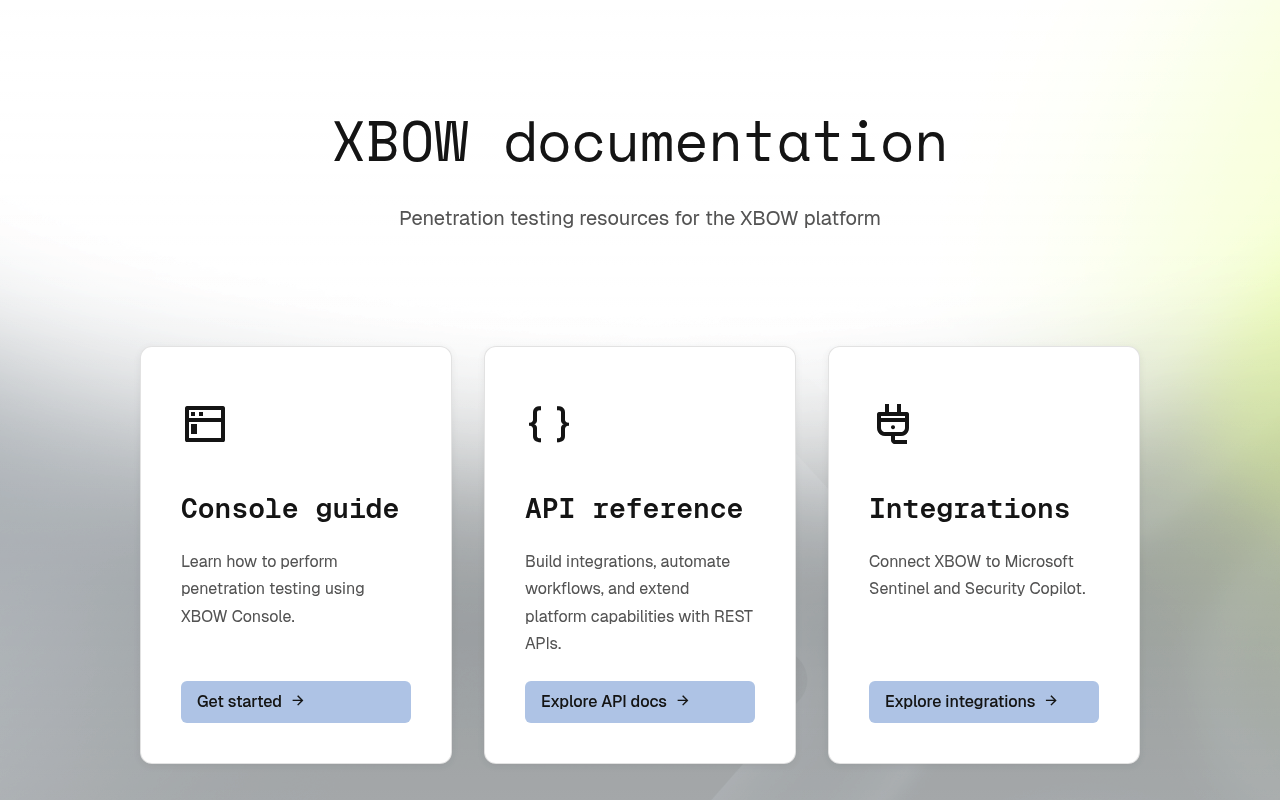
XBOW is an autonomous offensive security platform that uses AI to perform penetration testing with real exploit validation — it identifies vulnerabilities, chains them into attack paths, and proves exploitability before findings reach security teams. The XBOW API (public preview) exposes the full platform workflow: register assets, launch and manage assessments, fetch validated findings and reports, upload source-code resources for gray-box testing, and subscribe webhooks with Ed25519-signed deliveries. XBOW has ranked #1 on the HackerOne and Microsoft MSRC leaderboards and is used by 150+ security teams.
Xbow publishes 9 API contracts indexed on the APIs.io network, including Assessments API, Assets API, Findings API, and 6 more. Tagged areas include Security, Penetration Testing, Offensive Security, Artificial Intelligence, and Vulnerability Management.
The Xbow catalog on APIs.io includes 1 event-driven AsyncAPI specification.
Xbow’s developer surface includes authentication, documentation, API reference, getting-started guide, support, engineering blog, pricing, and 27 more developer resources.
Regulatory Posture applies to this provider. Its tags matched the
Horizontal (data, software, accessibility, platform) regime, so
Regulatory Posture carries 15 points of the composite.
If this regime is wrong for your business, say so on your
provider repo — the
applicability map is public and we will correct it.
Create-or-Update Ergonomics applies to this provider. This API accepts writes, so it
carries 10 points of the composite. It is scored from the published contracts
themselves: whether a caller can create-or-update in one call, whether the write accepts a key the caller already
holds, and whether the response says which branch ran. Without that, every write needs a search-and-branch in
front of it, and the first time that check is skipped a duplicate record is created.
Scored against the observed mean rather than raw — a provider at the catalog average is unchanged by this facet,
not penalised by it.
The six quality facets above are damped to 75 points between them,
because the conditional facet above carries the other
25. That is why each facet's contribution is shown against a damped
maximum: raising a quality facet moves the composite by 75% of its nominal
weight, not 100%. The full arithmetic is at apis.io/rating/.
Improve this rating by publishing the missing artifacts — every area above can be raised, and the full rubric is at apis.io/rating/. Every facet and dimension name above is a link: it opens that measurement's own page — what it means, the exact checks that feed it, how the whole catalog distributes on it, and the providers at the top of it. This rating is computed from github.com/api-evangelist/xbow: open an issue to ask a question, or submit a pull request to add artifacts.
Submit an artifact on GitHub — free →Manage your own listing — the Influence plan, $499/mo →
Upload and manage files used in assessments, such as source code archives. All endpoints require an _organization_ API key. ## Upload flow Resources use a multipart S3 upload. T...
Manage webhook subscriptions and receive event notifications. When creating an organization, you may provide an HTTPS webhook URL to receive events related to the organization's...
Overlays applied on top of this provider's contracts. Each card says who wrote it: a document the provider publishes, or one API Evangelist derived or generated.
aid: xbow
name: Xbow
description: 'XBOW is an autonomous offensive security platform that uses AI to perform penetration testing with real exploit
  validation — it identifies vulnerabilities, chains them into attack paths, and proves exploitability before findings reach
  security teams. The XBOW API (public preview) exposes the full platform workflow: register assets, launch and manage assessments,
  fetch validated findings and reports, upload source-code resources for gray-box testing, and subscribe webhooks with Ed25519-signed
  deliveries. XBOW has ranked #1 on the HackerOne and Microsoft MSRC leaderboards and is used by 150+ security teams.'
url: https://raw.githubusercontent.com/api-evangelist/xbow/refs/heads/main/apis.yml
deliveryModel:
  model: saas
  open_source: false
  commercial: true
  callable_host: true
  label: Hosted service · you call their endpoint
  confidence: high
  source:
  - openapi
  - pricing
  generated: '2026-08-28'
  method: derived
accessModel:
  pricing: unknown
  onboarding: unknown
  trial: false
  try_now: false
  public: false
  label: Unknown
  confidence: low
  source:
  - authentication
  - security
  generated: '2026-09-03'
  method: derived
image: https://docs.xbow.com/xbow-logomark.svg
x-type: company
x-source: vc-portfolio
x-enrichment:
  date: '2026-07-21'
  status: enriched
  artifacts_added: 22
  pass: local-v1
x-backed-by:
- northzone
specificationVersion: '0.23'
created: '2026-07-17'
modified: '2026-07-21'
tags:
- Security
- Penetration Testing
- Offensive Security
- Artificial Intelligence
- Vulnerability Management
- Cybersecurity
- Application Security
apis:
- aid: xbow:xbow-assessments-api
  name: Xbow Assessments API
  description: 'Endpoints related to assessments for assets.


    All endpoints require an _organization_ API key.'
  humanURL: https://docs.xbow.com/api/
  baseURL: https://console.xbow.com/api/v1
  tags:
  - Assessment
  tags_raw:
  - Assessments
  properties:
  - type: OpenAPI
    url: openapi/xbow-assessments-api-openapi.yml
  - type: Documentation
    url: https://docs.xbow.com/api/
- aid: xbow:xbow-assets-api
  name: Xbow Assets API
  description: 'Endpoints related to assets within an organization.


    All endpoints require an _organization_ API key.'
  humanURL: https://docs.xbow.com/api/
  baseURL: https://console.xbow.com/api/v1
  tags:
  - Assets
  properties:
  - type: OpenAPI
    url: openapi/xbow-assets-api-openapi.yml
  - type: Documentation
    url: https://docs.xbow.com/api/
- aid: xbow:xbow-findings-api
  name: Xbow Findings API
  description: 'Endpoints for viewing and managing findings.


    All endpoints require an _organization_ API key.'
  humanURL: https://docs.xbow.com/api/
  baseURL: https://console.xbow.com/api/v1
  tags:
  - Findings
  properties:
  - type: OpenAPI
    url: openapi/xbow-findings-api-openapi.yml
  - type: Documentation
    url: https://docs.xbow.com/api/
- aid: xbow:xbow-lightspeed-api
  name: Xbow Lightspeed API
  description: Endpoints related to Lightspeed assessment requests.
  humanURL: https://docs.xbow.com/api/
  baseURL: https://console.xbow.com/api/v1
  tags:
  - Lightspeed
  properties:
  - type: OpenAPI
    url: openapi/xbow-lightspeed-api-openapi.yml
  - type: Documentation
    url: https://docs.xbow.com/api/
- aid: xbow:xbow-meta-api
  name: Xbow Meta API
  description: Instance metadata endpoints.
  humanURL: https://docs.xbow.com/api/
  baseURL: https://console.xbow.com/api/v1
  tags:
  - Meta
  properties:
  - type: OpenAPI
    url: openapi/xbow-meta-api-openapi.yml
  - type: Documentation
    url: https://docs.xbow.com/api/
- aid: xbow:xbow-organizations-api
  name: Xbow Organizations API
  description: Endpoints related to organizations and their management.
  humanURL: https://docs.xbow.com/api/
  baseURL: https://console.xbow.com/api/v1
  tags:
  - Organization
  tags_raw:
  - Organizations
  properties:
  - type: OpenAPI
    url: openapi/xbow-organizations-api-openapi.yml
  - type: Documentation
    url: https://docs.xbow.com/api/
- aid: xbow:xbow-reports-api
  name: Xbow Reports API
  description: 'Endpoints for downloading and viewing reports.


    All endpoints require an _organization_ API key.'
  humanURL: https://docs.xbow.com/api/
  baseURL: https://console.xbow.com/api/v1
  tags:
  - Reports
  properties:
  - type: OpenAPI
    url: openapi/xbow-reports-api-openapi.yml
  - type: Documentation
    url: https://docs.xbow.com/api/
- aid: xbow:xbow-resources-api
  name: Xbow Resources API
  description: "Upload and manage files used in assessments, such as source code archives.\n\nAll endpoints require an _organization_\
    \ API key.\n\n## Upload flow\n\nResources use a multipart S3 upload. The full flow is:\n\n1. **Create** — `POST /api/v1/organizations/:organizationId/resources`\
    \ — initiates an upload and returns a resource ID. Status is `initiated`.\n2. **Get part URLs** — `POST /api/v1/resources/:resourceId/parts`\
    \ — provide a list of part numbers and receive a corresponding list of presigned S3 `PUT` URLs.\n3. **Upload parts** —\
    \ `PUT` each part directly to its presigned URL. Save the `ETag` header from each part response.\n4. **Commit** — `POST\
    \ /api/v1/resources/:resourceId/commit` — submit the part numbers and ETags. Optionally include a `sha256` checksum of\
    \ the full file for server-side integrity verification. Status moves to `processing`.\n5. **Poll** — `GET /api/v1/resources/:resourceId`\
    \ — wait until status is `ready` (or `failed`).\n6. **Delete** — `DELETE /api/v1/resources/:resourceId` — the resource\
    \ can be manually deleted when required. Status moves to `deleted`.\n\nThe maximum part size is 5 GiB. Parts must be at\
    \ least 5 MiB each, except the final part which may be smaller.\nBreaking large files into multiple parts allows failed\
    \ parts to be retried individually rather than restarting the entire upload.\n\n## Resource statuses\n\n| Status | Meaning\
    \ |\n|---|---|\n| `initiated` | Upload in progress — parts not yet committed |\n| `processing` | Commit received — server\
    \ is validating and storing |\n| `ready` | Available to use in assessments |\n| `failed` | Processing failed — see `statusMessage`\
    \ for details |\n| `deleted` | Deleted |\n\n## Example\n\nThis snippet shows how to upload an example file named `source.tar.gz`\
    \ using the API multipart upload feature.\nIt uses the `fetch` API and assumes a Node.js environment with `fs/promises`\
    \ available.\n\n```typescript\nimport fs from \"node:fs/promises\";\nimport crypto from \"node:crypto\";\nconst BASE =\
    \ \"https://console.xbow.com\";\nconst ORG_ID = \"your-organization-id\";\nconst API_KEY = \"your-api-key\";\nconst PART_SIZE\
    \ = 5 * 1024 * 1024; // 5 MiB minimum\nconst API_VERSION = \"next\";\n\nconst headers = { \"Authorization\": `Bearer ${API_KEY}`,\
    \ \"X-XBOW-API-Version\": `${API_VERSION}` };\n\n// 1. Create resource\nconst created = await fetch(`${BASE}/api/v1/organizations/${ORG_ID}/resources`,\
    \ {\n  method: \"POST\",\n  headers: { ...headers, \"Content-Type\": \"application/json\" },\n  body: JSON.stringify({\
    \ name: \"My source\", fileName: \"source.tar.gz\", type: \"source\" }),\n}).then(r => r.json());\nconst resourceId =\
    \ created.id;\n\n// 2. Split file into parts and request presigned URLs\nconst file = await fs.readFile(\"source.tar.gz\"\
    );\nconst partCount = Math.ceil(file.length / PART_SIZE);\nconst { parts: partUrls } = await fetch(`${BASE}/api/v1/resources/${resourceId}/parts`,\
    \ {\n  method: \"POST\",\n  headers: { ...headers, \"Content-Type\": \"application/json\" },\n  body: JSON.stringify({\
    \ parts: Array.from({ length: partCount }, (_, i) => i + 1) }),\n}).then(r => r.json());\n\n// 3. Upload each part to\
    \ S3 directly, collect ETags\nconst uploadedParts = await Promise.all(partUrls.map(async ({ partNumber, url }) => {\n\
    \  const chunk = file.slice((partNumber - 1) * PART_SIZE, partNumber * PART_SIZE);\n  const res = await fetch(url, { method:\
    \ \"PUT\", body: chunk });\n  return { partNumber, eTag: res.headers.get(\"ETag\").replaceAll('\"', \"\") };\n}));\n\n\
    // 4. Commit (sha256 is optional but recommended for integrity verification)\nconst sha256 = crypto.createHash(\"sha256\"\
    ).update(file).digest(\"hex\");\nawait fetch(`${BASE}/api/v1/resources/${resourceId}/commit`, {\n  method: \"POST\",\n\
    \  headers: { ...headers, \"Content-Type\": \"application/json\" },\n  body: JSON.stringify({ parts: uploadedParts, sha256\
    \ }),\n}).then(r => r.json());\n\n// 5. Poll until ready\nlet resource;\ndo {\n  await new Promise(r => setTimeout(r,\
    \ 5000));\n  resource = await fetch(`${BASE}/api/v1/resources/${resourceId}`, { headers }).then(r => r.json());\n} while\
    \ (resource.status === \"processing\" || resource.status === \"initiated\");\n\nif (resource.status !== \"ready\") throw\
    \ new Error(`Upload failed: ${resource.statusMessage}`);\nconsole.log(\"Resource ready:\", resource.id);\n\n// 6. Delete\
    \ when no longer required\nawait fetch(`${BASE}/api/v1/resources/${resourceId}`, {\n  method: \"DELETE\",\n  headers,\n\
    });\n```"
  humanURL: https://docs.xbow.com/api/
  baseURL: https://console.xbow.com/api/v1
  tags:
  - Resources
  properties:
  - type: OpenAPI
    url: openapi/xbow-resources-api-openapi.yml
  - type: Documentation
    url: https://docs.xbow.com/api/
- aid: xbow:xbow-webhooks-api
  name: Xbow Webhooks API
  description: "Manage webhook subscriptions and receive event notifications.\n\nWhen creating an organization, you may provide\
    \ an HTTPS webhook URL to receive events related to the organization's resources.\n\nWe implement _best-effort_ delivery\
    \ of events, soon after they occur. We will not retry delivery if it fails for any reason.\n\n## Webhook Versioning\n\n\
    Webhook payloads follow the API version of the subscription. When a version reaches its end-of-life date, webhook subscriptions\
    \ for that version will stop emitting events. Ensure your integration is updated to a supported version before the EOL\
    \ date.\n\n## Signature Verification\n\nEach request will be a `POST` request sent with the following headers:\n* `X-Signature-Timestamp`:\
    \ A Unix timestamp in seconds.\n* `X-Signature-Ed25519`: An hex string representing an Ed25519 signature of the concatenation\
    \ of the timestamp and the request body, signed with XBOW's private key.\n\nYou must verify the signature using the public\
    \ key from the `GET /api/v1/meta/webhooks-signing-keys` endpoint.\nYou must verify that the timestamp is within a valid\
    \ range from the current time to prevent replay attacks. An example of a valid range might be +/-5 minutes.\nYou should\
    \ respond with a 2xx status code if the signature is valid, and a 401 status code otherwise.\nBefore organization creation,\
    \ we will send two test `ping` events. One signed with XBOW's private key, and one signed with an invalid key. This allows\
    \ you to verify that your signature verification is working correctly.\n\nFor example, if you're using Node.js:\n\n```javascript\n\
    import consumers from \"node:stream/consumers\";\n\n// Fetch the public key from the API (cache this - it rarely changes)\n\
    const keysResponse = await fetch(\"https://console.xbow.com/api/v1/meta/webhooks-signing-keys\", {\n  headers: { Authorization:\
    \ \"Bearer your-api-key\", \"X-XBOW-API-Version\": \"2026-02-01\" }\n});\nconst keys = await keysResponse.json();\nconst\
    \ publicKeyBase64 = keys[0].publicKey;\n\n// Import the public key (SPKI format, base64-encoded)\nconst publicKey = await\
    \ crypto.subtle.importKey(\n  \"spki\",\n  Buffer.from(publicKeyBase64, \"base64\"),\n  { name: \"Ed25519\" },\n  false,\n\
    \  [\"verify\"],\n);\n\nconst timestamp = req.headers[\"x-signature-timestamp\"];\nconst timestampTime = parseInt(timestamp,\
    \ 10);\nconst now = Math.floor(Date.now() / 1000);\nconst isValidTimestamp = (Math.abs(now - timestampTime) < 300);\n\n\
    if (!isValidTimestamp) {\n  throw new Error(\"Invalid timestamp\");\n}\n\nconst signature = req.headers[\"x-signature-ed25519\"\
    ];\nconst body = await consumers.text(req.body);\nconst isVerified = await crypto.subtle.verify(\n  { name: \"Ed25519\"\
    \ },\n  publicKey,\n  Buffer.from(signature, \"hex\"),\n  Buffer.from(timestamp + body),\n);\n\nif (!isVerified) {\n \
    \ throw new Error(\"Invalid request signature\");\n}\n```\n\n## Upgrading webhook subscriptions\n\nEach subscription is\
    \ pinned to an API version. When we release a new version, you should plan to migrate your subscriptions to it. Once a\
    \ version reaches its end-of-life date we stop emitting events for subscriptions on that version, so an unmigrated subscription\
    \ will silently stop receiving deliveries.\n\nUpgrading is a single `PATCH` per subscription. The snippet below lists\
    \ every subscription on your organization, bumps any pinned to a given older version to a specified newer one, and skips\
    \ subscriptions on `next` (which track the latest stable version automatically). It uses cursor pagination so it works\
    \ for organizations with any number of subscriptions.\n\n```typescript\n// Upgrade webhook subscriptions from 2026-02-01\
    \ -> 2026-04-01. Skip \"next\".\nconst BASE = \"https://console.xbow.com\";\nconst ORG_ID = \"your-organization-id\";\n\
    const API_KEY = \"your-api-key\";\nconst OLD = \"2026-02-01\";\nconst NEW = \"2026-04-01\";\n\nconst headers = { Authorization:\
    \ `Bearer ${API_KEY}`, \"X-XBOW-API-Version\": NEW };\n\nasync function* paginate<T>(url: string): AsyncGenerator<T> {\n\
    \  let cursor: string | null = null;\n  do {\n    const u = new URL(url);\n    if (cursor) u.searchParams.set(\"cursor\"\
    , cursor);\n    const res = await fetch(u, { headers });\n    if (!res.ok) throw new Error(`${res.status} ${await res.text()}`);\n\
    \    const page = (await res.json()) as { items: T[]; nextCursor: string | null };\n    yield* page.items;\n    cursor\
    \ = page.nextCursor;\n  } while (cursor);\n}\n\ntype Sub = { id: string; apiVersion: string };\nfor await (const wh of\
    \ paginate<Sub>(`${BASE}/api/v1/organizations/${ORG_ID}/webhooks`)) {\n  if (wh.apiVersion === \"next\") { console.log(`skip\
    \   ${wh.id} (next)`); continue; }\n  if (wh.apiVersion !== OLD)    { console.log(`skip   ${wh.id} (${wh.apiVersion})`);\
    \ continue; }\n  const res = await fetch(`${BASE}/api/v1/webhooks/${wh.id}`, {\n    method: \"PATCH\",\n    headers: {\
    \ ...headers, \"Content-Type\": \"application/json\" },\n    body: JSON.stringify({ apiVersion: NEW }),\n  });\n  if (!res.ok)\
    \ throw new Error(`${res.status} ${await res.text()}`);\n  console.log(`bump   ${wh.id} ${OLD} -> ${NEW}`);\n}\n```\n\n\
    An `apiVersion`-only `PATCH` does not re-validate your endpoint, so the upgrade is cheap and safe to run for many subscriptions\
    \ at once. A `PATCH` that changes `targetUrl` does re-send the validation pings described above, and must receive a 2xx\
    \ for the valid ping to succeed."
  humanURL: https://docs.xbow.com/api/
  baseURL: https://console.xbow.com/api/v1
  tags:
  - Webhook
  tags_raw:
  - Webhooks
  properties:
  - type: OpenAPI
    url: openapi/xbow-webhooks-api-openapi.yml
  - type: Documentation
    url: https://docs.xbow.com/api/
maintainers:
- FN: Kin Lane
  email: kin@apievangelist.com
- FN: APIs.json
  email: info@apis.io
common:
- type: Plans
  url: plans/xbow-plans-pricing.yml
- type: CapabilityMap
  url: capabilities/xbow-capability-edges.yml
  name: Xbow Business Capability Map
- type: Overlay
  url: overlays/xbow-openapi-overlay.yaml
- type: AgenticAccess
  url: agentic-access/xbow-agentic-access.yml
- type: VulnerabilityDisclosure
  url: security/xbow-vulnerability-disclosure.yml
- type: DomainSecurity
  url: security/xbow-domain-security.yml
- type: Authentication
  url: authentication/xbow-authentication.yml
- type: Website
  url: https://xbow.com
- type: DeveloperPortal
  url: https://docs.xbow.com/
- type: Documentation
  url: https://docs.xbow.com/
- type: APIReference
  url: https://docs.xbow.com/api/
- type: GettingStarted
  url: https://docs.xbow.com/console/get-started/introduction/
- type: Support
  url: mailto:support@xbow.com
- type: Blog
  url: https://xbow.com/blog
- type: GitHubOrganization
  url: https://github.com/xbow-engineering
- type: Pricing
  url: https://xbow.com/pricing
- type: Login
  url: https://console.xbow.com/
- type: TermsOfService
  url: https://xbow.com/terms-of-use
- type: PrivacyPolicy
  url: https://xbow.com/privacy-policy
- type: StatusPage
  url: https://status.xbow.com
- type: TrustCenter
  url: https://trust.xbow.com/
- type: Compliance
  url: https://docs.xbow.com/console/get-started/trust-and-safety/
- type: Security
  url: https://xbow.com/security-policy
- type: Deprecation
  url: https://docs.xbow.com/api/#description/version-lifecycle
- type: LLMsTxt
  url: llms/xbow-llms.txt
- type: X-MCPServerCandidate
  url: mcp/xbow-mcp.yml
  note: 'Renamed from MCPServer 2026-09-03 (roadmap#247): the manifest self-describes as status: candidate — a tool list derived
    from the published API contracts, not an existing server. The scorer already read the manifest and reported mcp_server
    correctly; the MCPServer type was crediting the artifact-type surfaces with a server that does not exist.'
- type: Webhooks
  url: asyncapi/xbow-webhooks.yml
- type: ChangeLog
  url: changelog/xbow-changelog.yml
- type: Conventions
  url: conventions/xbow-conventions.yml
- type: ErrorCatalog
  url: errors/xbow-problem-types.yml
- type: Lifecycle
  url: lifecycle/xbow-lifecycle.yml
- type: Conformance
  url: conformance/xbow-conformance.yml
- type: DataModel
  url: data-model/xbow-data-model.yml
- type: AgentSkill
  url: skills/_index.yml
Discovery needs no key. Ratings and market analysis are Pro.
Get an API key
Free tier, no form to fill in. Signing in shares your email address with us — we
store it to create your key and to recognise you if you sign in with another
provider. See our Privacy Policy and
Terms.
 Kin Score
How this is scored →
Kin Score
How this is scored →