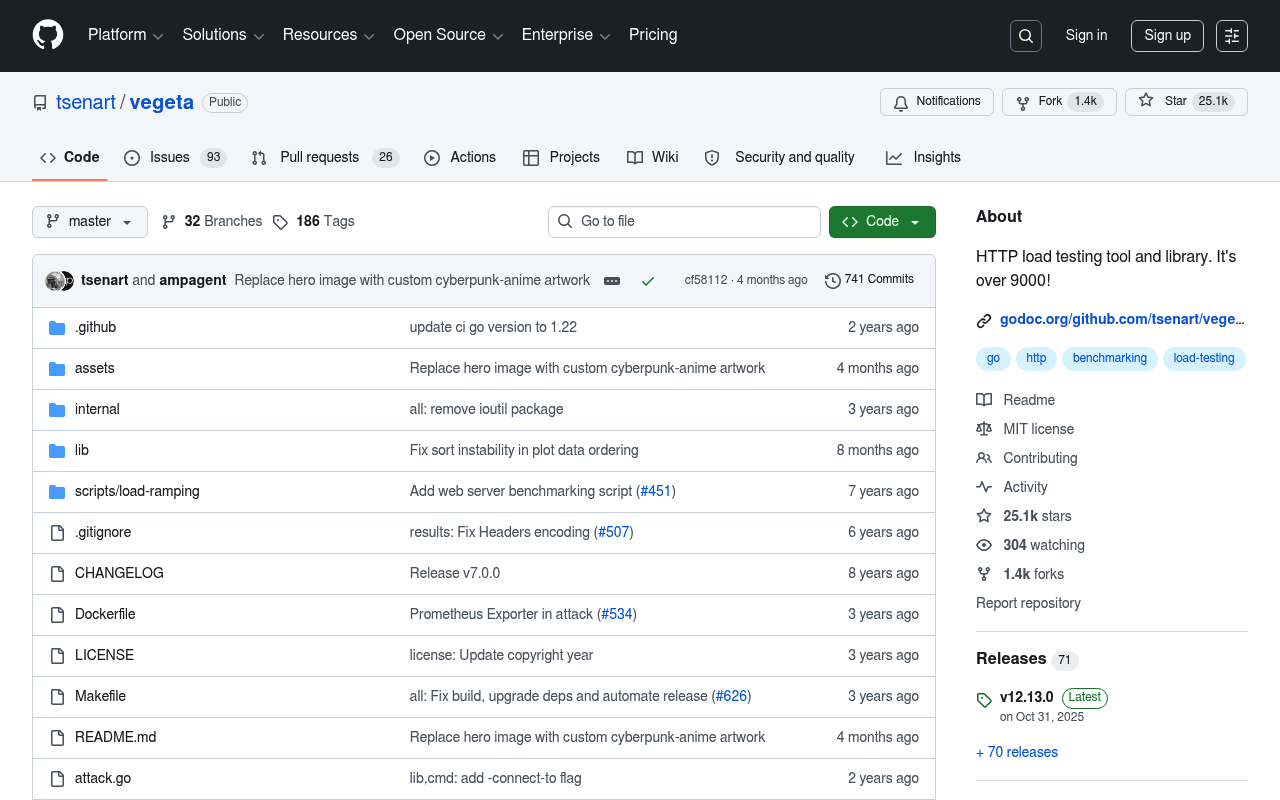
Vegeta
Vegeta is an open source HTTP load testing tool and library written in Go for generating constant request rates to measure API performance and reliability under sustained load. Supports CLI and library usage with attack plans, rate limiting, duration control, and detailed result metrics including latency histograms and success rates.
Vegeta is listed with 1 API on the APIs.io network. Tagged areas include Go, HTTP, Load Testing, Performance, and Testing.
The Vegeta catalog on APIs.io includes 1 Spectral governance ruleset.
Vegeta’s developer surface includes documentation and 11 more developer resources.
Kin Score
 Kin Score
How this is scored →
Kin Score
How this is scored →scored 2026-10-23 · rubric v0.25.0
 It updates itself when the score changes. Paste this where you link to your API docs:
<a href="https://apis.io/providers/vegeta/"><img src="https://apis.io/badge/vegeta/card.svg" alt="Vegeta on APIs.io — Kin Score by API Evangelist"></a>Other styles, a README pill and a shields.io endpoint are on the badge page.
Standards implemented 1
Standards this provider implements or carries. De facto ones are profiled and measured by the API Commons; formal ones come from the standards directory and are linked by the provider's own tags. The evidence column says how each claim was established — not that it was made.
APIs 1
Individual APIs this provider publishes, each with its own machine-readable definition.
Vegeta Load Testing Tool
Vegeta is an open source HTTP load testing tool and library written in Go for generating constant request rates. Supports targets from files or stdin, rate limiting (req/s), dur...
Pricing Plans 1
Published pricing tiers and plan structures.
Vegeta Plans Pricing
PLANSRate Limits 1
Documented rate limits and quota policies.
Vegeta Rate Limits
RATE LIMITSFinOps 1
Cost, billing, and metering signals for API financial operations.
Vegeta Finops
FINOPSFeatures 6
Notable capabilities this provider offers.
Constant Rate Attack
Generates HTTP requests at a constant rate (requests per second) for a specified duration, simulating sustained load on API endpoints.
Multiple Output Formats
Supports text, JSON, and binary result output formats with encoding/decoding support for pipeline-based workflows.
Latency Histograms
Produces detailed latency histograms with configurable buckets for analyzing p50, p95, p99, and max latency distributions.
Target Formats
Accepts HTTP targets from files or stdin with support for custom headers, request bodies, and per-target configuration.
TLS and Redirects
Configurable TLS settings including certificate pinning, insecure mode, and redirect following for testing secured endpoints.
Library API
Go library (vegeta/lib) for programmatic integration of load testing into test suites, CI/CD pipelines, and monitoring tools.
Spectral Rules 1
Spectral governance rulesets for linting and validating these APIs.
Vegeta — jsonschema rules
SPECTRALJSON Schema 3
Standalone JSON Schema definitions for this provider's data models.
JSON Structure 3
JSON Structure definitions describing this provider's data shapes.
Vegeta Attack Structure
JSON STRUCTUREVegeta Metrics Structure
JSON STRUCTUREVegeta Result Structure
JSON STRUCTUREExamples 3
Example request and response payloads for these APIs.
Use Cases 4
What developers build with this provider.
API Performance Benchmarking
Measure API throughput, latency percentiles, and success rates at various request rates to establish performance baselines and SLA compliance.
Load Testing in CI/CD
Integrate vegeta as a library in Go test suites to run automated load tests as part of continuous integration pipelines.
Capacity Planning
Determine maximum sustainable request rates before latency degradation or error rates exceed acceptable thresholds for capacity planning.
Regression Detection
Compare latency and throughput metrics across API versions to detect performance regressions before deployment to production.
Resources
Documentation 2
Reference material describing how the API behaves
Design & Contract 1
Pagination, idempotency, versioning, errors, and events
Build 2
SDKs, sample code, and the tooling you integrate with
Operate 3
Status, limits, changes, and where to get help
Commercial 3
Pricing, plans, and the legal terms of use
Company 1
The organization behind the API
Source (apis.yml)
Work with this as data
Every provider here is available over the APIs.io API and to AI agents over MCP.