UVeye
UVeye builds AI-powered automated vehicle inspection systems — "the MRI for cars" — that drive a vehicle through a scanning lane and produce a full condition report in seconds. Four scanning modules cover the vehicle: Artemis (tires and tread), Helios (undercarriage), Atlas (exterior body damage) and Apollo (interior). The systems are deployed across dealership service lanes, fleet and leasing depots, auctions and remarketing lots, rental returns, OEM manufacturing and logistics/PDI ports. UVeye exposes the resulting inspection data to third parties through the UVeye Public API v1 — inspection detail lookups by VIN, license plate, inspection id or barcode, latest-inspection discovery by site or site group, customer-facing public inspection links, appraisal/quote data, inspection imagery, and a Merchandise surface that ingests dealer inventory and pushes rendered multi-angle imagery back over a signed webhook. Headquartered in Teaneck, New Jersey with offices in Norcross GA, Tel Aviv and London.
UVeye publishes 5 API contracts indexed on the APIs.io network, including Appraisal API, Inspections API, Media API, and 2 more. Tagged areas include Automotive, Vehicle Inspection, Artificial Intelligence, Computer Vision, and Dealership.
The UVeye catalog on APIs.io includes 1 event-driven AsyncAPI specification.
UVeye’s developer surface includes documentation, API reference, getting-started guide, support, engineering blog, signup flow, authentication, and 28 more developer resources.
Kin Score
 Kin Score
How this is scored →
Kin Score
How this is scored →scored 2026-10-23 · rubric v0.25.0
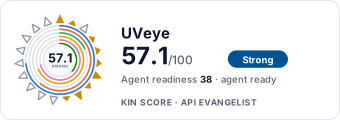 It updates itself when the score changes. Paste this where you link to your API docs:
<a href="https://apis.io/providers/uveye/"><img src="https://apis.io/badge/uveye/card.svg" alt="UVeye on APIs.io — Kin Score by API Evangelist"></a>Other styles, a README pill and a shields.io endpoint are on the badge page.
Markets this provider is in provisional
The Kin Score Market layer reads a provider inside its market: its position, and how deep its integrations go. Depth is only comparable within a position. Provisional and unweighted: not part of the Kin Score or agent readiness.
| Market | Position | Depth | Registered MCP server | Declares compatibility |
|---|---|---|---|---|
| Franchise Registries (registered franchisors, IFA, POS franchise partners) | undeclared | - | - | - |
| ONVIF Video Analytics (video surveillance, edge cameras, computer vision) | undeclared | - | - | - |
Registered MCP server and declares compatibility are report only — not weighted. Undeclared means we found nothing we can read, so there is no number: we never infer integrations.
APIs 5
Individual APIs this provider publishes, each with its own machine-readable definition.
UVeye Appraisal API
Appraisal / quote data derived from an inspection.
UVeye Inspections API
Retrieve vehicle inspection data and the most recent inspections for a site or site group.
UVeye Media API
Inspection imagery.
UVeye Merchandise API
Submit dealer inventory for merchandising and mark vehicles sold.
UVeye Public Links API
Generate and record customer-facing public inspection links.
Open Collections 5
Open, tool-agnostic API collections (OpenAPI-derived and Bruno).
UVeye Public API v1 Appraisal API
OPEN COLLECTIONUVeye Public API v1 Inspections API
OPEN COLLECTIONUVeye Public API v1 Media API
OPEN COLLECTIONUVeye Public API v1 Merchandise API
OPEN COLLECTIONUVeye Public API v1 Public Links API
OPEN COLLECTIONRate Limits 1
Documented rate limits and quota policies.
Uveye Rate Limits
RATE LIMITSEvent Specifications 1
AsyncAPI definitions for this provider's event-driven and streaming APIs.
Uveye Merchandise Webhooks
ASYNCAPIOpenAPI Overlays 1
Overlays applied on top of this provider's contracts. Each card says who wrote it: a document the provider publishes, or one API Evangelist derived or generated.
Uveye Public Api V1 Overlay
DERIVEDSecurity Posture 4
Authentication, domain security, vulnerability disclosure, and trust-center signals.
Agentic Access 1
Recommended x-agentic-access execution contracts for AI agents.
Resources
Get Started 4
Portal, sign-up, and the first successful call
Documentation 2
Reference material describing how the API behaves
Agent Surfaces 5
MCP servers, agent skills, and machine-readable catalogs
Design & Contract 5
Pagination, idempotency, versioning, errors, and events
Build 3
SDKs, sample code, and the tooling you integrate with
Access & Security 6
Authentication, authorization, and security posture
Operate 3
Status, limits, changes, and where to get help
Commercial 2
Pricing, plans, and the legal terms of use
Company 4
The organization behind the API
Other 1
Properties that don't map to a standard resource type
Source (apis.yml)
Work with this as data
Every provider here is available over the APIs.io API and to AI agents over MCP.