
Timeswap
Timeswap is a decentralized fixed-maturity lending and borrowing protocol built by Timeswap Labs. Its AMM lets lenders earn fixed interest, borrowers take non-liquidatable loans against any ERC-20 collateral, and liquidity providers act as the counterparty, across pools on multiple EVM chains. Alongside the on-chain V2 contracts, Timeswap runs a public backend API at api.timeswap.io serving pools, caps, tokens, and spot prices to its dApp, and publishes TypeScript SDK packages under the @timeswap-labs npm scope.
Timeswap publishes 5 API contracts indexed on the APIs.io network, including FastAPI API, Paulygon API, Pools API, and 2 more. Tagged areas include Company, Web3, DeFi, Lending, and Borrowing.
Timeswap’s developer surface includes engineering blog, documentation, support, authentication, and 21 more developer resources.
Kin Score
 Kin Score
How this is scored →
Kin Score
How this is scored →scored 2026-10-23 · rubric v0.25.0
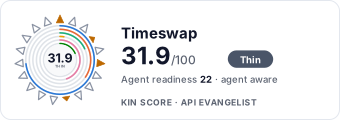 It updates itself when the score changes. Paste this where you link to your API docs:
<a href="https://apis.io/providers/timeswap/"><img src="https://apis.io/badge/timeswap/card.svg" alt="Timeswap on APIs.io — Kin Score by API Evangelist"></a>Other styles, a README pill and a shields.io endpoint are on the badge page.
APIs 5
Individual APIs this provider publishes, each with its own machine-readable definition.
Timeswap FastAPI API
The FastAPI API from Timeswap — 1 operation(s) for fastapi.
Timeswap Paulygon API
The Paulygon API from Timeswap — 1 operation(s) for paulygon.
Timeswap Pools API
The Pools API from Timeswap — 10 operation(s) for pools.
Timeswap TaskON API
The TaskON API from Timeswap — 1 operation(s) for taskon.
Timeswap Token API
The Token API from Timeswap — 1 operation(s) for token.
Open Collections 5
Open, tool-agnostic API collections (OpenAPI-derived and Bruno).
Fast FastAPI API
OPEN COLLECTIONFast FastAPI Paulygon API
OPEN COLLECTIONFast FastAPI Pools API
OPEN COLLECTIONFast FastAPI TaskON API
OPEN COLLECTIONFast FastAPI Token API
OPEN COLLECTIONOpenAPI Overlays 1
Overlays applied on top of this provider's contracts. Each card says who wrote it: a document the provider publishes, or one API Evangelist derived or generated.
Timeswap Api Overlay
DERIVEDSecurity Posture 2
Authentication, domain security, vulnerability disclosure, and trust-center signals.
Resources
Documentation 1
Reference material describing how the API behaves
Agent Surfaces 4
MCP servers, agent skills, and machine-readable catalogs
Design & Contract 5
Pagination, idempotency, versioning, errors, and events
Build 3
SDKs, sample code, and the tooling you integrate with
Access & Security 3
Authentication, authorization, and security posture
Operate 1
Status, limits, changes, and where to get help
Commercial 1
Pricing, plans, and the legal terms of use
Company 4
The organization behind the API
Other 3
Properties that don't map to a standard resource type
Source (apis.yml)
Work with this as data
Every provider here is available over the APIs.io API and to AI agents over MCP.