Three.js is an open-source JavaScript 3D library originally created by Ricardo Cabello (mrdoob) in 2010 and now maintained by a broad community of contributors. It abstracts WebGL and WebGPU behind a clean object-oriented API — Scenes, Cameras, Lights, Geometries, Materials, Textures, Loaders, Controls, Animation, and Post-Processing — to make interactive 3D in the browser practical for games, product configurators, data visualization, generative art, GIS, scientific visualization, simulations, AR/VR (WebXR), and creative coding. The library ships as the `three` npm package under MIT license with a rich addon ecosystem (`three/addons/*`) including dozens of loaders for industry asset formats (glTF, OBJ, FBX, USDZ, KTX2, DRACO), controls, helpers, post-processing passes, and a node-based shading language (TSL) that targets both WebGL and WebGPU. A browser-based editor at threejs.org/editor produces scenes in a documented JSON object format. Three.js has become the de-facto foundation for the JavaScript 3D ecosystem and underpins higher-level projects including React Three Fiber, A-Frame, model-viewer, Threlte, and TroisJS.
Three.js is listed with 6 APIs on the APIs.io network. Tagged areas include 3D, Graphics, WebGL, WebGPU, and JavaScript.
The Three.js catalog on APIs.io includes 1 JSON-LD context and 1 Spectral governance ruleset.
Three.js’ developer surface includes developer portal, documentation, code examples, sandbox, changelog, support, tooling, and 23 more developer resources.
Regulatory Posture applies to this provider. Its tags matched the
Horizontal (data, software, accessibility, platform) regime, so
Regulatory Posture carries 15 points of the composite.
If this regime is wrong for your business, say so on your
provider repo — the
applicability map is public and we will correct it.
Create-or-Update Ergonomics could not be measured. We hold no machine-readable contract for
this provider to read, so there is nothing to measure a write surface against. Excluded rather than scored zero:
never-measured and measured-empty are different facts. Publishing an OpenAPI is what makes this facet — and
several others — scorable at all.
The six quality facets above are damped to 85 points between them,
because the conditional facet above carries the other
15. That is why each facet's contribution is shown against a damped
maximum: raising a quality facet moves the composite by 85% of its nominal
weight, not 100%. The full arithmetic is at apis.io/rating/.
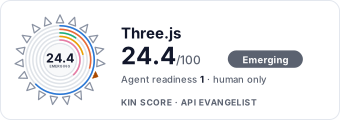
Show this score on your site.
It updates itself when the score changes. Paste this where you link to your API docs:
<a href="https://apis.io/providers/threejs/"><img src="https://apis.io/badge/threejs/card.svg" alt="Three.js on APIs.io — Kin Score by API Evangelist"></a>
Other styles, a README pill and a shields.io endpoint are on the badge page.
Improve this rating by publishing the missing artifacts — every area above can be raised, and the full rubric is at apis.io/rating/. Every facet and dimension name above is a link: it opens that measurement's own page — what it means, the exact checks that feed it, how the whole catalog distributes on it, and the providers at the top of it. This rating is computed from github.com/api-evangelist/threejs: open an issue to ask a question, or submit a pull request to add artifacts.
Submit an artifact on GitHub — free →Manage your own listing — the Influence plan, $499/mo →
Markets this provider is in provisional
The Kin Score Market layer reads a provider inside its market:
its position, and how deep its integrations go. Depth is only comparable within a position. Provisional and unweighted:
not part of the Kin Score or agent readiness.
Registered MCP server and declares compatibility are report only — not weighted.
Undeclared means we found nothing we can read, so there is no number: we never infer integrations.
The Three.js core library provides the scene graph, cameras, lights, geometries, materials, textures, loaders, and animation primitives used to build interactive 3D applications...
WebGLRenderer (default, ships in the main bundle) and the newer WebGPURenderer (under `three/webgpu`) draw the scene graph to a canvas. The Node Material System (TSL — Three.js ...
A family of asset loaders consumed via `three/addons/loaders/*` covering glTF/GLB (recommended), OBJ, FBX, Collada, STL, PLY, 3MF, USDZ, DRACO, KTX2, Basis, and HDR/EXR environm...
Camera and object controls shipped as addons (`three/addons/controls/*`) including OrbitControls, MapControls, TrackballControls, FirstPersonControls, FlyControls, PointerLockCo...
Browser-based scene editor for assembling Three.js scenes, importing assets, editing materials and lights, and exporting to the documented Three.js JSON object format. Useful as...
Discovery needs no key. Ratings and market analysis are Pro.
Get an API key
Free tier, no form to fill in. Signing in shares your email address with us — we
store it to create your key and to recognise you if you sign in with another
provider. See our Privacy Policy and
Terms.
 Kin Score
How this is scored →
 It updates itself when the score changes. Paste this where you link to your API docs: