Sourcegraph
Sourcegraph is a code intelligence platform that lets developers and AI agents search, navigate, understand, and modify code across very large, multi-repo codebases. The platform pairs classic code search and code intelligence (jump-to-definition, references, batch changes) with AI products — Cody (in-IDE AI coding assistant), Amp (frontier coding agent with its own CLI and plugin system), and Deep Search (a natural-language code research agent). Sourcegraph instances expose a versioned external REST API introduced in v7.0, a streaming search API, an analytics API, webhooks, an MCP server, and the historical GraphQL API kept available for migration. The src CLI is the long-standing command-line client.
Sourcegraph is listed with 10 APIs on the APIs.io network. Tagged areas include Code Intelligence, Code Search, Cody, AMP, and AI Coding Agents.
Sourcegraph’s developer surface includes developer portal, documentation, API reference, engineering blog, CLI, pricing, support, and 18 more developer resources.
Kin Score
 Kin Score
How this is scored →
scored 2026-11-13 · rubric v0.28.0
 It updates itself when the score changes. Paste this where you link to your API docs:
<a href="https://apis.io/providers/sourcegraph/"><img src="https://apis.io/badge/sourcegraph/card.svg" alt="Sourcegraph on APIs.io — Kin Score by API Evangelist"></a>Other styles, a README pill and a shields.io endpoint are on the badge page.
- Machine-Readable Contract +18 pts — api_specs includes an OpenAPI document Ask about this →
- Agentic Access Contract +10 pts — agentic_access artifact present (x-agentic-access), graded by author Ask about this →
- Machine-Readable Auth +10 pts — a served openid-configuration/oauth-authorization-server carrying `issuer` (served), else the securitySchemes class in the provider OpenAPIs — bound (mutualTLS, DPoP, Signature) > negotiable (oauth2 authorizationCode/clientCredentials, openIdConnect) > bearer (http bearer, apiKey) Ask about this →
- Idempotency +9 pts — OpenAPI mutating operations declare an idempotency key — a header, a request-body property, or a named de-duplication token whose own description says so (verified); else common[].type matches /idempoten/i (documented) Ask about this →
- Stable Error Semantics +8 pts — OpenAPI $refs a shared error schema across 4xx/5xx responses (verified), else common[].type includes ErrorCatalog / ErrorCodes / DeclineCodes Ask about this →
- A2A Agent Card +8 pts — a2a/
-a2a.yml manifest, graded on conformance.grade against A2A 1.0.0 Ask about this →
- Contract Quality scores 0.0 — up to +25.0 composite points Ask about this →
- Access Clarity scores 21.3 — up to +15.7 composite points Ask about this →
- Contract Governance scores 0.0 — up to +12.0 composite points Ask about this →
Markets this provider is in provisional
The Kin Score Market layer reads a provider inside its market: its position, and how deep its integrations go. Depth is only comparable within a position. Provisional and unweighted: not part of the Kin Score or agent readiness.
| Market | Position | Depth | Registered MCP server | Declares compatibility |
|---|---|---|---|---|
| Agent Skills (SKILL.md packages) | builds-on | 49.4 | - | 1 |
| IDE Extension Marketplaces (JetBrains, VS Code, Open VSX, Docker Verified Publishers, PyPI orgs) | builds-on | 49.4 | - | 1 |
| GitHub Marketplace (GitHub-native publisher layer) | builds-on | 49.4 | - | 1 |
| Browser Extension Stores (company-published Firefox add-ons; Chrome Web Store unreadable) | builds-on | 49.4 | - | 1 |
| Raycast Store Extensions (first-party publishers + community-wrapped products) | builds-on | 49.4 | - | 1 |
Registered MCP server and declares compatibility are report only — not weighted. Undeclared means we found nothing we can read, so there is no number: we never infer integrations.
Standards implemented 2
Standards this provider implements or carries. De facto ones are profiled and measured by the API Commons; formal ones come from the standards directory and are linked by the provider's own tags. The evidence column says how each claim was established — not that it was made.
APIs 10
Individual APIs this provider publishes, each with its own machine-readable definition.
Sourcegraph REST API
Versioned external REST API introduced in Sourcegraph 7.0 and intended as the stable integration surface going forward. Each Sourcegraph instance exposes its own /api-reference ...
Sourcegraph GraphQL API
The historical GraphQL API used by most Sourcegraph integrations to date. It is still available but Sourcegraph now recommends migrating to the versioned REST API for compatibil...
Sourcegraph Streaming Search API
Server-sent-event API that streams search results as they are produced, used by the Sourcegraph UI and by integrations that want incremental result delivery instead of batched r...
Sourcegraph Analytics API
API surface for pulling usage and search analytics from a Sourcegraph instance.
Sourcegraph Webhooks
Sourcegraph instances expose three distinct webhook surfaces. Outgoing webhooks (Site Admin > Configuration > Outgoing webhooks) push batch_change, changeset, and user:create ev...
Sourcegraph MCP Server
Model Context Protocol server exposed by Sourcegraph so MCP-compatible AI agents can use Sourcegraph search and code intelligence as tools.
Cody by Sourcegraph
Cody is Sourcegraph's AI coding assistant. It runs inside VS Code and JetBrains IDEs, uses Sourcegraph code intelligence for codebase-aware context, and can write, explain, and ...
Amp Coding Agent
Amp is Sourcegraph's frontier coding agent, designed for pay-as-you-go use against leading AI models. It ships a CLI for macOS, Linux, WSL, and Windows, supports plugins (slash ...
Sourcegraph Deep Search
Deep Search is a natural-language code research agent that answers complex questions about a codebase by combining Sourcegraph search, code intelligence, and AI.
src CLI
src is Sourcegraph's command-line client for code search, code intelligence, batch changes, and administrative operations against a Sourcegraph instance.
Scroll for all 10
MCP Servers 1
Model Context Protocol servers that expose these APIs to AI agents.
Sourcegraph MCP Server
MCP SERVERGraphQL 1
GraphQL schemas published by this provider.
Sourcegraph GraphQL API
The historical GraphQL API used by most Sourcegraph integrations to date. It is still available but Sourcegraph now recommends migrating to the versioned REST API for compatibil...
GRAPHQLSourcegraph API pricing
Not yet checked against Sourcegraph's own pricing page. Compiled by API Evangelist on 2026-05-22; confirm before you rely on a figure. A free plan or tier is listed.
| Plan | Price |
|---|---|
| Free freemium | Free |
Plan details, limits and sources →
Rate limits
- Free Tier Default: 10 requests per minute
- Pro Tier Default: 120 requests per minute
Compiled by API Evangelist, not yet checked against Sourcegraph's documentation. Rate-limit details →
Pricing Plans 1
Published pricing tiers and plan structures.
Rate Limits 1
Documented rate limits and quota policies.
Sourcegraph Rate Limits
RATE LIMITSData License 1
How its data and outputs may be reused, quoted from its own terms.
FinOps 1
Cost, billing, and metering signals for API financial operations.
Sourcegraph Finops
FINOPSFeatures 9
Notable capabilities this provider offers.
Multi-Repo Code Search
Search across every branch of every repository on every code host connected to Sourcegraph.
Code Intelligence
Jump-to-definition, find references, hover documentation, and dependency graphs powered by SCIP indexes.
Batch Changes
Apply large-scale code modifications across many repositories from a single specification.
Cody AI Assistant
Codebase-aware AI assistant for writing, explaining, and fixing code inside VS Code and JetBrains.
Amp Coding Agent
Frontier coding agent with its own CLI, plugin model, and pay-as-you-go pricing.
Deep Search
Natural-language code research agent for complex questions about large codebases.
Versioned REST API
Stable, backwards-compatible REST API introduced in v7.0 with per-instance OpenAPI schema.
Streaming Search and Analytics
SSE streaming search and an analytics API for pulling usage data.
Webhooks and MCP Server
Push events to external systems and expose Sourcegraph as a tool surface to AI agents via MCP.
Scroll for all 9
Security Posture 3
Authentication, domain security, vulnerability disclosure, and trust-center signals.
Use Cases 5
What developers build with this provider.
Code Search at Scale
Find anything across millions of lines of code across many repositories.
AI-Assisted Coding
Use Cody and Amp to write, refactor, and fix code with codebase context.
Large-Scale Refactors
Apply consistent changes across hundreds of repositories with Batch Changes.
Codebase Research
Use Deep Search to answer architectural questions about an unfamiliar codebase.
Agentic Code Tooling
Expose Sourcegraph code intelligence as MCP tools for AI agents.
Integrations 5
Pre-built integrations with other platforms and tools.
VS Code
Cody and Amp IDE integration for Visual Studio Code.
JetBrains
Cody plugin for JetBrains IDEs.
GitHub, GitLab, Bitbucket
Connects to all major code hosts.
MCP Server
Exposes Sourcegraph as a tool to MCP-compatible AI agents.
Webhooks
Event push to CI, chat, and ticketing systems.
Resources
Get Started 1
Portal, sign-up, and the first successful call
Documentation 2
Reference material describing how the API behaves
Agent Surfaces 1
MCP servers, agent skills, and machine-readable catalogs
Build 7
SDKs, sample code, and the tooling you integrate with
Scroll for all 7
Access & Security 3
Authentication, authorization, and security posture
Operate 4
Status, limits, changes, and where to get help
Commercial 5
Pricing, plans, and the legal terms of use
Company 2
The organization behind the API
Source (apis.yml)
Sourcegraph API — frequently asked questions
Does Sourcegraph have an API?
Yes. APIs.io lists 10 APIs from Sourcegraph, including Sourcegraph REST API, Sourcegraph GraphQL API and Sourcegraph Streaming Search API, and 7 more.
How much does the Sourcegraph API cost?
APIs.io lists 1 pricing plan for Sourcegraph, with each plan's price, limits and inclusions under Pricing on this page.
Does Sourcegraph have an MCP server?
Yes. APIs.io lists 1 MCP server for Sourcegraph.
Is the Sourcegraph API ready for AI agents?
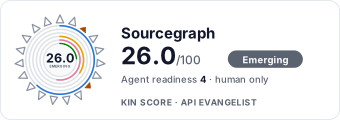
Sourcegraph has a Kin Score of 25.5 out of 100 (emerging) and an Agent Readiness score of 3.7 (human-only), scored by API Evangelist on 2026-11-13.
Work with this as data
Every provider here is available over the APIs.io API and to AI agents over MCP.