ShippingEasy
ShippingEasy is an Austin, Texas shipping software platform for online merchants, providing multi-carrier label printing with discounted USPS, UPS, FedEx, and DHL rates, automated order import and workflow rules, inventory and product management, branded tracking, customer email marketing, and reporting. ShippingEasy was acquired by Stamps.com in 2016 and is part of the Auctane portfolio of shipping brands, which also includes ShipStation, ShipEngine, ShipWorks, MetaPack, Packlink, and Endicia. The company exposes a public Customer API focused on sending orders into ShippingEasy from custom marketplaces or storefronts not already covered by the built-in integration catalog; for fuller multi-carrier label, rate, and tracking APIs, ShippingEasy directs developers to sister brand ShipEngine.
ShippingEasy publishes 2 API contracts indexed on the APIs.io network: Orders API and Stores API. Tagged areas include Shipping, Logistics, Multi-Carrier, Labels, and Order Management.
ShippingEasy’s developer surface includes authentication, pricing, documentation, signup flow, support, engineering blog, YouTube channel, and 15 more developer resources.
Kin Score
 Kin Score
How this is scored →
Kin Score
How this is scored →scored 2026-10-23 · rubric v0.25.0
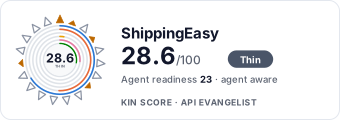 It updates itself when the score changes. Paste this where you link to your API docs:
<a href="https://apis.io/providers/shippingeasy/"><img src="https://apis.io/badge/shippingeasy/card.svg" alt="ShippingEasy on APIs.io — Kin Score by API Evangelist"></a>Other styles, a README pill and a shields.io endpoint are on the badge page.
Markets this provider is in provisional
The Kin Score Market layer reads a provider inside its market: its position, and how deep its integrations go. Depth is only comparable within a position. Provisional and unweighted: not part of the Kin Score or agent readiness.
| Market | Position | Depth | Registered MCP server | Declares compatibility |
|---|---|---|---|---|
| Commerce Platform Ecosystems (Shopify, WooCommerce, Stripe Apps) | undeclared | - | - | - |
| Amazon Seller Ecosystem (Selling Partner Appstore, Amazon Ads partners) | undeclared | - | - | - |
Registered MCP server and declares compatibility are report only — not weighted. Undeclared means we found nothing we can read, so there is no number: we never infer integrations.
APIs 2
Individual APIs this provider publishes, each with its own machine-readable definition.
ShippingEasy Orders API
Order create, look up, status update, and cancellation.
ShippingEasy Stores API
API-enabled stores configured in the ShippingEasy account.
Open Collections 3
Open, tool-agnostic API collections (OpenAPI-derived and Bruno).
ShippingEasy Customer API
OPEN COLLECTIONShippingEasy Customer Orders API
OPEN COLLECTIONShippingEasy Customer Orders Stores API
OPEN COLLECTIONSecurity Posture 2
Authentication, domain security, vulnerability disclosure, and trust-center signals.
Agentic Access 1
Recommended x-agentic-access execution contracts for AI agents.
Resources
Get Started 2
Portal, sign-up, and the first successful call
Documentation 1
Reference material describing how the API behaves
Agent Surfaces 1
MCP servers, agent skills, and machine-readable catalogs
Build 1
SDKs, sample code, and the tooling you integrate with
Access & Security 2
Authentication, authorization, and security posture
Learn 1
Tutorials, courses, talks, and written guidance
Operate 1
Status, limits, changes, and where to get help
Commercial 3
Pricing, plans, and the legal terms of use
Company 6
The organization behind the API
Other 4
Properties that don't map to a standard resource type
Source (apis.yml)
Work with this as data
Every provider here is available over the APIs.io API and to AI agents over MCP.