Selenium
Selenium is the open-source browser automation project behind the W3C WebDriver and WebDriver BiDi standards. It drives real browsers through a vendor-neutral, standardised HTTP wire protocol that the browser vendors implement themselves, with official language bindings for Java, Python, C#, Ruby and JavaScript, all released in lockstep. The suite covers WebDriver (the browser-control protocol), Selenium Grid (distributed, parallel execution across machines and platforms), Selenium Manager (a Rust CLI that resolves and downloads matching browser drivers automatically) and Selenium IDE (record and playback). Selenium is self-hosted software rather than a service: there is no vendor-operated API host, no account and no pricing — the remote end runs on infrastructure the consumer owns, at a documented default of http://localhost:4444, under Apache-2.0 and the stewardship of the Software Freedom Conservancy.
Selenium publishes 8 API contracts indexed on the APIs.io network, including Cookies API, Elements API, Navigation API, and 5 more. Tagged areas include Automation, Browser, End-to-End Testing, Quality Assurance, and Testing.
The Selenium catalog on APIs.io includes 1 event-driven AsyncAPI specification.
Selenium’s developer surface includes engineering blog, support, documentation, API reference, getting-started guide, CLI, authentication, and 30 more developer resources.
Kin Score
 Kin Score
How this is scored →
Kin Score
How this is scored →scored 2026-10-23 · rubric v0.25.0
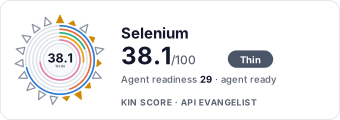 It updates itself when the score changes. Paste this where you link to your API docs:
<a href="https://apis.io/providers/selenium/"><img src="https://apis.io/badge/selenium/card.svg" alt="Selenium on APIs.io — Kin Score by API Evangelist"></a>Other styles, a README pill and a shields.io endpoint are on the badge page.
Markets this provider is in provisional
The Kin Score Market layer reads a provider inside its market: its position, and how deep its integrations go. Depth is only comparable within a position. Provisional and unweighted: not part of the Kin Score or agent readiness.
| Market | Position | Depth | Registered MCP server | Declares compatibility |
|---|---|---|---|---|
| Cloud Native (Kubernetes, CNCF, FinOps) | undeclared | - | - | 1 |
| Jenkins Plugins + CD Foundation Landscape | undeclared | - | - | 1 |
Registered MCP server and declares compatibility are report only — not weighted. Undeclared means we found nothing we can read, so there is no number: we never infer integrations.
APIs 8
Individual APIs this provider publishes, each with its own machine-readable definition.
Selenium WebDriver
WebDriver is a browser automation framework that accepts commands and sends them to a browser. It is implemented through a browser-specific driver that sends commands to a brows...
Selenium Grid
Selenium Grid allows you to run test cases in different machines across different platforms. It enables the execution of test scripts on remote machines by routing commands to r...
Selenium Cookies API
Cookie management
Selenium Elements API
Element discovery and interaction
Selenium Navigation API
Page navigation and metadata
Selenium Script API
Execute JavaScript in the page context
Selenium Session API
Session lifecycle
Selenium Status API
Remote end readiness
Scroll for all 8
Open Collections 7
Open, tool-agnostic API collections (OpenAPI-derived and Bruno).
Selenium WebDriver (W3C Wire Protocol) Cookies API
OPEN COLLECTIONSelenium WebDriver (W3C Wire Protocol) Cookies Elements API
OPEN COLLECTIONSelenium WebDriver (W3C Wire Protocol) Cookies Script API
OPEN COLLECTIONSelenium WebDriver (W3C Wire Protocol) Cookies Session API
OPEN COLLECTIONSelenium WebDriver (W3C Wire Protocol) Cookies Status API
OPEN COLLECTIONSelenium WebDriver (W3C Wire Protocol)
OPEN COLLECTIONScroll for all 7
Pricing Plans 1
Published pricing tiers and plan structures.
Rate Limits 1
Documented rate limits and quota policies.
Selenium Rate Limits
RATE LIMITSFinOps 1
Cost, billing, and metering signals for API financial operations.
Selenium Finops
FINOPSEvent Specifications 1
AsyncAPI definitions for this provider's event-driven and streaming APIs.
Selenium Bidi Events
ASYNCAPIOpenAPI Overlays 6
Overlays applied on top of this provider's contracts. Each card says who wrote it: a document the provider publishes, or one API Evangelist derived or generated.
Selenium Cookies Api Overlay
DERIVEDSelenium Elements Api Overlay
DERIVEDSelenium Navigation Api Overlay
DERIVEDSelenium Script Api Overlay
DERIVEDSelenium Session Api Overlay
DERIVEDSelenium Status Api Overlay
DERIVEDSecurity Posture 2
Authentication, domain security, vulnerability disclosure, and trust-center signals.
Agentic Access 1
Recommended x-agentic-access execution contracts for AI agents.
Resources
Get Started 2
Portal, sign-up, and the first successful call
Documentation 3
Reference material describing how the API behaves
Agent Surfaces 4
MCP servers, agent skills, and machine-readable catalogs
Design & Contract 5
Pagination, idempotency, versioning, errors, and events
Build 5
SDKs, sample code, and the tooling you integrate with
Access & Security 2
Authentication, authorization, and security posture
Operate 5
Status, limits, changes, and where to get help
Commercial 3
Pricing, plans, and the legal terms of use
Company 2
The organization behind the API
Other 6
Properties that don't map to a standard resource type
Source (apis.yml)
Work with this as data
Every provider here is available over the APIs.io API and to AI agents over MCP.