Rome2Rio
Rome2Rio is a multi-modal travel planning platform founded in Melbourne, Australia in 2011, and part of the Omio Group since 2019. It covers 240+ countries, 10 million+ locations, and 20,000+ transport operators, enabling door-to-door route discovery across flights, trains, buses, ferries, and driving. Developers can access route search, geocoding, and autocomplete capabilities through the Rome2Rio REST API, which returns JSON responses covering routes, segments, duration, and operator information for any two points worldwide.
Rome2Rio is listed with 3 APIs on the APIs.io network. Tagged areas include Travel, Multi-Modal, Transportation, Routes, and Transit.
The Rome2Rio catalog on APIs.io includes 1 JSON-LD context.
Rome2Rio’s developer surface includes documentation, engineering blog, support, GitHub presence, and 12 more developer resources.
Kin Score
 Kin Score
How this is scored →
Kin Score
How this is scored →scored 2026-10-23 · rubric v0.25.0
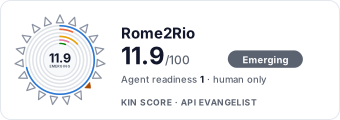 It updates itself when the score changes. Paste this where you link to your API docs:
<a href="https://apis.io/providers/rome2rio/"><img src="https://apis.io/badge/rome2rio/card.svg" alt="Rome2Rio on APIs.io — Kin Score by API Evangelist"></a>Other styles, a README pill and a shields.io endpoint are on the badge page.
Markets this provider is in provisional
The Kin Score Market layer reads a provider inside its market: its position, and how deep its integrations go. Depth is only comparable within a position. Provisional and unweighted: not part of the Kin Score or agent readiness.
| Market | Position | Depth | Registered MCP server | Declares compatibility |
|---|---|---|---|---|
| Rail Sales and Distribution (OSDM, railway union, EU railway licences) | undeclared | - | - | - |
Registered MCP server and declares compatibility are report only — not weighted. Undeclared means we found nothing we can read, so there is no number: we never infer integrations.
APIs 3
Individual APIs this provider publishes, each with its own machine-readable definition.
Rome2Rio Search API
The Rome2Rio Search API returns multi-modal door-to-door travel routes between any origin and destination worldwide. Given origin and destination as place names or coordinates, ...
Rome2Rio Autocomplete API
The Rome2Rio Autocomplete API provides place-name suggestions as a user types, returning a ranked list of matching locations (cities, airports, train stations, addresses) that c...
Rome2Rio Geocode API
The Rome2Rio Geocode API resolves a place-name or address string to a canonical Rome2Rio place record with geographic coordinates, place type, and country, enabling precise orig...
Pricing Plans 1
Published pricing tiers and plan structures.
Rate Limits 1
Documented rate limits and quota policies.
Rome2Rio Rate Limits
RATE LIMITSFinOps 1
Cost, billing, and metering signals for API financial operations.
Rome2Rio Finops
FINOPSSemantic Vocabularies 1
JSON-LD contexts and semantic vocabularies used across these APIs.
Apis Context
JSON-LDSecurity Posture 1
Authentication, domain security, vulnerability disclosure, and trust-center signals.
Resources
Documentation 1
Reference material describing how the API behaves
Build 1
SDKs, sample code, and the tooling you integrate with
Access & Security 1
Authentication, authorization, and security posture
Operate 3
Status, limits, changes, and where to get help
Commercial 4
Pricing, plans, and the legal terms of use
Company 4
The organization behind the API
Other 2
Properties that don't map to a standard resource type
Source (apis.yml)
Work with this as data
Every provider here is available over the APIs.io API and to AI agents over MCP.