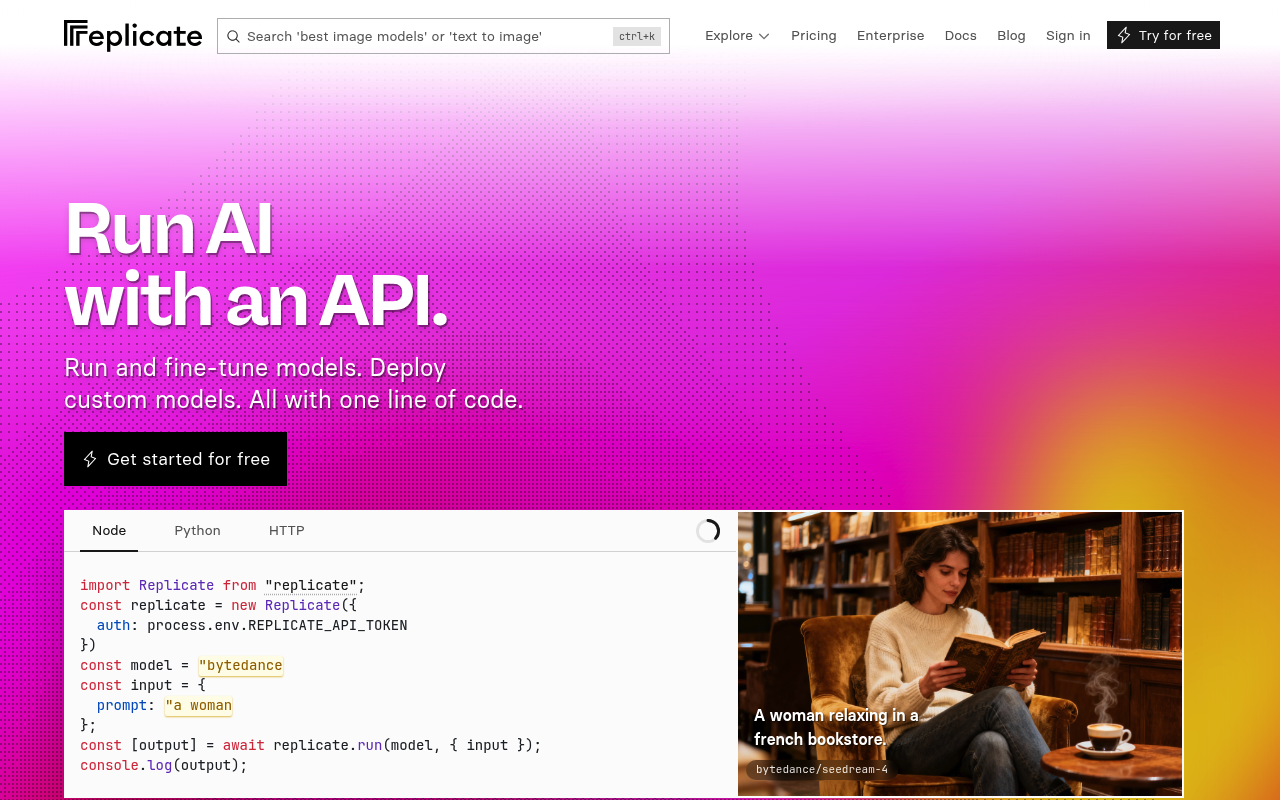
Replicate website screenshot

Replicate

Replicate lets you run machine learning models in the cloud with a simple API. Thousands of open-source models are available, and you can run your own custom models at scale. Run image generation, language models, audio synthesis, video generation, and more with a few lines of code. Replicate makes AI accessible to every software engineer.

1 APIs 16 Features
Artificial IntelligenceMachine LearningImage GenerationLanguage ModelsModel Deployment

APIs

Replicate

Replicate lets you run machine learning models in the cloud with a simple REST API. Access thousands of open-source models for image generation, language modeling, audio synthes...

Agent Skills

build-models

AGENT SKILL

compare-models

AGENT SKILL

find-models

AGENT SKILL

prompt-images

AGENT SKILL

prompt-videos

AGENT SKILL

publish-models

AGENT SKILL

run-models

AGENT SKILL

Collections

Replicate

POSTMAN

Replicate

OPEN

Arazzo Workflows

Replicate Pick a Model from a Collection and Predict

Read a curated collection, confirm a chosen model, run its latest version, and poll the prediction.

ARAZZO

Replicate Create a Deployment and Run a Prediction Through It

Pick hardware, create a deployment for a model version, then run a prediction via the deployment.

ARAZZO

Replicate Resolve Latest Version and Predict

Look up a model, pick its latest version, run a prediction, and poll to completion.

ARAZZO

Replicate Run an Official Model and Poll

Run a prediction against an official model by name, then poll until complete.

ARAZZO

Replicate Create Prediction and Poll Until Complete

Run a model version, then poll the prediction until it reaches a terminal state.

ARAZZO

Replicate Run a Prediction with Bounded Wait and Cancel

Create a prediction, poll a bounded number of times, and cancel it if it has not finished.

ARAZZO

Replicate Scale a Deployment and Run a Prediction

Read a deployment, update its version and instance bounds, then run a prediction through it.

ARAZZO

Replicate Search for a Model and Run a Prediction

Search public models by query, run a prediction on the top match's latest version, and poll it.

ARAZZO

Replicate Start a Training and Poll Until Complete

Start a fine-tuning run from a base model version, then poll until the training finishes.

ARAZZO

Replicate Fetch Webhook Secret and Run a Webhook Prediction

Retrieve the default webhook signing secret, then create a prediction that posts to a webhook.

ARAZZO

GraphQL

Replicate GraphQL

Replicate does not currently expose a public GraphQL endpoint. The platform's primary API is a REST HTTP API available at `https://api.replicate.com/v1`. This GraphQL schema is ...

GRAPHQL

Pricing Plans

Replicate Plans Pricing

4 plans

PLANS

Rate Limits

Replicate Rate Limits

4 limits

RATE LIMITS

FinOps

Features

T4 GPU at $0.000225/sec (cheapest)
L40S GPU at $0.000975/sec
A100 80GB at $0.00140/sec
H100 at $0.001525/sec (highest performance)
Pay only for execution time (per second)
Default 10 predictions/sec; can be raised to 100 on paid
Other endpoints: 60 req/sec
Public model library with thousands of models
Cog framework for packaging your own models
Deployments for low-latency inference (charges idle time)
Webhooks for prediction completion
OAuth 2.0 and API tokens
Streaming output for LLM models
Files input via signed URLs
Training service for fine-tuning
Trainings billed at hardware rate

Event Specifications

Replicate Streaming and Webhooks API

AsyncAPI definition for Replicate's event-driven surfaces: - Server-Sent Events (SSE) stream returned for predictions where the model supports streaming output. The stream URL i...

ASYNCAPI

Semantic Vocabularies

Replicate Context

2 classes · 32 properties

JSON-LD

API Governance Rules

Replicate API Rules

10 rules · 2 errors 6 warnings

SPECTRAL

JSON Structure

Replicate Prediction Structure

0 properties

JSON STRUCTURE

Replicate Structure

0 properties

JSON STRUCTURE

Example Payloads

Resources

🔗
PostmanWorkspace
PostmanWorkspace
🔗
Arazzo
Arazzo
🔗
Arazzo
Arazzo
🔗
Arazzo
Arazzo
🔗
Arazzo
Arazzo
🔗
Arazzo
Arazzo
🔗
Arazzo
Arazzo
🔗
Arazzo
Arazzo
🔗
Arazzo
Arazzo
🔗
Arazzo
Arazzo
🔗
Arazzo
Arazzo
🔗
LinkedIn
LinkedIn
🔗
Website
Website
🔗
Documentation
Documentation
💰
Pricing
Pricing
📰
Blog
Blog
📄
ChangeLog
ChangeLog
📜
TermsOfService
TermsOfService
📜
PrivacyPolicy
PrivacyPolicy
📝
Signup
Signup
🔗
Login
Login
🔗
Playground
Playground
👥
GitHubOrganization
GitHubOrganization
📦
SDKs
SDKs
📦
Python SDK
Python SDK
📦
Node.js SDK
Node.js SDK
📦
Go SDK
Go SDK
📦
Swift SDK
Swift SDK
🔗
Cog
Cog
🟢
StatusPage
StatusPage
🔗
MCPServer
MCPServer
🔗
AgentSkills
AgentSkills
🔗
LlmsText
LlmsText

Sources

Raw ↑
opencollection: 1.0.0
info:
  name: Replicate
  version: 1.0.0-a1
request:
  auth:
    type: bearer
    token: '{{bearerToken}}'
items:
- info:
    name: Accounts
    type: folder
  items:
  - info:
      name: Get the Authenticated Account
      type: http
    http:
      method: GET
      url: https://api.replicate.com/v1/account
    docs: "Returns information about the user or organization associated with the provided API token.\n\nExample cURL request:\n\
      \n```console\ncurl -s \\\n  -H \"Authorization: Bearer $REPLICATE_API_TOKEN\" \\\n  https://api.replicate.com/v1/account\n\
      ```\n\nThe response will be a JSON object describing the account:\n\n```json\n{\n  \"type\": \"organization\",\n  \"\
      username\": \"acme\",\n  \"name\": \"Acme Corp, Inc.\",\n  \"github_url\": \"https://github.com/acme\",\n}\n```\n"
- info:
    name: Collections
    type: folder
  items:
  - info:
      name: List Collections of Models
      type: http
    http:
      method: GET
      url: https://api.replicate.com/v1/collections
    docs: "Example cURL request:\n\n```console\ncurl -s \\\n  -H \"Authorization: Bearer $REPLICATE_API_TOKEN\" \\\n  https://api.replicate.com/v1/collections\n\
      ```\n\nThe response will be a paginated JSON list of collection objects:\n\n```json\n{\n  \"next\": \"null\",\n  \"\
      previous\": null,\n  \"results\": [\n    {\n      \"name\": \"Super resolution\",\n      \"slug\": \"super-resolution\"\
      ,\n      \"description\": \"Upscaling models that create high-quality images from low-quality images.\"\n    }\n  ]\n\
      }\n```\n"
  - info:
      name: Get a Collection of Models
      type: http
    http:
      method: GET
      url: https://api.replicate.com/v1/collections/:collection_slug
      params:
      - name: collection_slug
        value: ''
        type: path
        description: 'The slug of the collection, like `super-resolution` or `image-restoration`. See [replicate.com/collections](https://replicate.com/collections).

          '
    docs: "Example cURL request:\n\n```console\ncurl -s \\\n  -H \"Authorization: Bearer $REPLICATE_API_TOKEN\" \\\n  https://api.replicate.com/v1/collections/super-resolution\n\
      ```\n\nThe response will be a collection object with a nested list of the models in that collection:\n\n```json\n{\n\
      \  \"name\": \"Super resolution\",\n  \"slug\": \"super-resolution\",\n  \"description\": \"Upscaling models that create\
      \ high-quality images from low-quality images.\",\n  \"models\": [...]\n}\n```\n"
- info:
    name: Deployments
    type: folder
  items:
  - info:
      name: List Deployments
      type: http
    http:
      method: GET
      url: https://api.replicate.com/v1/deployments
    docs: "Get a list of deployments associated with the current account, including the latest release configuration for each\
      \ deployment.\n\nExample cURL request:\n\n```console\ncurl -s \\\n  -H \"Authorization: Bearer $REPLICATE_API_TOKEN\"\
      \ \\\n  https://api.replicate.com/v1/deployments\n```\n\nThe response will be a paginated JSON array of deployment objects,\
      \ sorted with the most recent deployment first:\n\n```json\n{\n  \"next\": \"http://api.replicate.com/v1/deployments?cursor=cD0yMDIzLTA2LTA2KzIzJTNBNDAlM0EwOC45NjMwMDAlMk"
  - info:
      name: Create a Deployment
      type: http
    http:
      method: POST
      url: https://api.replicate.com/v1/deployments
      body:
        type: json
        data: '{}'
    docs: "Create a new deployment:\n\nExample cURL request:\n\n```console\ncurl -s \\\n  -X POST \\\n  -H \"Authorization:\
      \ Bearer $REPLICATE_API_TOKEN\" \\\n  -H \"Content-Type: application/json\" \\\n  -d '{\n        \"name\": \"my-app-image-generator\"\
      ,\n        \"model\": \"stability-ai/sdxl\",\n        \"version\": \"da77bc59ee60423279fd632efb4795ab731d9e3ca9705ef3341091fb989b7eaf\"\
      ,\n        \"hardware\": \"gpu-t4\",\n        \"min_instances\": 0,\n        \"max_instances\": 3\n      }' \\\n  https://api.replicate.com/v1/deployments\n\
      ```\n\nThe res"
  - info:
      name: Get a Deployment
      type: http
    http:
      method: GET
      url: https://api.replicate.com/v1/deployments/:deployment_owner/:deployment_name
      params:
      - name: deployment_owner
        value: ''
        type: path
        description: 'The name of the user or organization that owns the deployment.

          '
      - name: deployment_name
        value: ''
        type: path
        description: 'The name of the deployment.

          '
    docs: "Get information about a deployment by name including the current release.\n\nExample cURL request:\n\n```console\n\
      curl -s \\\n  -H \"Authorization: Bearer $REPLICATE_API_TOKEN\" \\\n  https://api.replicate.com/v1/deployments/replicate/my-app-image-generator\n\
      ```\n\nThe response will be a JSON object describing the deployment:\n\n```json\n{\n  \"owner\": \"acme\",\n  \"name\"\
      : \"my-app-image-generator\",\n  \"current_release\": {\n    \"number\": 1,\n    \"model\": \"stability-ai/sdxl\",\n\
      \    \"version\": \"da77bc59ee60423279fd632efb4795"
  - info:
      name: Update a Deployment
      type: http
    http:
      method: PATCH
      url: https://api.replicate.com/v1/deployments/:deployment_owner/:deployment_name
      params:
      - name: deployment_owner
        value: ''
        type: path
        description: 'The name of the user or organization that owns the deployment.

          '
      - name: deployment_name
        value: ''
        type: path
        description: 'The name of the deployment.

          '
      body:
        type: json
        data: '{}'
    docs: "Update properties of an existing deployment, including hardware, min/max instances, and the deployment's underlying\
      \ model [version](https://replicate.com/docs/how-does-replicate-work#versions).\n\nExample cURL request:\n\n```console\n\
      curl -s \\\n  -X PATCH \\\n  -H \"Authorization: Bearer $REPLICATE_API_TOKEN\" \\\n  -H \"Content-Type: application/json\"\
      \ \\\n  -d '{\"min_instances\": 3, \"max_instances\": 10}' \\\n  https://api.replicate.com/v1/deployments/acme/my-app-image-generator\n\
      ```\n\nThe response will be a JSON o"
  - info:
      name: Delete a Deployment
      type: http
    http:
      method: DELETE
      url: https://api.replicate.com/v1/deployments/:deployment_owner/:deployment_name
      params:
      - name: deployment_owner
        value: ''
        type: path
        description: 'The name of the user or organization that owns the deployment.

          '
      - name: deployment_name
        value: ''
        type: path
        description: 'The name of the deployment.

          '
    docs: "Delete a deployment\n\nDeployment deletion has some restrictions:\n\n- You can only delete deployments that have\
      \ been offline and unused for at least 15 minutes.\n\nExample cURL request:\n\n```command\ncurl -s -X DELETE \\\n  -H\
      \ \"Authorization: Bearer $REPLICATE_API_TOKEN\" \\\n  https://api.replicate.com/v1/deployments/acme/my-app-image-generator\n\
      ```\n\nThe response will be an empty 204, indicating the deployment has been deleted.\n"
  - info:
      name: Create a Prediction Using a Deployment
      type: http
    http:
      method: POST
      url: https://api.replicate.com/v1/deployments/:deployment_owner/:deployment_name/predictions
      headers:
      - name: Prefer
        value: ''
      params:
      - name: deployment_owner
        value: ''
        type: path
        description: 'The name of the user or organization that owns the deployment.

          '
      - name: deployment_name
        value: ''
        type: path
        description: 'The name of the deployment.

          '
      body:
        type: json
        data: '{}'
    docs: "Create a prediction for the deployment and inputs you provide.\n\nExample cURL request:\n\n```console\ncurl -s\
      \ -X POST -H 'Prefer: wait' \\\n  -d '{\"input\": {\"prompt\": \"A photo of a bear riding a bicycle over the moon\"\
      }}' \\\n  -H \"Authorization: Bearer $REPLICATE_API_TOKEN\" \\\n  -H 'Content-Type: application/json' \\\n  https://api.replicate.com/v1/deployments/acme/my-app-image-generator/predictions\n\
      ```\n\nThe request will wait up to 60 seconds for the model to run. If this time is exceeded the prediction wi"
- info:
    name: Hardware
    type: folder
  items:
  - info:
      name: List Available Hardware for Models
      type: http
    http:
      method: GET
      url: https://api.replicate.com/v1/hardware
    docs: "Example cURL request:\n\n```console\ncurl -s \\\n  -H \"Authorization: Bearer $REPLICATE_API_TOKEN\" \\\n  https://api.replicate.com/v1/hardware\n\
      ```\n\nThe response will be a JSON array of hardware objects:\n\n```json\n[\n    {\"name\": \"CPU\", \"sku\": \"cpu\"\
      },\n    {\"name\": \"Nvidia T4 GPU\", \"sku\": \"gpu-t4\"},\n    {\"name\": \"Nvidia A40 GPU\", \"sku\": \"gpu-a40-small\"\
      },\n    {\"name\": \"Nvidia A40 (Large) GPU\", \"sku\": \"gpu-a40-large\"},\n]\n```\n"
- info:
    name: Models
    type: folder
  items:
  - info:
      name: List Public Models
      type: http
    http:
      method: GET
      url: https://api.replicate.com/v1/models
    docs: "Get a paginated list of public models.\n\nExample cURL request:\n\n```console\ncurl -s \\\n  -H \"Authorization:\
      \ Bearer $REPLICATE_API_TOKEN\" \\\n  https://api.replicate.com/v1/models\n```\n\nThe response will be a paginated JSON\
      \ array of model objects:\n\n```json\n{\n  \"next\": null,\n  \"previous\": null,\n  \"results\": [\n    {\n      \"\
      url\": \"https://replicate.com/acme/hello-world\",\n      \"owner\": \"acme\",\n      \"name\": \"hello-world\",\n \
      \     \"description\": \"A tiny model that says hello\",\n      \"visibility\": \"public\",\n "
  - info:
      name: Create a Model
      type: http
    http:
      method: POST
      url: https://api.replicate.com/v1/models
      body:
        type: json
        data: '{}'
    docs: "Create a model.\n\nExample cURL request:\n\n```console\ncurl -s -X POST \\\n  -H \"Authorization: Bearer $REPLICATE_API_TOKEN\"\
      \ \\\n  -H 'Content-Type: application/json' \\\n  -d '{\"owner\": \"alice\", \"name\": \"my-model\", \"description\"\
      : \"An example model\", \"visibility\": \"public\", \"hardware\": \"cpu\"}' \\\n  https://api.replicate.com/v1/models\n\
      ```\n\nThe response will be a model object in the following format:\n\n```json\n{\n  \"url\": \"https://replicate.com/alice/my-model\"\
      ,\n  \"owner\": \"alice\",\n  \"name\": \"my-model\",\n  \"desc"
- info:
    name: Model
    type: folder
  items:
  - info:
      name: Get a Model
      type: http
    http:
      method: GET
      url: https://api.replicate.com/v1/models/:model_owner/:model_name
      params:
      - name: model_owner
        value: ''
        type: path
        description: 'The name of the user or organization that owns the model.

          '
      - name: model_name
        value: ''
        type: path
        description: 'The name of the model.

          '
    docs: "Example cURL request:\n\n```console\ncurl -s \\\n  -H \"Authorization: Bearer $REPLICATE_API_TOKEN\" \\\n  https://api.replicate.com/v1/models/replicate/hello-world\n\
      ```\n\nThe response will be a model object in the following format:\n\n```json\n{\n  \"url\": \"https://replicate.com/replicate/hello-world\"\
      ,\n  \"owner\": \"replicate\",\n  \"name\": \"hello-world\",\n  \"description\": \"A tiny model that says hello\",\n\
      \  \"visibility\": \"public\",\n  \"github_url\": \"https://github.com/replicate/cog-examples\",\n  \"paper_url\": null,\n\
      \  \"li"
  - info:
      name: Delete a Model
      type: http
    http:
      method: DELETE
      url: https://api.replicate.com/v1/models/:model_owner/:model_name
      params:
      - name: model_owner
        value: ''
        type: path
        description: 'The name of the user or organization that owns the model.

          '
      - name: model_name
        value: ''
        type: path
        description: 'The name of the model.

          '
    docs: "Delete a model\n\nModel deletion has some restrictions:\n\n- You can only delete models you own.\n- You can only\
      \ delete private models.\n- You can only delete models that have no versions associated with them. Currently you'll\
      \ need to [delete the model's versions](#models.versions.delete) before you can delete the model itself.\n\nExample\
      \ cURL request:\n\n```command\ncurl -s -X DELETE \\\n  -H \"Authorization: Bearer $REPLICATE_API_TOKEN\" \\\n  https://api.replicate.com/v1/models/replicate/hello-world\n\
      ```\n\nThe "
  - info:
      name: Create a Prediction Using an Official Model
      type: http
    http:
      method: POST
      url: https://api.replicate.com/v1/models/:model_owner/:model_name/predictions
      headers:
      - name: Prefer
        value: ''
      params:
      - name: model_owner
        value: ''
        type: path
        description: 'The name of the user or organization that owns the model.

          '
      - name: model_name
        value: ''
        type: path
        description: 'The name of the model.

          '
      body:
        type: json
        data: '{}'
    docs: "Create a prediction for the deployment and inputs you provide.\n\nExample cURL request:\n\n```console\ncurl -s\
      \ -X POST -H 'Prefer: wait' \\\n  -d '{\"input\": {\"prompt\": \"Write a short poem about the weather.\"}}' \\\n  -H\
      \ \"Authorization: Bearer $REPLICATE_API_TOKEN\" \\\n  -H 'Content-Type: application/json' \\\n  https://api.replicate.com/v1/models/meta/meta-llama-3-70b-instruct/predictions\n\
      ```\n\nThe request will wait up to 60 seconds for the model to run. If this time is exceeded the prediction will be\
      \ returne"
  - info:
      name: List Model Versions
      type: http
    http:
      method: GET
      url: https://api.replicate.com/v1/models/:model_owner/:model_name/versions
      params:
      - name: model_owner
        value: ''
        type: path
        description: 'The name of the user or organization that owns the model.

          '
      - name: model_name
        value: ''
        type: path
        description: 'The name of the model.

          '
    docs: "Example cURL request:\n\n```console\ncurl -s \\\n  -H \"Authorization: Bearer $REPLICATE_API_TOKEN\" \\\n  https://api.replicate.com/v1/models/replicate/hello-world/versions\n\
      ```\n\nThe response will be a JSON array of model version objects, sorted with the most recent version first:\n\n```json\n\
      {\n  \"next\": null,\n  \"previous\": null,\n  \"results\": [\n    {\n      \"id\": \"5c7d5dc6dd8bf75c1acaa8565735e7986bc5b66206b55cca93cb72c9bf15ccaa\"\
      ,\n      \"created_at\": \"2022-04-26T19:29:04.418669Z\",\n      \"cog_version\": \"0.3.0\""
  - info:
      name: Get a Model Version
      type: http
    http:
      method: GET
      url: https://api.replicate.com/v1/models/:model_owner/:model_name/versions/:version_id
      params:
      - name: model_owner
        value: ''
        type: path
        description: 'The name of the user or organization that owns the model.

          '
      - name: model_name
        value: ''
        type: path
        description: 'The name of the model.

          '
      - name: version_id
        value: ''
        type: path
        description: 'The ID of the version.

          '
    docs: "Example cURL request:\n\n```console\ncurl -s \\\n  -H \"Authorization: Bearer $REPLICATE_API_TOKEN\" \\\n  https://api.replicate.com/v1/models/replicate/hello-world/versions/5c7d5dc6dd8bf75c1acaa8565735e7986bc5b66206b55cca93cb72c9bf15ccaa\n\
      ```\n\nThe response will be the version object:\n\n```json\n{\n  \"id\": \"5c7d5dc6dd8bf75c1acaa8565735e7986bc5b66206b55cca93cb72c9bf15ccaa\"\
      ,\n  \"created_at\": \"2022-04-26T19:29:04.418669Z\",\n  \"cog_version\": \"0.3.0\",\n  \"openapi_schema\": {...}\n\
      }\n```\n\nEvery model describes its input"
  - info:
      name: Delete a Model Version
      type: http
    http:
      method: DELETE
      url: https://api.replicate.com/v1/models/:model_owner/:model_name/versions/:version_id
      params:
      - name: model_owner
        value: ''
        type: path
        description: 'The name of the user or organization that owns the model.

          '
      - name: model_name
        value: ''
        type: path
        description: 'The name of the model.

          '
      - name: version_id
        value: ''
        type: path
        description: 'The ID of the version.

          '
    docs: 'Delete a model version and all associated predictions, including all output files.


      Model version deletion has some restrictions:


      - You can only delete versions from models you own.

      - You can only delete versions from private models.

      - You cannot delete a version if someone other than you has run predictions with it.

      - You cannot delete a version if it is being used as the base model for a fine tune/training.

      - You cannot delete a version if it has an associated deployment.

      - You cannot delete '
  - info:
      name: Create a Training
      type: http
    http:
      method: POST
      url: https://api.replicate.com/v1/models/:model_owner/:model_name/versions/:version_id/trainings
      params:
      - name: model_owner
        value: ''
        type: path
        description: 'The name of the user or organization that owns the model.

          '
      - name: model_name
        value: ''
        type: path
        description: 'The name of the model.

          '
      - name: version_id
        value: ''
        type: path
        description: 'The ID of the version.

          '
      body:
        type: json
        data: '{}'
    docs: "Start a new training of the model version you specify.\n\nExample request body:\n\n```json\n{\n  \"destination\"\
      : \"{new_owner}/{new_name}\",\n  \"input\": {\n    \"train_data\": \"https://example.com/my-input-images.zip\",\n  },\n\
      \  \"webhook\": \"https://example.com/my-webhook\",\n}\n```\n\nExample cURL request:\n\n```console\ncurl -s -X POST\
      \ \\\n  -d '{\"destination\": \"{new_owner}/{new_name}\", \"input\": {\"input_images\": \"https://example.com/my-input-images.zip\"\
      }}' \\\n  -H \"Authorization: Bearer $REPLICATE_API_TOKEN\" \\\n  -H 'Cont"
- info:
    name: Predictions
    type: folder
  items:
  - info:
      name: List Predictions
      type: http
    http:
      method: GET
      url: https://api.replicate.com/v1/predictions
    docs: "Get a paginated list of all predictions created by the user or organization associated with the provided API token.\n\
      \nThis will include predictions created from the API and the website. It will return 100 records per page.\n\nExample\
      \ cURL request:\n\n```console\ncurl -s \\\n  -H \"Authorization: Bearer $REPLICATE_API_TOKEN\" \\\n  https://api.replicate.com/v1/predictions\n\
      ```\n\nThe response will be a paginated JSON array of prediction objects, sorted with the most recent prediction first:\n\
      \n```json\n{\n  \"next\":"
  - info:
      name: Create a Prediction
      type: http
    http:
      method: POST
      url: https://api.replicate.com/v1/predictions
      headers:
      - name: Prefer
        value: ''
      body:
        type: json
        data: '{}'
    docs: "Create a prediction for the model version and inputs you provide.\n\nExample cURL request:\n\n```console\ncurl\
      \ -s -X POST -H 'Prefer: wait' \\\n  -d '{\"version\": \"5c7d5dc6dd8bf75c1acaa8565735e7986bc5b66206b55cca93cb72c9bf15ccaa\"\
      , \"input\": {\"text\": \"Alice\"}}' \\\n  -H \"Authorization: Bearer $REPLICATE_API_TOKEN\" \\\n  -H 'Content-Type:\
      \ application/json' \\\n  https://api.replicate.com/v1/predictions\n```\n\nThe request will wait up to 60 seconds for\
      \ the model to run. If this time is exceeded the prediction will "
  - info:
      name: Get a Prediction
      type: http
    http:
      method: GET
      url: https://api.replicate.com/v1/predictions/:prediction_id
      params:
      - name: prediction_id
        value: ''
        type: path
        description: 'The ID of the prediction to get.

          '
    docs: "Get the current state of a prediction.\n\nExample cURL request:\n\n```console\ncurl -s \\\n  -H \"Authorization:\
      \ Bearer $REPLICATE_API_TOKEN\" \\\n  https://api.replicate.com/v1/predictions/gm3qorzdhgbfurvjtvhg6dckhu\n```\n\nThe\
      \ response will be the prediction object:\n\n```json\n{\n  \"id\": \"gm3qorzdhgbfurvjtvhg6dckhu\",\n  \"model\": \"\
      replicate/hello-world\",\n  \"version\": \"5c7d5dc6dd8bf75c1acaa8565735e7986bc5b66206b55cca93cb72c9bf15ccaa\",\n  \"\
      input\": {\n    \"text\": \"Alice\"\n  },\n  \"logs\": \"\",\n  \"output\": \"hello Alice\",\n"
- info:
    name: Cancel
    type: folder
  items:
  - info:
      name: Cancel a Prediction
      type: http
    http:
      method: POST
      url: https://api.replicate.com/v1/predictions/:prediction_id/cancel
      params:
      - name: prediction_id
        value: ''
        type: path
        description: 'The ID of the prediction to cancel.

          '
    docs: Cancel a Prediction
  - info:
      name: Cancel a Training
      type: http
    http:
      method: POST
      url: https://api.replicate.com/v1/trainings/:training_id/cancel
      params:
      - name: training_id
        value: ''
        type: path
        description: 'The ID of the training you want to cancel.

          '
    docs: Cancel a Training
- info:
    name: Trainings
    type: folder
  items:
  - info:
      name: List Trainings
      type: http
    http:
      method: GET
      url: https://api.replicate.com/v1/trainings
    docs: "Get a paginated list of all trainings created by the user or organization associated with the provided API token.\n\
      \nThis will include trainings created from the API and the website. It will return 100 records per page.\n\nExample\
      \ cURL request:\n\n```console\ncurl -s \\\n  -H \"Authorization: Bearer $REPLICATE_API_TOKEN\" \\\n  https://api.replicate.com/v1/trainings\n\
      ```\n\nThe response will be a paginated JSON array of training objects, sorted with the most recent training first:\n\
      \n```json\n{\n  \"next\": null,\n  \""
- info:
    name: Training
    type: folder
  items:
  - info:
      name: Get a Training
      type: http
    http:
      method: GET
      url: https://api.replicate.com/v1/trainings/:training_id
      params:
      - name: training_id
        value: ''
        type: path
        description: 'The ID of the training to get.

          '
    docs: "Get the current state of a training.\n\nExample cURL request:\n\n```console\ncurl -s \\\n  -H \"Authorization:\
      \ Bearer $REPLICATE_API_TOKEN\" \\\n  https://api.replicate.com/v1/trainings/zz4ibbonubfz7carwiefibzgga\n```\n\nThe\
      \ response will be the training object:\n\n```json\n{\n  \"completed_at\": \"2023-09-08T16:41:19.826523Z\",\n  \"created_at\"\
      : \"2023-09-08T16:32:57.018467Z\",\n  \"error\": null,\n  \"id\": \"zz4ibbonubfz7carwiefibzgga\",\n  \"input\": {\n\
      \    \"input_images\": \"https://example.com/my-input-images.zip\"\n  },\n  \"logs\":"
- info:
    name: Secrets
    type: folder
  items:
  - info:
      name: Get the Signing Secret for the Default Webhook
      type: http
    http:
      method: GET
      url: https://api.replicate.com/v1/webhooks/default/secret
    docs: "Get the signing secret for the default webhook endpoint. This is used to verify that webhook requests are coming\
      \ from Replicate.\n\nExample cURL request:\n\n```console\ncurl -s \\\n  -H \"Authorization: Bearer $REPLICATE_API_TOKEN\"\
      \ \\\n  https://api.replicate.com/v1/webhooks/default/secret\n```\n\nThe response will be a JSON object with a `key`\
      \ property:\n\n```json\n{\n  \"key\": \"...\"\n}\n```\n"
bundled: true
