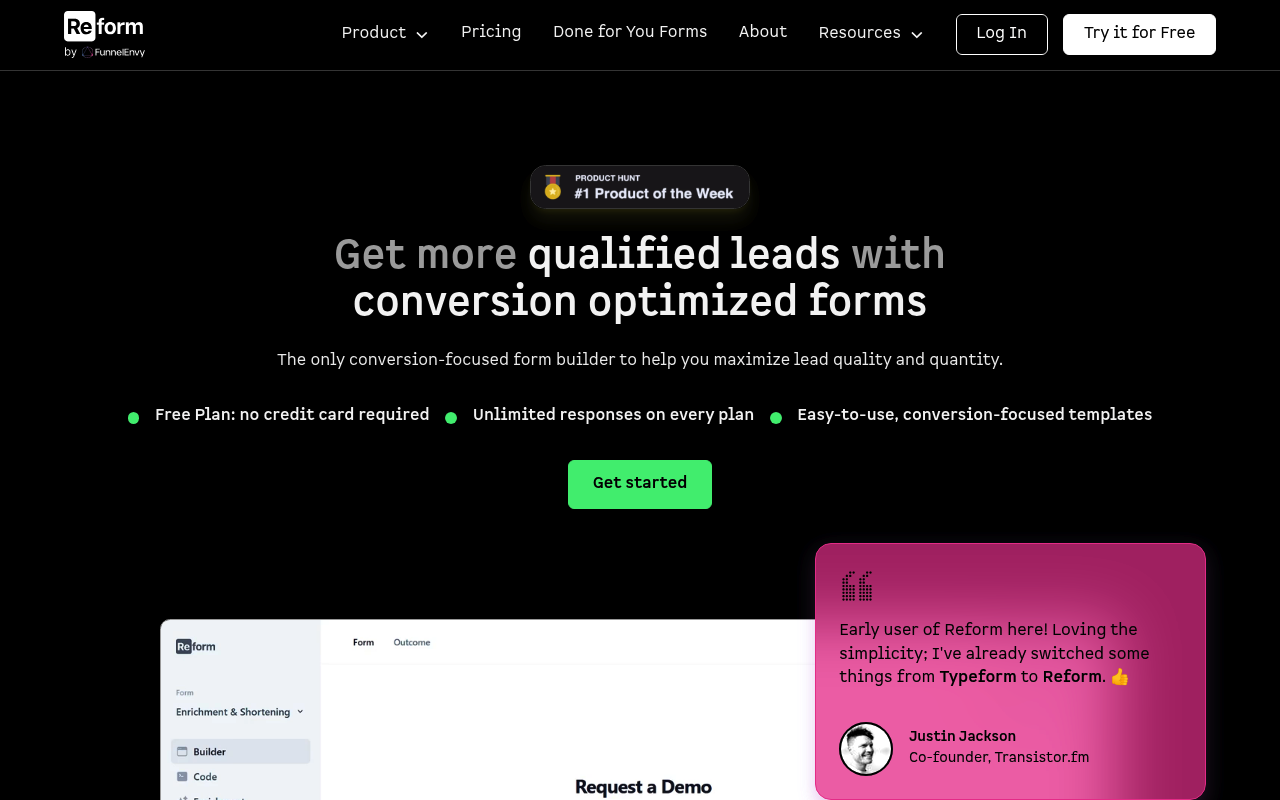
Reform
Reform is a conversion-focused, no-code form builder for B2B and SaaS teams, acquired by conversion-rate-optimization agency FunnelEnvy. It builds multi-step forms with conditional logic, lead qualification and enrichment, and syncs submissions to CRMs and marketing platforms. Reform publishes no REST API, SDK or OpenAPI definition; its integration surface is three published pieces — a signed outbound webhook (form.submitted, HMAC-SHA256), a CDN-hosted browser embed loader with a parent-page event API, and a headless mode that posts your own HTML form to Reform using answers[block-id] field naming.
Reform is listed with 1 API on the APIs.io network. Tagged areas include Forms, Form Builder, Lead Generation, Headless Forms, and Webhook.
The Reform catalog on APIs.io includes 1 event-driven AsyncAPI specification and 1 JSON-LD context.
Reform’s developer surface includes documentation, support, getting-started guide, engineering blog, pricing, signup flow, authentication, and 21 more developer resources.
Kin Score
 Kin Score
How this is scored →
Kin Score
How this is scored →scored 2026-10-17 · rubric v0.24.0
APIs 1
Individual APIs this provider publishes, each with its own machine-readable definition.
Reform Forms
Reform's public integration surface. It is not a REST management API — no endpoint exists to create, read or update forms and submissions. What Reform publishes is the hosted fo...
Pricing Plans 1
Published pricing tiers and plan structures.
Reform Plans Pricing
PLANSRate Limits 1
Documented rate limits and quota policies.
Reform Rate Limits
RATE LIMITSFinOps 1
Cost, billing, and metering signals for API financial operations.
Reform Finops
FINOPSEvent Specifications 1
AsyncAPI definitions for this provider's event-driven and streaming APIs.
Reform Webhooks
ASYNCAPISemantic Vocabularies 1
JSON-LD contexts and semantic vocabularies used across these APIs.
Reform Context
JSON-LDSecurity Posture 3
Authentication, domain security, vulnerability disclosure, and trust-center signals.
Resources
Get Started 3
Portal, sign-up, and the first successful call
Documentation 1
Reference material describing how the API behaves
Agent Surfaces 1
MCP servers, agent skills, and machine-readable catalogs
Design & Contract 6
Pagination, idempotency, versioning, errors, and events
Build 1
SDKs, sample code, and the tooling you integrate with
Access & Security 4
Authentication, authorization, and security posture
Operate 3
Status, limits, changes, and where to get help
Commercial 4
Pricing, plans, and the legal terms of use
Company 3
The organization behind the API
Other 2
Properties that don't map to a standard resource type
Source (apis.yml)
Work with this as data
Every provider here is available over the APIs.io API and to AI agents over MCP.