
Radia
Radia is a dual-use aerospace company founded in 2016 by MIT-trained aerospace engineer Mark Lundstrom, headquartered in Boulder, Colorado with a second operating base in Italy led by Giuseppe Giordo. After roughly seven years in stealth the company emerged in March 2024 with WindRunner, an aircraft it describes as the largest ever built: roughly ten times the cargo volume of a Boeing 777, sized to carry onshore wind turbine blades of up to about 105 metres, and designed to land on semi-prepared packed-dirt or gravel strips so that oversized cargo can be flown directly to a wind farm, a forward operating site or a disaster zone rather than trucked over highways it cannot fit on. Radia frames WindRunner as a deliberately low-novelty airframe assembled from existing certified technologies to shorten the certification path, targeting entry into service in the early 2030s across three markets: energy (delivering the very large blades that make low-wind onshore sites economic), defense (outsized-volume strategic airlift), and commercial supply-chain logistics. It has assembled an industrial ecosystem of more than twenty suppliers and technology partners including Aernnova, Leonardo, AFuzion, Atitech, Latecoere, Stirling Dynamics, Collier Aerospace and Maximus Air, and has raised roughly USD 128 million from investors including ConocoPhillips, Lauder Partners, LS Power Development and HCVC. Radia is an aircraft manufacturer and logistics operator rather than a software vendor: as of August 2026 it publishes no developer portal, no API documentation, no SDK and no machine-readable API contract of any kind. Its only machine-readable public surface is the Strapi headless-CMS backend at radia.com/strapi that renders its own marketing site, whose content API is permission-locked and undocumented.
Radia is profiled on the APIs.io network. Tagged areas include Company, Aerospace, Aviation, Air Cargo, and Logistics.
Kin Score
 Kin Score
How this is scored →
Kin Score
How this is scored →scored 2026-10-23 · rubric v0.25.0
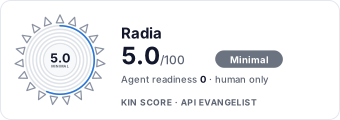 It updates itself when the score changes. Paste this where you link to your API docs:
<a href="https://apis.io/providers/radia/"><img src="https://apis.io/badge/radia/card.svg" alt="Radia on APIs.io — Kin Score by API Evangelist"></a>Other styles, a README pill and a shields.io endpoint are on the badge page.
Security Posture 1
Authentication, domain security, vulnerability disclosure, and trust-center signals.
Resources
Agent Surfaces 2
MCP servers, agent skills, and machine-readable catalogs
Design & Contract 1
Pagination, idempotency, versioning, errors, and events
Build 2
SDKs, sample code, and the tooling you integrate with
Access & Security 1
Authentication, authorization, and security posture
Operate 1
Status, limits, changes, and where to get help
Company 4
The organization behind the API
Other 3
Properties that don't map to a standard resource type
Source (apis.yml)
Work with this as data
Every provider here is available over the APIs.io API and to AI agents over MCP.