Quantinuum is an integrated quantum computing company formed by the 2021 merger of Honeywell Quantum Solutions and Cambridge Quantum. It builds trapped-ion (QCCD) quantum computers — the H1, H2, and Helios System Models — and develops the full software stack that runs on them: the Nexus cloud platform, the TKET quantum compiler, the InQuanto computational chemistry package, the lambeq quantum natural language processing toolkit, the Guppy quantum programming language, the Selene emulation framework, and the Quantum Origin verifiable randomness service. Programmatic access to Quantinuum systems is delivered through the Nexus platform (Python client `qnexus` plus a REST/OpenAPI surface) and via partner clouds; circuits are described in OpenQASM 2.0 and the Quantum Intermediate Representation (QIR).
Quantinuum is listed with 9 APIs on the APIs.io network. Tagged areas include Quantum Computing, Trapped Ion, Quantum Hardware, Quantum Software, and Quantum Compiler.
Quantinuum’s developer surface includes developer portal, documentation, signup flow, getting-started guide, support, engineering blog, tooling, and 23 more developer resources.
Regulatory Posture applies to this provider. Its tags matched the
Horizontal (data, software, accessibility, platform) regime, so
Regulatory Posture carries 15 points of the composite.
If this regime is wrong for your business, say so on your
provider repo — the
applicability map is public and we will correct it.
Create-or-Update Ergonomics could not be measured. We hold no machine-readable contract for
this provider to read, so there is nothing to measure a write surface against. Excluded rather than scored zero:
never-measured and measured-empty are different facts. Publishing an OpenAPI is what makes this facet — and
several others — scorable at all.
The six quality facets above are damped to 85 points between them,
because the conditional facet above carries the other
15. That is why each facet's contribution is shown against a damped
maximum: raising a quality facet moves the composite by 85% of its nominal
weight, not 100%. The full arithmetic is at apis.io/rating/.
Show this score on your site.
It updates itself when the score changes. Paste this where you link to your API docs:
<a href="https://apis.io/providers/quantinuum/"><img src="https://apis.io/badge/quantinuum/card.svg" alt="Quantinuum on APIs.io — Kin Score by API Evangelist"></a>
Other styles, a README pill and a shields.io endpoint are on the badge page.
Improve this rating by publishing the missing artifacts — every area above can be raised, and the full rubric is at apis.io/rating/. Every facet and dimension name above is a link: it opens that measurement's own page — what it means, the exact checks that feed it, how the whole catalog distributes on it, and the providers at the top of it. This rating is computed from github.com/api-evangelist/quantinuum: open an issue to ask a question, or submit a pull request to add artifacts.
Submit an artifact on GitHub — free →Manage your own listing — the Influence plan, $499/mo →
Markets this provider is in provisional
The Kin Score Market layer reads a provider inside its market:
its position, and how deep its integrations go. Depth is only comparable within a position. Provisional and unweighted:
not part of the Kin Score or agent readiness.
Registered MCP server and declares compatibility are report only — not weighted.
Undeclared means we found nothing we can read, so there is no number: we never infer integrations.
Nexus is Quantinuum's all-in-one quantum computing cloud platform. It brokers access to Quantinuum H-Series hardware (H1, H2, Helios) and to partner backends including IBM Quant...
The Quantinuum Systems API exposes the H-Series trapped-ion (QCCD) quantum computers — System Model H1, System Model H2, and the next-generation Helios — for circuit submission....
TKET is Quantinuum's optimizing quantum compiler. The Python interface `pytket` and the C++ core `tket` provide gate-level circuit construction, hardware-agnostic optimization p...
InQuanto is Quantinuum's computational quantum chemistry platform for molecular and materials simulations on near-term and fault-tolerant quantum computers. It implements VQE, q...
lambeq is Quantinuum's open-source Python toolkit for Quantum Natural Language Processing (QNLP). It converts sentences into string diagrams (DisCoCat / DisCoCirc), rewrites the...
Guppy (`guppylang`) is Quantinuum's Pythonic quantum-classical programming language. Guppy programs compile through the HUGR hierarchical intermediate representation and target ...
Selene is Quantinuum's plugin-extensible emulator for hybrid quantum computation. It simulates the behavior of Quantinuum H-Series hardware including mid-circuit measurement, co...
Quantum Origin is Quantinuum's verifiable quantum random number generation service, delivering cryptographically strong entropy seeded by quantum measurements for use in PKI, ke...
Qermit is a Python module for running error-mitigation protocols (probabilistic error cancellation, zero-noise extrapolation, Clifford data regression, dynamical decoupling, etc...
Discovery needs no key. Ratings and market analysis are Pro.
Get an API key
Free tier, no form to fill in. Signing in shares your email address with us — we
store it to create your key and to recognise you if you sign in with another
provider. See our Privacy Policy and
Terms.

 Kin Score
How this is scored →
Kin Score
How this is scored →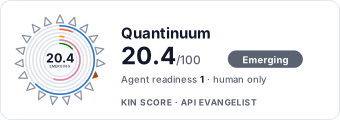 It updates itself when the score changes. Paste this where you link to your API docs: