Prompt Driven
Prompt Driven (PDD) is the company behind Prompt-Driven Development, a prompt-native programming system in which .prompt files are the human-authored source language and traditional code (Python, TypeScript, Go, and others) is generated as an artifact. PDD ships as a single open-source Python CLI, pdd-cli, plus a local web interface, and offers agentic commands that implement GitHub issues automatically through a Define -> Generate -> Verify -> Test -> Update cycle. Positioned as "The Last Programming Language," the project is MIT-licensed, maintained by Greg Tanaka, and backed by 500 Global. It is a developer tool rather than a hosted API — there is no public REST/GraphQL API, OpenAPI spec, or MCP server; the developer surface is the CLI and its GitHub repository.
Prompt Driven is profiled on the APIs.io network. Tagged areas include Company, Developer Tools, Artificial Intelligence, Code Generation, and Developer Experience.
Prompt Driven’s developer surface includes documentation, support, CLI, changelog, and 14 more developer resources.
Kin Score
 Kin Score
How this is scored →
scored 2026-11-06 · rubric v0.27.0
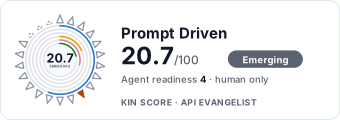 It updates itself when the score changes. Paste this where you link to your API docs:
<a href="https://apis.io/providers/prompt-driven/"><img src="https://apis.io/badge/prompt-driven/card.svg" alt="Prompt Driven on APIs.io — Kin Score by API Evangelist"></a>Other styles, a README pill and a shields.io endpoint are on the badge page.
- Machine-Readable Contract +18 pts — api_specs includes an OpenAPI document
- MCP Server +12 pts — deployment.mode + probe verdict on the mcp/ manifest, not the pointer; an unprobed slug falls back to authorship
- Agentic Access Contract +10 pts — agentic_access artifact present (x-agentic-access), graded by author
- Machine-Readable Auth +10 pts — a served openid-configuration/oauth-authorization-server carrying `issuer` (served), else the securitySchemes class in the provider OpenAPIs — bound (mutualTLS, DPoP, Signature) > negotiable (oauth2 authorizationCode/clientCredentials, openIdConnect) > bearer (http bearer, apiKey)
- Idempotency +9 pts — OpenAPI mutating operations declare an idempotency key — a header, a request-body property, or a named de-duplication token whose own description says so (verified); else common[].type matches /idempoten/i (documented)
- Stable Error Semantics +8 pts — OpenAPI $refs a shared error schema across 4xx/5xx responses (verified), else common[].type includes ErrorCatalog / ErrorCodes / DeclineCodes
- Contract Quality scores 0.0 — up to +25.0 composite points
- Access Clarity scores 21.1 — up to +15.8 composite points
- Developer Ergonomics scores 28.6 — up to +14.3 composite points
Markets this provider is in provisional
The Kin Score Market layer reads a provider inside its market: its position, and how deep its integrations go. Depth is only comparable within a position. Provisional and unweighted: not part of the Kin Score or agent readiness.
| Market | Position | Depth | Registered MCP server | Declares compatibility |
|---|---|---|---|---|
| Agent Skills (SKILL.md packages) | undeclared | - | - | 2 |
Registered MCP server and declares compatibility are report only — not weighted. Undeclared means we found nothing we can read, so there is no number: we never infer integrations.
Standards implemented 1
Standards this provider implements or carries. De facto ones are profiled and measured by the API Commons; formal ones come from the standards directory and are linked by the provider's own tags. The evidence column says how each claim was established — not that it was made.
Security Posture 1
Authentication, domain security, vulnerability disclosure, and trust-center signals.
Resources
Documentation 2
Reference material describing how the API behaves
Agent Surfaces 3
MCP servers, agent skills, and machine-readable catalogs
Build 4
SDKs, sample code, and the tooling you integrate with
Access & Security 1
Authentication, authorization, and security posture
Operate 4
Status, limits, changes, and where to get help
Commercial 3
Pricing, plans, and the legal terms of use
Company 1
The organization behind the API
Source (apis.yml)
Work with this as data
Every provider here is available over the APIs.io API and to AI agents over MCP.