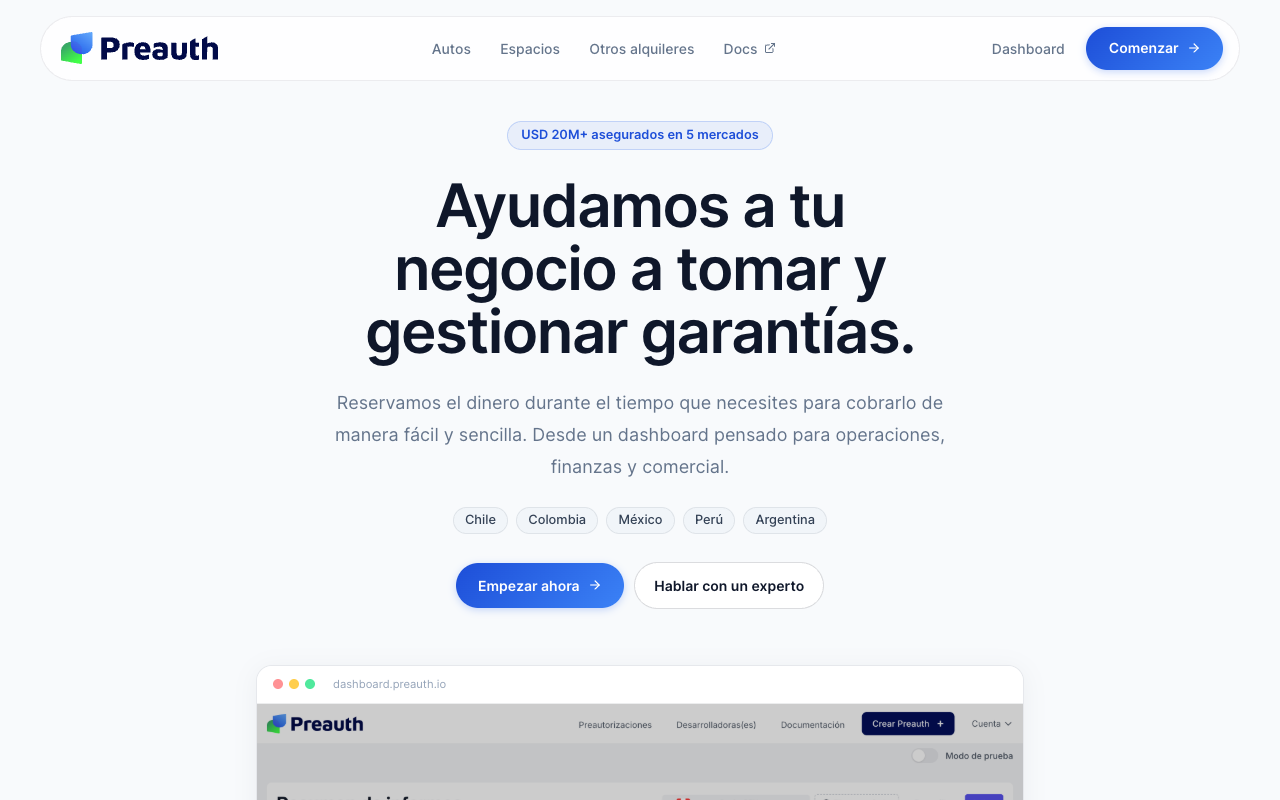
PreAuth (Instacash)
Preauth is a Latin American fintech (the payment-guarantee product associated with the Instacash / Reevalúa lineage, surfaced via 500 Global) that lets businesses take and manage payment guarantees through card pre-authorization. A merchant creates an order via the REST API, the buyer's card is pre-authorized (funds reserved) through the hosted Preauth widget, and the merchant can later capture all or part of the reserved amount, update it, cancel it to release the hold, or run a card liveness check. It operates across Chile, Colombia, Mexico, Peru, and Argentina and integrates with Izipay, Kushki, dLocal, Stripe, Mercadopago, and Conekta as payment processors. Authentication is a per-request x-auth-token API key, and order lifecycle events are delivered by webhooks.
PreAuth (Instacash) publishes 1 API contract indexed on the APIs.io network: Orders API. Tagged areas include Company, Payments, Payment Pre-Authorization, Payment Guarantees, and Fintech.
The PreAuth (Instacash) catalog on APIs.io includes 1 event-driven AsyncAPI specification.
PreAuth (Instacash)’s developer surface includes documentation, API reference, getting-started guide, support, signup flow, authentication, sandbox, and 19 more developer resources.
Kin Score
 Kin Score
How this is scored →
Kin Score
How this is scored →scored 2026-10-17 · rubric v0.24.0
APIs 1
Individual APIs this provider publishes, each with its own machine-readable definition.
PreAuth (Instacash) Orders API
Create and manage pre-authorization orders.
Open Collections 2
Open, tool-agnostic API collections (OpenAPI-derived and Bruno).
API Collection
OPEN COLLECTIONPreauth Orders API
OPEN COLLECTIONEvent Specifications 1
AsyncAPI definitions for this provider's event-driven and streaming APIs.
Preauth Webhooks
Preauth delivers order lifecycle notifications as HTTP POST requests to a URL the merchant configures in the developer panel (https://dashboard.preauth.io/panel/devs). Faithfull...
ASYNCAPIOpenAPI Overlays 1
Overlays applied on top of this provider's contracts. Each card says who wrote it: a document the provider publishes, or one API Evangelist derived or generated.
Preauth Instacash Orders Overlay
UNRECORDEDSecurity Posture 3
Authentication, domain security, vulnerability disclosure, and trust-center signals.
Resources
Get Started 4
Portal, sign-up, and the first successful call
Documentation 2
Reference material describing how the API behaves
Agent Surfaces 4
MCP servers, agent skills, and machine-readable catalogs
Design & Contract 7
Pagination, idempotency, versioning, errors, and events
Scroll for all 7
Build 2
SDKs, sample code, and the tooling you integrate with
Access & Security 4
Authentication, authorization, and security posture
Operate 1
Status, limits, changes, and where to get help
Company 1
The organization behind the API
Other 1
Properties that don't map to a standard resource type
Source (apis.yml)
Work with this as data
Every provider here is available over the APIs.io API and to AI agents over MCP.