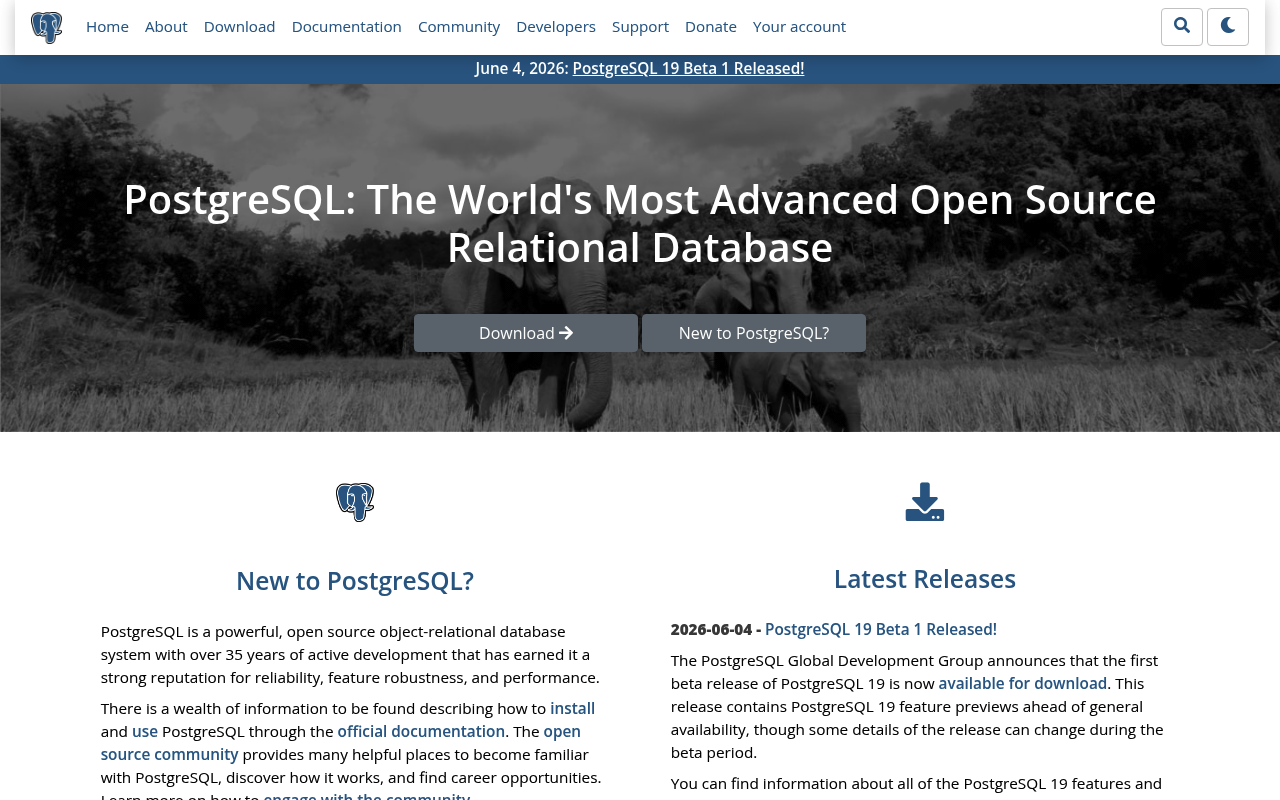
PostgreSQL website screenshot

PostgreSQL

PostgreSQL is a powerful, open-source object-relational database system with over 35 years of active development. It provides advanced SQL compliance, ACID transactions, and extensibility. PostgreSQL exposes a binary wire protocol via libpq and language bindings rather than a public HTTP REST API, so there is no canonical OpenAPI specification. HTTP access is typically layered on top via PostgREST, Hasura, or application code.

PostgreSQL publishes 5 APIs on the APIs.io network. Tagged areas include Database, Open-Source, Relational Database, and SQL.

PostgreSQL’s developer surface includes documentation, engineering blog, and 4 more developer resources.

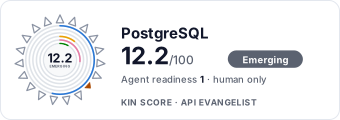
15.3/100 emerging ▬ flat Agent 3/100 human only Full breakdown ↓
scored 2026-09-14 · rubric v0.22.0
AccessFreemium
5 APIs
DatabaseOpen-SourceRelational DatabaseSQL

Kin Score

Kin Score Kin Score How this is scored →
scored 2026-09-14 · rubric v0.22.0
Create-or-Update Ergonomics could not be measured. We hold no machine-readable contract for this provider to read, so there is nothing to measure a write surface against. Excluded rather than scored zero: never-measured and measured-empty are different facts. Publishing an OpenAPI is what makes this facet — and several others — scorable at all.
Improve this rating by publishing the missing artifacts — every area above can be raised, and the full rubric is at apis.io/rating/. Every facet and dimension name above is a link: it opens that measurement's own page — what it means, the exact checks that feed it, how the whole catalog distributes on it, and the providers at the top of it. This rating is computed from github.com/api-evangelist/postgresql: open an issue to ask a question, or submit a pull request to add artifacts. Submit an artifact on GitHub — free → Manage your own listing — the Influence plan, $499/mo →

APIs 5

Individual APIs this provider publishes, each with its own machine-readable definition.

PostgreSQL

Open-source relational database with advanced SQL compliance and extensibility. Client libraries available in many languages.

PostgreSQL Wire Protocol

The PostgreSQL frontend/backend protocol is the low-level message-based protocol used by all client drivers (libpq, JDBC, ODBC, psycopg, pgx, node-postgres, etc.) to communicate...

libpq C Client Library

libpq is the official C application programmer's interface to PostgreSQL and the underlying library used by most other PostgreSQL client interfaces. It provides connection manag...

PostgreSQL JDBC Driver

The official Type 4 JDBC driver for PostgreSQL enables Java applications to connect to PostgreSQL using the standard JDBC API. It supports connection pooling, prepared statement...

PostgreSQL ODBC Driver (psqlODBC)

The official ODBC driver for PostgreSQL providing Open Database Connectivity for Windows, Linux, and macOS applications including Microsoft Office, Tableau, Power BI, and other ...

GraphQL 1

GraphQL schemas published by this provider.

Pricing Plans 1

Published pricing tiers and plan structures.

Rate Limits 1

Documented rate limits and quota policies.

Postgresql Rate Limits

5 limits

RATE LIMITS

FinOps 1

Cost, billing, and metering signals for API financial operations.

Security Posture 1

Authentication, domain security, vulnerability disclosure, and trust-center signals.

Postgresql Domain Security

TLSv1.3 · HSTS · DNSSEC · DMARC

SECURITY

Resources

Documentation 1

Reference material describing how the API behaves

Build 1

SDKs, sample code, and the tooling you integrate with

Access & Security 1

Authentication, authorization, and security posture

Operate 1

Status, limits, changes, and where to get help

Company 2

The organization behind the API

Source (apis.yml)

apis.yml Raw ↑
aid: postgresql
name: PostgreSQL
description: PostgreSQL is a powerful, open-source object-relational database system with over 35 years of active development.
  It provides advanced SQL compliance, ACID transactions, and extensibility. PostgreSQL exposes a binary wire protocol via
  libpq and language bindings rather than a public HTTP REST API, so there is no canonical OpenAPI specification. HTTP access
  is typically layered on top via PostgREST, Hasura, or application code.
type: Index
deliveryModel:
  model: unknown
  open_source: false
  commercial: false
  callable_host: false
  label: Delivery model not determined — needs a product licence on record
  confidence: low
  source:
  - none
  generated: '2026-08-28'
  method: derived
accessModel:
  pricing: freemium
  onboarding: unknown
  trial: false
  try_now: false
  public: false
  label: Freemium
  confidence: medium
  source:
  - plans
  generated: '2026-07-22'
  method: derived
image: https://kinlane-images.s3.amazonaws.com/shared/apis-json/icons/postgresql.png
tags:
- Database
- Open-Source
- Relational Database
- SQL
tags_raw:
- Database
- Open Source
- Relational Database
- SQL
url: https://raw.githubusercontent.com/api-evangelist/postgresql/refs/heads/main/apis.yml
created: '2026-03-16'
modified: '2026-04-28'
specificationVersion: '0.23'
apis:
- aid: postgresql:postgresql
  name: PostgreSQL
  description: Open-source relational database with advanced SQL compliance and extensibility. Client libraries available
    in many languages.
  humanURL: https://www.postgresql.org/
  tags:
  - Database
  - SQL
  properties:
  - type: Documentation
    url: https://www.postgresql.org/docs/
  - type: GettingStarted
    url: https://www.postgresql.org/docs/current/tutorial.html
- aid: postgresql:wire-protocol
  name: PostgreSQL Wire Protocol
  description: The PostgreSQL frontend/backend protocol is the low-level message-based protocol used by all client drivers
    (libpq, JDBC, ODBC, psycopg, pgx, node-postgres, etc.) to communicate with the PostgreSQL server over TCP/IP or Unix sockets.
    Authentication supports password, SCRAM-SHA-256, MD5, GSSAPI, SSPI, certificate, LDAP, and other pluggable methods.
  humanURL: https://www.postgresql.org/docs/current/protocol.html
  baseURL: postgresql://hostname:5432
  tags:
  - Database
  - Wire Protocol
  - SQL
  - Connection Protocol
  properties:
  - type: Documentation
    url: https://www.postgresql.org/docs/current/protocol.html
  - type: Specification
    url: https://www.postgresql.org/docs/current/protocol-message-formats.html
  - url: graphql/postgres-graphql.md
    type: GraphQL
- aid: postgresql:libpq
  name: libpq C Client Library
  description: libpq is the official C application programmer's interface to PostgreSQL and the underlying library used by
    most other PostgreSQL client interfaces. It provides connection management, query execution, prepared statements, COPY
    support, asynchronous operations, and SSL/TLS.
  humanURL: https://www.postgresql.org/docs/current/libpq.html
  baseURL: postgresql://hostname:5432
  tags:
  - Database
  - C Library
  - Client Library
  - libpq
  properties:
  - type: Documentation
    url: https://www.postgresql.org/docs/current/libpq.html
- aid: postgresql:jdbc
  name: PostgreSQL JDBC Driver
  description: The official Type 4 JDBC driver for PostgreSQL enables Java applications to connect to PostgreSQL using the
    standard JDBC API. It supports connection pooling, prepared statements, batched updates, LOBs, COPY, and SSL connections.
  humanURL: https://jdbc.postgresql.org/documentation/
  baseURL: jdbc:postgresql://hostname:5432/database
  tags:
  - Database
  - JDBC
  - Java
  - Driver
  properties:
  - type: Documentation
    url: https://jdbc.postgresql.org/documentation/
  - type: GitHub
    url: https://github.com/pgjdbc/pgjdbc
- aid: postgresql:odbc
  name: PostgreSQL ODBC Driver (psqlODBC)
  description: The official ODBC driver for PostgreSQL providing Open Database Connectivity for Windows, Linux, and macOS
    applications including Microsoft Office, Tableau, Power BI, and other BI/ETL tools that consume ODBC data sources.
  humanURL: https://odbc.postgresql.org/
  baseURL: Driver={PostgreSQL};Server=hostname;Port=5432;Database=mydb
  tags:
  - Database
  - ODBC
  - Driver
  - BI Integration
  properties:
  - type: Documentation
    url: https://odbc.postgresql.org/docs/
  - type: GitHub
    url: https://github.com/postgresql-interfaces/psqlodbc
common:
- type: DomainSecurity
  url: security/postgresql-domain-security.yml
- type: Website
  url: https://www.postgresql.org/
- type: Documentation
  url: https://www.postgresql.org/docs/
- type: Community
  url: https://www.postgresql.org/community/
- type: GitHubOrganization
  url: https://github.com/postgres/postgres
- url: https://www.postgresql.org/news.rss
  type: Blog
maintainers:
- FN: Kin Lane
  email: kin@apievangelist.com

Work with this as data

Every provider here is available over the APIs.io API and to AI agents over MCP.

MCP server

One button, every client — Claude, Cursor, VS Code and the rest.

https://apis.io/mcp

Tools for providers

9 MCP tools reach this
  • find_providersBrowse and filter every provider in the catalog.
  • get_provider_artifactsEvery artifact this provider publishes, grouped by type.
  • get_provider_operationsEvery operation across all of their OpenAPIs — one call instead of parsing every spec.
  • get_provider_toolsEvery MCP tool they ship, with the operation each wraps.
  • get_provider_evidenceHow each part of their score was established. Free — the basis for a claim should not sit behind it.
  • get_provider_ratingPRO — composite, band, trend and facet scores.
  • apis_io_searchSTART HERE — APIs, providers and tags for one query, each with its total.
  • resolveTurn a domain, URL or GitHub org into the provider it belongs to.
  • find_cohortsEvery scored population of providers in the catalog.
All 92 tools →

Call it yourself

curl for this page
This provider
curl "https://apis.io/api/v1/providers/postgresql"
All providers
curl "https://apis.io/api/v1/providers?limit=25"
Every operation they expose
curl "https://apis.io/api/v1/providers/postgresql/operations?limit=25"
How their score was established
curl "https://apis.io/api/v1/providers/postgresql/evidence"

Discovery needs no key. Ratings and market analysis are Pro.

Get an API key

Free tier, no form to fill in. Signing in shares your email address with us — we store it to create your key and to recognise you if you sign in with another provider. See our Privacy Policy and Terms.

A second provider on the same verified email joins the account you already have.