
Portcast
Portcast is a predictive supply-chain visibility platform whose Container Tracking API delivers the full journey of an ocean container - milestones, vessel schedules, port codes, and machine-learning predicted ETAs and ETDs - in a single JSON response, tracked by container number, bill of lading, or booking number plus carrier SCAC, with push (webhook) callbacks on every update.
Portcast publishes 5 API contracts indexed on the APIs.io network, including Augmentation API, Container Detail API, Reference API, and 2 more. Tagged areas include Supply Chain, Container Tracking, Logistics, Predictive ETA, and Ocean Freight.
Portcast’s developer surface includes engineering blog, authentication, documentation, and 9 more developer resources.
What this lets a business do 1
Business capabilities this provider's published APIs can perform, derived from its own contracts. Browse all capabilities →
Kin Score
 Kin Score
How this is scored →
Kin Score
How this is scored →scored 2026-10-23 · rubric v0.25.0
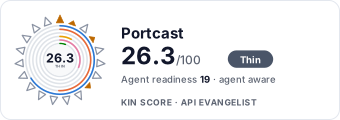 It updates itself when the score changes. Paste this where you link to your API docs:
<a href="https://apis.io/providers/portcast/"><img src="https://apis.io/badge/portcast/card.svg" alt="Portcast on APIs.io — Kin Score by API Evangelist"></a>Other styles, a README pill and a shields.io endpoint are on the badge page.
APIs 5
Individual APIs this provider publishes, each with its own machine-readable definition.
Portcast Augmentation API
Manage custom augmentation data on a bookmark.
Portcast Container Detail API
Container route, risks, and terminal data sub-APIs.
Portcast Reference API
Supported carrier SCAC reference data.
Portcast Tracking Data API
Retrieve tracking results, predicted ETA/ETD, and milestones.
Portcast Tracking Upload API
Start tracking an ocean shipment.
Open Collections 6
Open, tool-agnostic API collections (OpenAPI-derived and Bruno).
Portcast Container Tracking Augmentation API
OPEN COLLECTIONPortcast Container Tracking Augmentation Reference API
OPEN COLLECTIONPortcast Container Tracking Augmentation Tracking Data API
OPEN COLLECTIONPortcast Container Tracking Augmentation Tracking Upload API
OPEN COLLECTIONPortcast Container Tracking API
OPEN COLLECTIONPricing Plans 1
Published pricing tiers and plan structures.
Rate Limits 1
Documented rate limits and quota policies.
Portcast Rate Limits
RATE LIMITSFinOps 1
Cost, billing, and metering signals for API financial operations.
Portcast Finops
FINOPSSecurity Posture 2
Authentication, domain security, vulnerability disclosure, and trust-center signals.
Agentic Access 1
Recommended x-agentic-access execution contracts for AI agents.
Resources
Documentation 1
Reference material describing how the API behaves
Agent Surfaces 1
MCP servers, agent skills, and machine-readable catalogs
Build 1
SDKs, sample code, and the tooling you integrate with
Access & Security 2
Authentication, authorization, and security posture
Operate 1
Status, limits, changes, and where to get help
Commercial 2
Pricing, plans, and the legal terms of use
Company 3
The organization behind the API
Other 1
Properties that don't map to a standard resource type
Source (apis.yml)
Work with this as data
Every provider here is available over the APIs.io API and to AI agents over MCP.