
Pokémon TCG API
The Pokémon TCG API is a free, community-run REST API created and maintained by Andrew Backes that serves Pokémon Trading Card Game data - more than 20,000 cards across 170+ sets, from Base Set onward. Every card carries full gameplay data (attacks, abilities, weaknesses, resistances, retreat costs), format legalities, high-resolution card images, and daily-updated market prices from TCGplayer and Cardmarket. A Lucene-like query syntax supports keyword, phrase, wildcard, exact, range, and nested-field searches across every field. The API works without authentication at a reduced rate limit; a free API key from the developer portal, sent in the X-Api-Key header, raises the limits. Official SDKs cover Python, Ruby, JavaScript, TypeScript, C#, Kotlin, PHP, Go, Dart, and Elixir.
Pokémon TCG API publishes 3 API contracts indexed on the APIs.io network: Cards API, Metadata API, and Sets API. Tagged areas include Pokemon, Trading Cards, TCG, Gaming, and Card Games.
Pokémon TCG API’s developer surface includes authentication, documentation, and 12 more developer resources.
Kin Score
 Kin Score
How this is scored →
Kin Score
How this is scored →scored 2026-10-23 · rubric v0.25.0
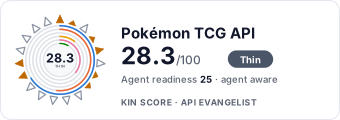 It updates itself when the score changes. Paste this where you link to your API docs:
<a href="https://apis.io/providers/pokemon-tcg/"><img src="https://apis.io/badge/pokemon-tcg/card.svg" alt="Pokémon TCG API on APIs.io — Kin Score by API Evangelist"></a>Other styles, a README pill and a shields.io endpoint are on the badge page.
APIs 3
Individual APIs this provider publishes, each with its own machine-readable definition.
Pokémon TCG API Cards API
Individual Pokémon, Trainer, and Energy cards with full gameplay data, images, legalities, and market prices.
Pokémon TCG API Metadata API
The controlled vocabularies used across cards - energy types, card subtypes, supertypes, and rarities.
Pokémon TCG API Sets API
Trading card game sets (expansions), from Base Set onward.
Open Collections 4
Open, tool-agnostic API collections (OpenAPI-derived and Bruno).
Pokémon TCG Cards API
OPEN COLLECTIONPokémon TCG Cards Metadata API
OPEN COLLECTIONPokémon TCG Cards Sets API
OPEN COLLECTIONPokémon TCG API
OPEN COLLECTIONPricing Plans 1
Published pricing tiers and plan structures.
Rate Limits 1
Documented rate limits and quota policies.
Pokemon Tcg Rate Limits
RATE LIMITSFinOps 1
Cost, billing, and metering signals for API financial operations.
Pokemon Tcg Finops
FINOPSSecurity Posture 2
Authentication, domain security, vulnerability disclosure, and trust-center signals.
Agentic Access 1
Recommended x-agentic-access execution contracts for AI agents.
Resources
Get Started 1
Portal, sign-up, and the first successful call
Documentation 2
Reference material describing how the API behaves
Agent Surfaces 1
MCP servers, agent skills, and machine-readable catalogs
Design & Contract 1
Pagination, idempotency, versioning, errors, and events
Build 2
SDKs, sample code, and the tooling you integrate with
Access & Security 3
Authentication, authorization, and security posture
Operate 1
Status, limits, changes, and where to get help
Commercial 2
Pricing, plans, and the legal terms of use
Company 1
The organization behind the API
Source (apis.yml)
Work with this as data
Every provider here is available over the APIs.io API and to AI agents over MCP.