OSlash
OSlash is a productivity tool that lets teams create short, memorable shortcuts — typed as "o/" followed by a keyword — to instantly find and open their documents, dashboards, and internal tools across 100+ connected apps such as Salesforce, Notion, Jira, GitHub, Figma, Asana, HubSpot, and Linear. Delivered as a Chrome extension with enterprise features like SSO and bank-level encryption, OSlash was backed by Accel. As of this profile the public product is marked "Coming Soon" and the company publishes no developer API, SDK, OpenAPI spec, or documentation surface — this remains an enrichment lead with no scored API artifacts beyond a domain-security probe.
OSlash is profiled on the APIs.io network. Tagged areas include Company, Cloud Saas, Productivity, Shortcuts, and Knowledge Management.
OSlash’s developer surface includes signup flow and 2 more developer resources.
Kin Score
 Kin Score
How this is scored →
scored 2026-11-13 · rubric v0.28.0
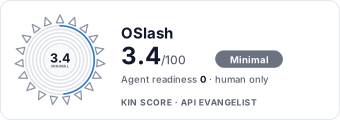 It updates itself when the score changes. Paste this where you link to your API docs:
<a href="https://apis.io/providers/oslash/"><img src="https://apis.io/badge/oslash/card.svg" alt="OSlash on APIs.io — Kin Score by API Evangelist"></a>Other styles, a README pill and a shields.io endpoint are on the badge page.
- Machine-Readable Contract +18 pts — api_specs includes an OpenAPI document Ask about this →
- MCP Server +12 pts — deployment.mode + probe verdict on the mcp/ manifest, not the pointer; an unprobed slug falls back to authorship Ask about this →
- Agentic Access Contract +10 pts — agentic_access artifact present (x-agentic-access), graded by author Ask about this →
- Machine-Readable Auth +10 pts — a served openid-configuration/oauth-authorization-server carrying `issuer` (served), else the securitySchemes class in the provider OpenAPIs — bound (mutualTLS, DPoP, Signature) > negotiable (oauth2 authorizationCode/clientCredentials, openIdConnect) > bearer (http bearer, apiKey) Ask about this →
- Idempotency +9 pts — OpenAPI mutating operations declare an idempotency key — a header, a request-body property, or a named de-duplication token whose own description says so (verified); else common[].type matches /idempoten/i (documented) Ask about this →
- Stable Error Semantics +8 pts — OpenAPI $refs a shared error schema across 4xx/5xx responses (verified), else common[].type includes ErrorCatalog / ErrorCodes / DeclineCodes Ask about this →
- Contract Quality scores 0.0 — up to +25.0 composite points Ask about this →
- Developer Ergonomics scores 0.0 — up to +20.0 composite points Ask about this →
- Access Clarity scores 0.0 — up to +20.0 composite points Ask about this →
Security Posture 1
Authentication, domain security, vulnerability disclosure, and trust-center signals.
Resources
Get Started 1
Portal, sign-up, and the first successful call
Access & Security 1
Authentication, authorization, and security posture
Company 1
The organization behind the API
Source (apis.yml)
Work with this as data
Every provider here is available over the APIs.io API and to AI agents over MCP.