Here Not There Labs
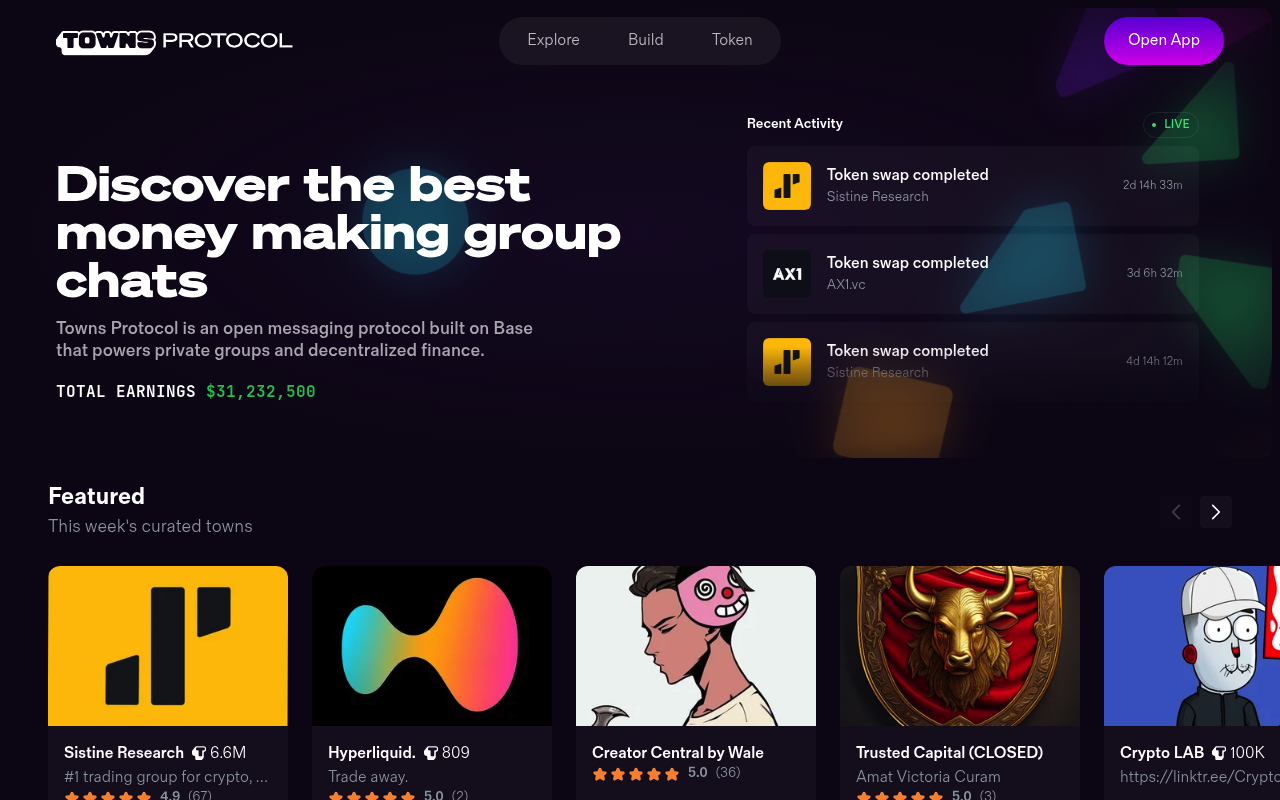
Here Not There Labs (Here Not There, Inc., operating as hntlabs.com) is the a16z-backed company behind Towns Protocol, an open, decentralized messaging protocol built on Base (an Ethereum L2) that powers ownable, programmable group chat spaces, memberships, direct messages, and decentralized finance. The protocol is delivered to builders as a set of first-party TypeScript packages under the @towns-protocol npm scope (client SDK, React SDK, bot framework, encryption, and generated protobuf bindings), a Connect/gRPC Stream RPC surface defined in public .proto files, a bot/app framework with a webhook-driven event model, and end-to-end message encryption. Spaces, memberships, roles, and entitlements are enforced by on-chain smart contracts, and a network of Stream Nodes run by node operators carries encrypted message streams. This profile was surfaced as an a16z portfolio lead and enriched from the company's public developer surface (docs.towns.com, app.towns.com, the towns-protocol GitHub organization, and npm).
Here Not There Labs is listed with 1 API on the APIs.io network. Tagged areas include Company, Messaging, Decentralized, Web3, and Blockchain.
The Here Not There Labs catalog on APIs.io includes 1 event-driven AsyncAPI specification.
Here Not There Labs’ developer surface includes documentation, API reference, getting-started guide, signup flow, CLI, authentication, and 13 more developer resources.
Kin Score
 Kin Score
How this is scored →
Kin Score
How this is scored →scored 2026-10-17 · rubric v0.24.0
APIs 1
Individual APIs this provider publishes, each with its own machine-readable definition.
Towns Protocol
Towns Protocol is an open, decentralized messaging protocol built on Base. Builders integrate via first-party TypeScript SDKs, a React SDK of hooks, and a bot/app framework. Und...
Event Specifications 1
AsyncAPI definitions for this provider's event-driven and streaming APIs.
Here Not There Labs Bot Events
ASYNCAPISecurity Posture 2
Authentication, domain security, vulnerability disclosure, and trust-center signals.
Resources
Get Started 3
Portal, sign-up, and the first successful call
Documentation 2
Reference material describing how the API behaves
Agent Surfaces 2
MCP servers, agent skills, and machine-readable catalogs
Design & Contract 3
Pagination, idempotency, versioning, errors, and events
Build 4
SDKs, sample code, and the tooling you integrate with
Access & Security 3
Authentication, authorization, and security posture
Company 1
The organization behind the API
Other 1
Properties that don't map to a standard resource type
Source (apis.yml)
Work with this as data
Every provider here is available over the APIs.io API and to AI agents over MCP.