Hatchet
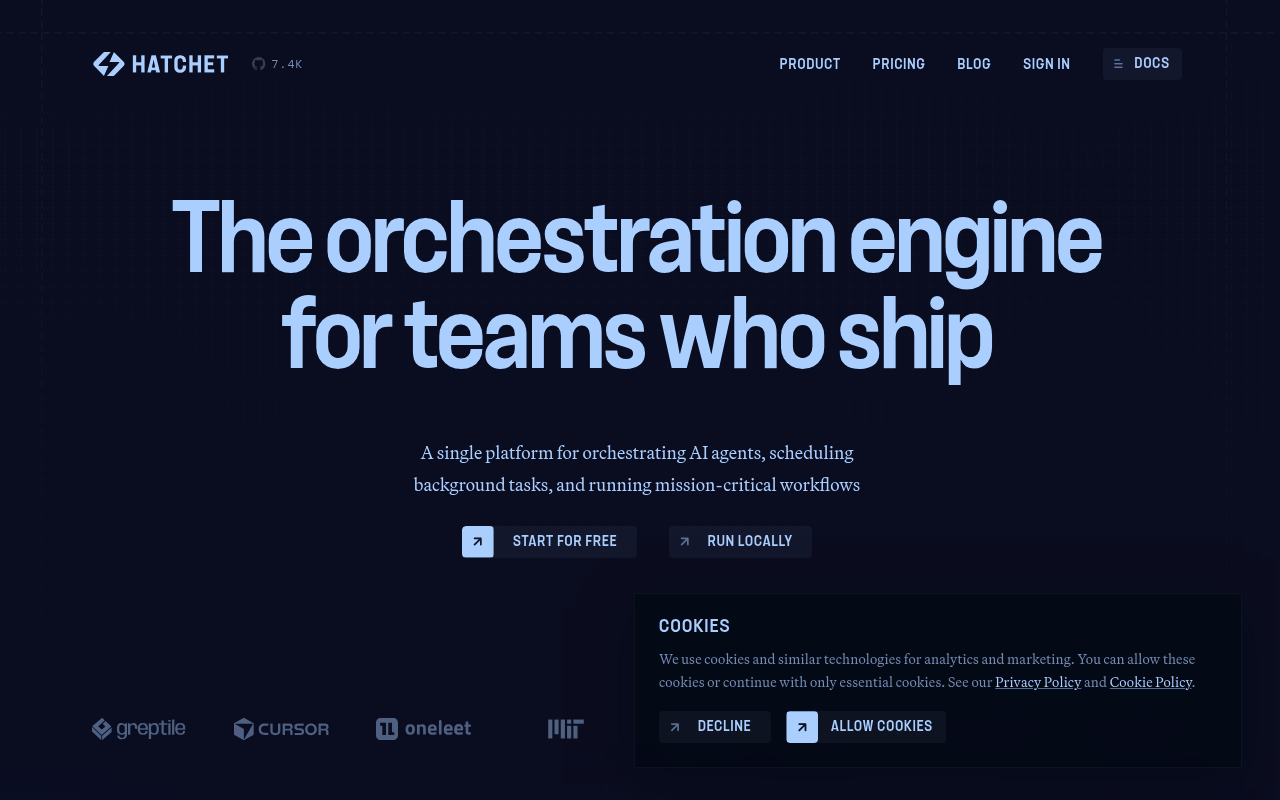
Hatchet is an open-source distributed task queue and workflow orchestration engine for background jobs, AI agents, and durable workflows. It is Postgres-backed, MIT-licensed, and ships with first-class SDKs for Python, TypeScript, Go, and Ruby plus a managed offering (Hatchet Cloud) and a self-hostable engine (Docker Compose, Hatchet Lite, Helm chart). The platform separates the orchestration engine from worker execution so workers can run on the operator's own infrastructure (Kubernetes, ECS, Render, Railway, Porter, or any container platform).
Hatchet publishes 27 API contracts indexed on the APIs.io network, including API Token API, CEL API, Durable Tasks API, and 24 more. Tagged areas include Task Queue, Workflow Engine, Durable Execution, Background Tasks, and AI Agents.
The Hatchet catalog on APIs.io includes 1 JSON-LD context and 2 Spectral governance rulesets.
Hatchet’s developer surface includes authentication, documentation, pricing, engineering blog, CLI, tooling, and 30 more developer resources.
What this lets a business do 2
Business capabilities this provider's published APIs can perform, derived from its own contracts. Browse all capabilities →
Kin Score
 Kin Score
How this is scored →
Kin Score
How this is scored →scored 2026-10-17 · rubric v0.24.0
Markets this provider is in provisional
The Kin Score Market layer reads a provider inside its market: its position, and how deep its integrations go. Depth is only comparable within a position. Provisional and unweighted: not part of the Kin Score or agent readiness.
| Market | Position | Depth | Registered MCP server | Declares compatibility |
|---|---|---|---|---|
| Cloud Native (Kubernetes, CNCF, FinOps) | standard | 17.2 (thin) | - | - |
Registered MCP server and declares compatibility are report only — not weighted. Undeclared means we found nothing we can read, so there is no number: we never infer integrations.
APIs 27
Individual APIs this provider publishes, each with its own machine-readable definition.
Hatchet API Token API
The API Token API from Hatchet — 2 operation(s) for api token.
Hatchet CEL API
The CEL API from Hatchet — 1 operation(s) for cel.
Hatchet Durable Tasks API
The Durable Tasks API from Hatchet — 1 operation(s) for durable tasks.
Hatchet Event API
The Event API from Hatchet — 11 operation(s) for event.
Hatchet Feature Flags API
The Feature Flags API from Hatchet — 1 operation(s) for feature flags.
Hatchet Filter API
The Filter API from Hatchet — 2 operation(s) for filter.
Hatchet Github API
The Github API from Hatchet — 1 operation(s) for github.
Hatchet Log API
The Log API from Hatchet — 3 operation(s) for log.
Hatchet Metadata API
The Metadata API from Hatchet — 3 operation(s) for metadata.
Hatchet Monitoring API
The Monitoring API from Hatchet — 1 operation(s) for monitoring.
Hatchet Observability API
The Observability API from Hatchet — 1 operation(s) for observability.
Hatchet Rate Limits API
The Rate Limits API from Hatchet — 1 operation(s) for rate limits.
Hatchet Slack API
The Slack API from Hatchet — 2 operation(s) for slack.
Hatchet SNS API
The SNS API from Hatchet — 2 operation(s) for sns.
Hatchet Step Run API
The Step Run API from Hatchet — 7 operation(s) for step run.
Hatchet Task API
The Task API from Hatchet — 8 operation(s) for task.
Hatchet Tenant API
The Tenant API from Hatchet — 15 operation(s) for tenant.
Hatchet Tenants API
The Tenants API from Hatchet — 2 operation(s) for tenants.
Hatchet User API
The User API from Hatchet — 12 operation(s) for user.
Hatchet Version API
The Version API from Hatchet — 1 operation(s) for version.
Hatchet Webhook API
The Webhook API from Hatchet — 2 operation(s) for webhook.
Hatchet Webhook Workers API
The Webhook Workers API from Hatchet — 2 operation(s) for webhook workers.
Hatchet Worker API
The Worker API from Hatchet — 2 operation(s) for worker.
Hatchet Workflow API
The Workflow API from Hatchet — 16 operation(s) for workflow.
Hatchet Workflow Run API
The Workflow Run API from Hatchet — 6 operation(s) for workflow run.
Hatchet Workflow Runs API
The Workflow Runs API from Hatchet — 9 operation(s) for workflow runs.
Hatchet Health Check API
The Health Check API from Hatchet — 2 operation(s) for health check.
Scroll for all 27
Postman Collections 27
Ready-to-run Postman collections for exercising this provider's APIs.
Hatchet API Token API
POSTMANHatchet API Token CEL API
POSTMANHatchet API Token Event API
POSTMANHatchet API Token Filter API
POSTMANHatchet API Token Github API
POSTMANHatchet API Token Log API
POSTMANHatchet API Token Slack API
POSTMANHatchet API Token SNS API
POSTMANHatchet API Token Task API
POSTMANHatchet API Token Tenant API
POSTMANHatchet API Token User API
POSTMANHatchet API Token Worker API
POSTMANScroll for all 27
Open Collections 29
Open, tool-agnostic API collections (OpenAPI-derived and Bruno).
API Collection
OPEN COLLECTIONHatchet API Token API
OPEN COLLECTIONHatchet API Token CEL API
OPEN COLLECTIONHatchet API Token Durable Tasks API
OPEN COLLECTIONHatchet API Token Event API
OPEN COLLECTIONHatchet API Token Feature Flags API
OPEN COLLECTIONHatchet API Token Filter API
OPEN COLLECTIONHatchet API Token Github API
OPEN COLLECTIONHatchet API Token Healthcheck API
OPEN COLLECTIONHatchet API Token Log API
OPEN COLLECTIONHatchet API Token Metadata API
OPEN COLLECTIONHatchet API Token Monitoring API
OPEN COLLECTIONHatchet API Token Observability API
OPEN COLLECTIONHatchet API Token Rate Limits API
OPEN COLLECTIONHatchet API Token Slack API
OPEN COLLECTIONHatchet API Token SNS API
OPEN COLLECTIONHatchet API Token Step Run API
OPEN COLLECTIONHatchet API Token Task API
OPEN COLLECTIONHatchet API Token Tenant API
OPEN COLLECTIONHatchet API Token Tenants API
OPEN COLLECTIONHatchet API Token User API
OPEN COLLECTIONHatchet API Token Version API
OPEN COLLECTIONHatchet API Token Webhook API
OPEN COLLECTIONHatchet API Token Webhook Workers API
OPEN COLLECTIONHatchet API Token Worker API
OPEN COLLECTIONHatchet API Token Workflow API
OPEN COLLECTIONHatchet API Token Workflow Run API
OPEN COLLECTIONHatchet API Token Workflow Runs API
OPEN COLLECTIONHatchet API
OPEN COLLECTIONScroll for all 29
Pricing Plans 1
Published pricing tiers and plan structures.
Rate Limits 1
Documented rate limits and quota policies.
Hatchet Rate Limits
RATE LIMITSFinOps 1
Cost, billing, and metering signals for API financial operations.
Hatchet Finops
FINOPSFeatures 15
Notable capabilities this provider offers.
Durable Execution
Task and workflow state is persisted to Postgres so executions survive worker restarts, network partitions, and engine upgrades.
Low-Latency Scheduling
Sub-20ms task start times with intelligent assignment rules.
Code-First SDKs
Native language SDKs for Python, TypeScript, Go, and Ruby; tasks are versionable, testable functions.
Engine / Worker Separation
The orchestration engine and workers are decoupled; workers run on the customer's own infrastructure.
Postgres-Backed
Hatchet's only hard dependency is PostgreSQL; RabbitMQ is optional for higher-throughput deployments.
First-Class Rate Limits
Engine-level rate-limit primitive throttles task execution by named key, scope, and window — independent of HTTP rate limits.
CEL Event Filters
Common Expression Language filters bind incoming events to workflows with payload predicates.
Scheduled and Cron Workflows
One-shot scheduled runs and recurring cron-triggered workflows are first-class engine resources.
Webhook Workers
External HTTPS endpoints can be registered as workers; the engine delivers task runs as signed webhook requests.
OpenTelemetry Tracing
Workflows and tasks emit OTel traces; the engine exposes a trace lookup endpoint.
Replays and Restores
Failed or cancelled tasks can be replayed with the same input or restored to the run queue.
Multi-Tenant
Tenants isolate workflows, tasks, workers, and tokens; quotas and throughput are scoped per tenant.
Dashboard
Built-in web dashboard for inspecting runs, replaying tasks, and managing tenants.
Slack and SNS Alerting
Alerts can be dispatched to Slack channels or AWS SNS topics for ops escalation.
MIT-Licensed
Engine, API, SDKs, dashboard, and Helm chart are all MIT-licensed.
Scroll for all 15
Semantic Vocabularies 1
JSON-LD contexts and semantic vocabularies used across these APIs.
Hatchet Context
JSON-LDSpectral Rules 2
Spectral governance rulesets for linting and validating these APIs.
Hatchet — jsonschema rules
SPECTRALHatchet API Rules
SPECTRALJSON Schema 12
Standalone JSON Schema definitions for this provider's data models.
APIToken
JSON SCHEMARateLimit
JSON SCHEMATenant
JSON SCHEMAV1Event
JSON SCHEMAV1Filter
JSON SCHEMAV1LogLine
JSON SCHEMAV1TaskEvent
JSON SCHEMAV1TaskSummary
JSON SCHEMAV1Webhook
JSON SCHEMAV1WorkflowRun
JSON SCHEMAWorker
JSON SCHEMAWorkflow
JSON SCHEMAScroll for all 12
JSON Structure 12
JSON Structure definitions describing this provider's data shapes.
Hatchet Api Token Structure
JSON STRUCTUREHatchet Rate Limit Structure
JSON STRUCTUREHatchet Tenant Structure
JSON STRUCTUREHatchet V1 Event Structure
JSON STRUCTUREHatchet V1 Filter Structure
JSON STRUCTUREHatchet V1 Log Line Structure
JSON STRUCTUREHatchet V1 Task Event Structure
JSON STRUCTUREHatchet V1 Task Structure
JSON STRUCTUREHatchet V1 Webhook Structure
JSON STRUCTUREHatchet V1 Workflow Run Structure
JSON STRUCTUREHatchet Worker Structure
JSON STRUCTUREHatchet Workflow Structure
JSON STRUCTUREScroll for all 12
Examples 10
Example request and response payloads for these APIs.
Rate Limit Upsert Example
EXAMPLEV1 Event Create Example
EXAMPLEV1 Filter Create Example
EXAMPLEV1 Log Line List Example
EXAMPLEV1 Task Cancel Example
EXAMPLEV1 Task Get Example
EXAMPLEV1 Task Replay Example
EXAMPLEWorker List Example
EXAMPLEScroll for all 10
Security Posture 2
Authentication, domain security, vulnerability disclosure, and trust-center signals.
Agentic Access 1
Recommended x-agentic-access execution contracts for AI agents.
Use Cases 7
What developers build with this provider.
AI Agent Orchestration
Manage tool calls, conversation state, timeouts, and checkpointing for production AI agents.
Background Jobs
Classic distributed task-queue use case — replace Celery, Sidekiq, BullMQ, or RQ with durable equivalents.
Durable Workflows
Multi-step pipelines with retries, conditional branching, and exactly-once semantics.
Ingestion and Indexing
Keep vector databases, knowledge graphs, and search indexes up-to-date as upstream sources change.
Massive Parallelization
Fan out to thousands of workers for batch processing and embarrassingly parallel workloads.
Mission-Critical Workloads
Workloads where retries, checkpointing, and replay are non-negotiable (payments, billing, compliance).
Event-Driven Architectures
Use events + CEL filters to route external signals into the right workflows without bespoke routing code.
Scroll for all 7
Integrations 13
Pre-built integrations with other platforms and tools.
PostgreSQL
The durability substrate; Hatchet ships with managed migrations and is happy on RDS, Cloud SQL, Neon, Supabase, or self-hosted Postgres.
RabbitMQ
Optional message bus for inter-service communication and high-throughput real-time updates.
Kubernetes
Official Helm chart at hatchet-dev/hatchet-charts for production self-hosting.
Docker
Hatchet Lite single-image deployment plus a production Docker Compose stack.
AWS (ECS, SNS)
ECS-friendly worker deployment patterns and first-class SNS alerting.
Slack
Native Slack alerting integration for run failures and SLA breaches.
GitHub
GitHub OAuth login for the dashboard plus repo-linked workflow source.
OpenTelemetry
Engine and SDKs emit OTel traces; the API exposes trace lookup.
Terraform
Official Terraform provider for managing Hatchet Cloud resources as code.
Homebrew
brew install via the hatchet-dev/homebrew-hatchet tap.
FastAPI
Documented quickstart for combining Hatchet Python SDK with FastAPI services.
Next.js
Multiple Next.js starter templates wire Hatchet into App Router and Pages Router projects.
Anthropic
Hatchet's durable-execution model is a natural substrate for orchestrating Anthropic Claude tool calls and multi-step agents; the hatchet-typescript-deep-research and hatchet-ty...
Scroll for all 13
Solutions 4
Packaged solutions this provider offers.
Hatchet Cloud
Fully managed orchestration engine on Hatchet's infrastructure with tier-included task-run allowances and SOC 2 / HIPAA controls.
Self-Hosted (Open Source)
MIT-licensed engine, API, dashboard, and Helm chart for running Hatchet on the operator's own infrastructure.
Hatchet Lite
Single-image bundled deployment of engine, API, and dashboard for development, testing, and low-throughput production.
Bring-Your-Own-Cloud (Enterprise)
Enterprise tier deploys the Hatchet engine inside the customer's own VPC while remaining managed by Hatchet.
Resources
Documentation 2
Reference material describing how the API behaves
Agent Surfaces 2
MCP servers, agent skills, and machine-readable catalogs
Design & Contract 3
Pagination, idempotency, versioning, errors, and events
Build 12
SDKs, sample code, and the tooling you integrate with
Scroll for all 12
Access & Security 4
Authentication, authorization, and security posture
Learn 1
Tutorials, courses, talks, and written guidance
Operate 3
Status, limits, changes, and where to get help
Commercial 4
Pricing, plans, and the legal terms of use
Company 4
The organization behind the API
Other 1
Properties that don't map to a standard resource type
Source (apis.yml)
Work with this as data
Every provider here is available over the APIs.io API and to AI agents over MCP.