evernote
Evernote is a cross-platform note-taking, organization, and task-management application operated by Bending Spoons. It lets people capture notes, web clips, images, audio, and documents, sync them across devices, and search across their knowledge base. For developers, Evernote publishes the Evernote Cloud API — a Thrift-based (EDAM) service exposing UserStore and NoteStore operations for creating, reading, searching, sharing, and synchronizing notes, notebooks, tags, and resources. Authentication is via three-legged OAuth 1.0a or long-lived developer tokens, with a sandbox environment for development. Official SDKs cover Python, Java, Ruby, JavaScript/Node, PHP, iOS, Android, and C#. The classic EDAM API and SDKs are deprecated and no longer actively developed; Evernote is now building a Model Context Protocol (MCP) server to connect AI tools to notes.
evernote is listed with 1 API on the APIs.io network. Tagged areas include Company, Note Taking, Productivity, Knowledge Management, and Notes.
The evernote catalog on APIs.io includes 1 event-driven AsyncAPI specification.
evernote’s developer surface includes documentation, API reference, getting-started guide, signup flow, support, engineering blog, pricing, and 26 more developer resources.
Kin Score
 Kin Score
How this is scored →
Kin Score
How this is scored →scored 2026-10-09 · rubric v0.23.0
APIs 1
Individual APIs this provider publishes, each with its own machine-readable definition.
Evernote Cloud API
The Evernote Cloud API (EDAM) is a Thrift-based service exposing UserStore and NoteStore operations to create, read, update, search, share, and synchronize notes, notebooks, tag...
MCP Servers 1
Model Context Protocol servers that expose these APIs to AI agents.
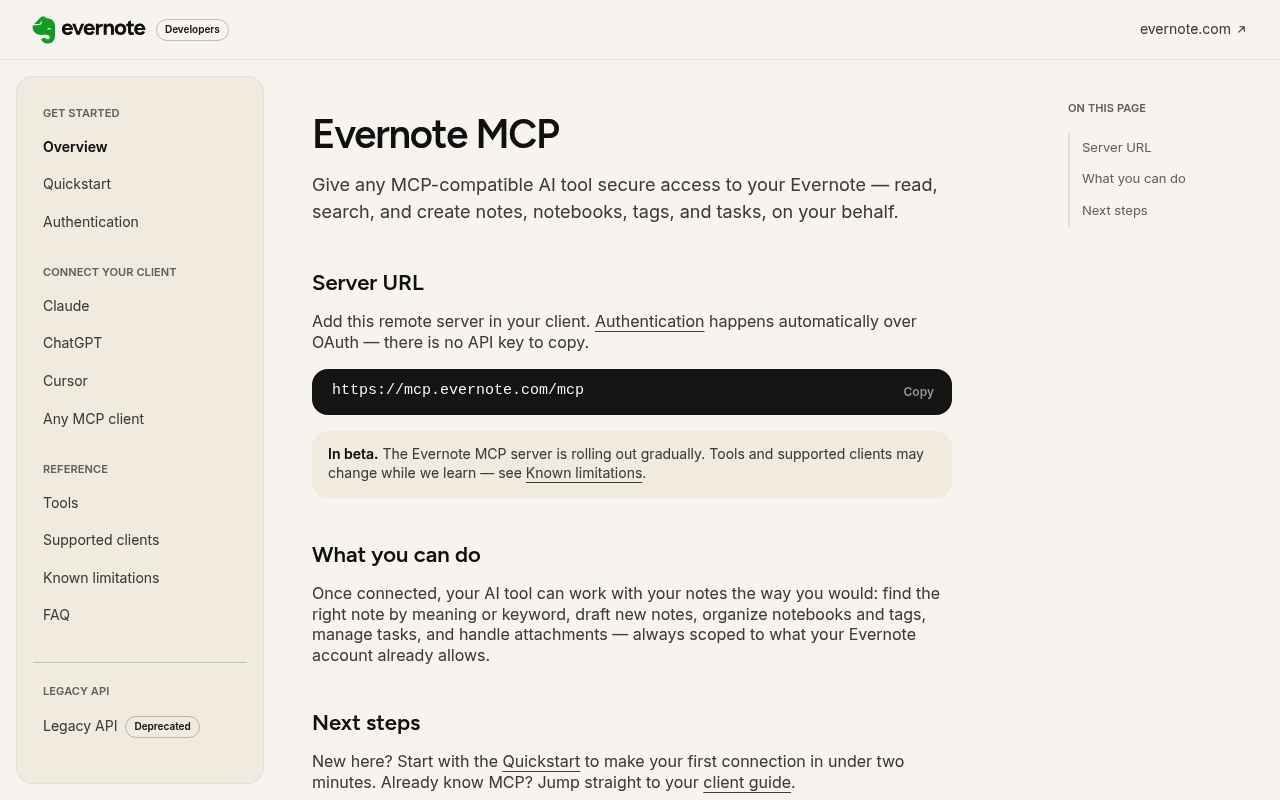
evernote MCP Server
Evernote is building an official Model Context Protocol (MCP) server that acts as a gateway between a user's Evernote account and MCP-compatible AI tools (Claude, Claude Code, a...
MCP SERVEREvent Specifications 1
AsyncAPI definitions for this provider's event-driven and streaming APIs.
Evernote Webhooks
ASYNCAPISecurity Posture 4
Authentication, domain security, vulnerability disclosure, and trust-center signals.
Resources
Get Started 4
Portal, sign-up, and the first successful call
Documentation 2
Reference material describing how the API behaves
Agent Surfaces 3
MCP servers, agent skills, and machine-readable catalogs
Design & Contract 6
Pagination, idempotency, versioning, errors, and events
Build 3
SDKs, sample code, and the tooling you integrate with
Access & Security 6
Authentication, authorization, and security posture
Operate 4
Status, limits, changes, and where to get help
Commercial 3
Pricing, plans, and the legal terms of use
Company 2
The organization behind the API
Source (apis.yml)
Work with this as data
Every provider here is available over the APIs.io API and to AI agents over MCP.