Event-driven APIs catalog. Documents the landscape of brokers, streaming platforms, schema registries, and the specifications that standardize how events are described, transported, and stored. "Events" is the broader category that contains webhooks (HTTP callbacks) as one delivery surface, alongside message brokers, log-based streaming platforms, and managed pub/sub services. The catalog aligns around CloudEvents (CNCF graduated, v1.0.2) as the spec for the event payload envelope and AsyncAPI as the spec for the event API surface (channels, operations, messages, servers), and covers the major open-source brokers (Apache Kafka, Apache Pulsar, NATS, Redpanda, IBM MQ), cloud-native managed buses (AWS EventBridge, Azure Event Grid, Google Cloud Pub/Sub, Confluent Cloud), schema registries (Confluent Schema Registry, Apicurio Registry), and streaming-analytics SaaS (Tinybird, Materialize). Wire-level protocols included are MQTT (OASIS), AMQP (OASIS / ISO 19464), and STOMP.
Events is listed with 18 APIs on the APIs.io network. Tagged areas include Event, Event-Driven, Event Streaming, Messaging, and Pub/Sub.
The Events catalog on APIs.io includes 1 JSON-LD context and 1 Spectral governance ruleset.
Events’ developer surface includes engineering blog, developer portal, and 10 more developer resources.
Pull Events's APIs, OpenAPI, scores and pricing into your own code or AI agent
with a free APIs.io key —
sign in with
GitHub,
Google or
LinkedIn.
No form to fill in; signing in shares your email address with us (Privacy).
Points earned after grading and authorship credit; n/a dimensions are left out of the score.
Regulatory Posture applies to this provider. Its tags matched the
Horizontal (data, software, accessibility, platform) regime, so
Regulatory Posture carries 15 points of the composite.
If this regime is wrong for your business, say so on your
provider repo — the
applicability map is public and we will correct it.
Open Source Surface applies to this provider. This product is open source and we
read its repository directly, so Open Source Surface carries
10 points of the composite. It is scored from what the repository actually
publishes — a security policy, a contribution guide, a release history, a code of conduct — read live from the
provider rather than inferred from our own catalog pointers.
This facet adds; nothing was taken away to make room for it. An open-source project is not excused from
the commercial facets, because exemption would strip it of the points it does earn.
If we have the wrong repository, or this product is not open source, say so on your
provider repo and we
will drop the facet rather than have you publish against it.
Create-or-Update Ergonomics could not be measured. We hold no machine-readable contract for
this provider to read, so there is nothing to measure a write surface against. Excluded rather than scored zero:
never-measured and measured-empty are different facts. Publishing an OpenAPI is what makes this facet — and
several others — scorable at all.
The six quality facets above are damped to 75 points between them,
because both conditional facets apply and carry
25 points together. That is why each facet's contribution is shown against a damped
maximum: raising a quality facet moves the composite by 75% of its nominal
weight, not 100%. The full arithmetic is at apis.io/rating/.
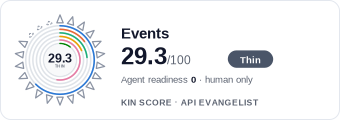
Show this score on your site.
It updates itself when the score changes. Paste this where you link to your API docs:
<a href="https://apis.io/providers/events/"><img src="https://apis.io/badge/events/card.svg" alt="Events on APIs.io — Kin Score by API Evangelist"></a>
Other styles, a README pill and a shields.io endpoint are on the badge page.
Raise your score.
Agent readiness — checks not met, largest first (exact, from this profile):
Machine-Readable Auth+10 pts — a served openid-configuration/oauth-authorization-server carrying `issuer` (served), else the securitySchemes class in the provider OpenAPIs — bound (mutualTLS, DPoP, Signature) > negotiable (oauth2 authorizationCode/clientCredentials, openIdConnect) > bearer (http bearer, apiKey) Ask about this →
Idempotency+9 pts — OpenAPI mutating operations declare an idempotency key — a header, a request-body property, or a named de-duplication token whose own description says so (verified); else common[].type matches /idempoten/i (documented) Ask about this →
Stable Error Semantics+8 pts — OpenAPI $refs a shared error schema across 4xx/5xx responses (verified), else common[].type includes ErrorCatalog / ErrorCodes / DeclineCodes Ask about this →
14 more unmet checks in the Agent Readiness table above.
Kin Score — facets with the most composite points still available (weight × headroom):
Each check links to what satisfies it. Publish the artifact, or tell us where it already lives, and the score moves on the next scoring run.
Not sure how this applies to your stack? Ask about any one item. Kin Lane reads every question, looks at your profile and your situation, and replies with what a fix would take — scoped to that one area, priced up front, yours whether you ship it or not. Ask a question →
Standards this provider implements or carries. De facto ones are profiled and measured by the API Commons; formal ones come from the standards directory and are linked by the provider's own tags. The evidence column says how each claim was established — not that it was made.
CNCF-graduated specification (graduated January 25, 2024) for describing event data in a common way. Defines a payload envelope with required attributes id, source, specversion,...
Open-source distributed event streaming platform governed by the Apache Software Foundation. Described as used by "thousands of companies for high-performance data pipelines, st...
Open-source distributed messaging and streaming platform built for the cloud. Top-10 Apache Software Foundation project (740+ contributors, current version 4.2). Multi-tenant by...
CNCF incubating high-performance, lightweight messaging system designed for cloud, edge, and IoT. Supports pub/sub, request/reply, and queue groups over a text-based protocol. J...
Kafka API-compatible streaming data platform written in C++ (no JVM, no ZooKeeper). Self-described as an "Agentic Data Plane and Data Streaming platform for real-time performanc...
Enterprise messaging middleware from IBM. Long the de facto standard for assured-once message delivery in regulated industries (banking, government). Exposes the MQI native API,...
AWS serverless event router. "EventBridge is a serverless service that uses events to connect application components together, making it easier for you to build scalable event-d...
Azure's "highly scalable and fully managed publish-subscribe service for message distribution." Supports both HTTP push/pull delivery and an MQTT v3.1.1 / v5.0 broker mode for I...
Google Cloud's asynchronous and scalable messaging service that decouples message producers from consumers with typical latencies around 100 ms. Uses per-message leasing (not pa...
Commercial managed service from Confluent positioned as "the industry's only fully managed data streaming platform." Built on the Kora cloud-native Kafka engine. Tiers: Basic, S...
Central repository with a RESTful interface for registering and evolving schemas in Avro, JSON Schema, and Protobuf. Enforces compatibility rules (backward, forward, full, trans...
Managed ClickHouse-based SaaS for real-time analytics on event data. Ingests events via an HTTP Events API (up to 1,000 req/s) plus connectors for Kafka, S3, GCS, BigQuery, Snow...
Streaming SQL database based on incremental view maintenance. Continually ingests CDC from Postgres, Kafka, and other sources, then keeps SQL views up to date with minimal recom...
OASIS standard messaging protocol for the Internet of Things. Lightweight publish/subscribe transport for remote, constrained devices. Current version is MQTT 5.0 (predecessors ...
Advanced Message Queuing Protocol. AMQP 1.0 is both an OASIS standard and an International Standard (ISO/IEC 19464). Wire-level binary protocol defining nodes, links, sessions, ...
Simple (or Streaming) Text Oriented Messaging Protocol. Lightweight, text-based wire protocol for message-oriented middleware. Widely used as an alternative front-end on brokers...
Many-to-many fan-out where producers publish to a topic and any number of subscribers receive a copy. Core to MQTT, NATS, Google Pub/Sub, Kafka (consumer-group fan-out), and Eve...
Queue Messaging
Point-to-point work distribution where each message is consumed by exactly one worker. Native to IBM MQ, RabbitMQ (AMQP 0-9-1), Pulsar shared subscriptions, and NATS queue groups.
Log Based Streaming
Durable, ordered, partitioned commit log that consumers read by offset. Kafka and Redpanda are the canonical implementations; Pulsar and Pub/Sub Lite share many properties.
Schema Governance
Schema registries (Confluent, Apicurio) version event schemas and enforce compatibility rules so producers cannot break consumers.
CloudEvents Envelope
Standard required attributes (id, source, specversion, type) plus optional (datacontenttype, dataschema, subject, time) wrap any event payload, with bindings for HTTP, Kafka, AM...
AsyncAPI Description
AsyncAPI documents describe the channels, operations, messages, and bindings of an event-driven API the way OpenAPI describes a REST API.
Decoupling services so producers emit events without coupling to downstream consumers.
Change Data Capture
Replicating database changes (Postgres logical replication, MySQL binlog, MongoDB change streams) onto Kafka, Pulsar, or Materialize for downstream consumers.
IoT Telemetry
Constrained devices publishing readings over MQTT or NATS to cloud gateways such as Azure Event Grid or AWS IoT Core.
Real Time Analytics
Streaming events into ClickHouse-, Pinot-, or Druid-based platforms (Tinybird, Materialize) to power user-facing dashboards with sub-second freshness.
Event Sourcing
Storing every state change as an immutable event in a durable log (Kafka, Pulsar) so application state can be rebuilt by replay.
Webhook Delivery
HTTP-based fan-out from a SaaS to subscriber URLs. The narrowest slice of the event landscape; covered in detail in the api-evangelist webhooks topic repo.
Apache Kafka, Apache Pulsar, NATS, Redpanda Community Edition, and RabbitMQ cover most self-hosted deployments.
Managed Cloud Buses
AWS EventBridge, Azure Event Grid, and Google Cloud Pub/Sub provide serverless, pay-per-event delivery within their respective clouds.
Managed Streaming SaaS
Confluent Cloud, Redpanda Cloud, Aiven for Kafka, and Tinybird offer fully managed Kafka or ClickHouse with their own consoles, APIs, and SLAs.
Specification Stack
CloudEvents (envelope), AsyncAPI (API description), and JSON Schema / Avro / Protobuf (payload schema) compose into the standards layer that brokers and registries implement.
Calls without X-API-Key need no key. Calls with it need a paid plan — get a key.
Get an API key
Free tier, no form to fill in. Signing in shares your email address with us — we
store it to create your key and to recognise you if you sign in with another
provider. By signing up you are subscribing to the APIs.io and API Evangelist
newsletters — you can unsubscribe from any issue. See our
Privacy Policy and Terms.
 Kin Score
How this is scored →
 It updates itself when the score changes. Paste this where you link to your API docs: