Curated
Curated provides human‑curated recommendation lists for books, restaurants, software and more. Users create and share lists with personal notes, ensuring recommendations stay current and trustworthy. The platform emphasizes community‑driven content, easy sharing, and a clean UI for discovering the things people love.
Curated is profiled on the APIs.io network. Tagged areas include Company, Recommendations, Community, List, and Curated.
Curated’s developer surface includes support and 13 more developer resources.
Kin Score
 Kin Score
How this is scored →
scored 2026-11-21 · rubric v0.28.1
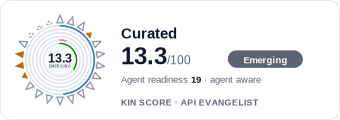 It updates itself when the score changes. Paste this where you link to your API docs:
<a href="https://apis.io/providers/curated-network/"><img src="https://apis.io/badge/curated-network/card.svg" alt="Curated on APIs.io — Kin Score by API Evangelist"></a>Other styles, a README pill and a shields.io endpoint are on the badge page.
- Machine-Readable Contract +18 pts — api_specs includes an OpenAPI document Ask about this →
- MCP Server +12 pts — deployment.mode + probe verdict on the mcp/ manifest, not the pointer; an unprobed slug falls back to authorship Ask about this →
- Agentic Access Contract +10 pts — agentic_access artifact present (x-agentic-access), graded by author Ask about this →
- Idempotency +9 pts — OpenAPI mutating operations declare an idempotency key — a header, a request-body property, or a named de-duplication token whose own description says so (verified); else common[].type matches /idempoten/i (documented) Ask about this →
- A2A Agent Card +8 pts — a2a/
-a2a.yml manifest, graded on conformance.grade against A2A 1.0.0 Ask about this → - Stable Error Semantics +8 pts — OpenAPI $refs a shared error schema across 4xx/5xx responses (verified), else common[].type includes ErrorCatalog / ErrorCodes / DeclineCodes Ask about this →
- Contract Quality scores 0.0 — up to +25.0 composite points Ask about this →
- Developer Ergonomics scores 4.8 — up to +19.0 composite points Ask about this →
- Operational Transparency scores 0.0 — up to +13.0 composite points Ask about this →
Standards implemented 2
Standards this provider implements or carries. De facto ones are profiled and measured by the API Commons; formal ones come from the standards directory and are linked by the provider's own tags. The evidence column says how each claim was established — not that it was made.
Terms of Service 1
What its API terms permit and prohibit, quoted from its own page.
Privacy & Data 1
Its role, the data it processes, retention and transfers, quoted from its own privacy page.
Eligibility 1
Who may sign up and where, quoted from its own terms.
AI Preferences 1
Its stance on AI training, inference and agents, quoted from its own pages.
Security Posture 1
Authentication, domain security, vulnerability disclosure, and trust-center signals.
Resources
Get Started 1
Portal, sign-up, and the first successful call
Documentation 1
Reference material describing how the API behaves
Agent Surfaces 2
MCP servers, agent skills, and machine-readable catalogs
Access & Security 1
Authentication, authorization, and security posture
Operate 1
Status, limits, changes, and where to get help
Commercial 3
Pricing, plans, and the legal terms of use
Company 1
The organization behind the API
Other 4
Properties that don't map to a standard resource type
Source (apis.yml)
Work with this as data
Every provider here is available over the APIs.io API and to AI agents over MCP.